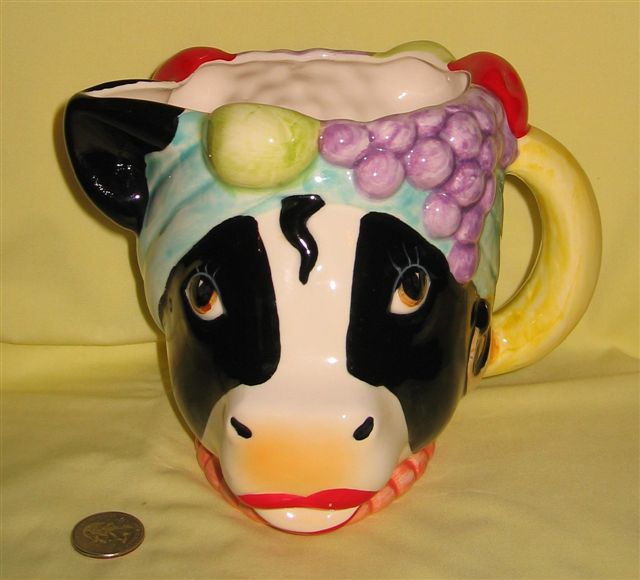
Pitchers
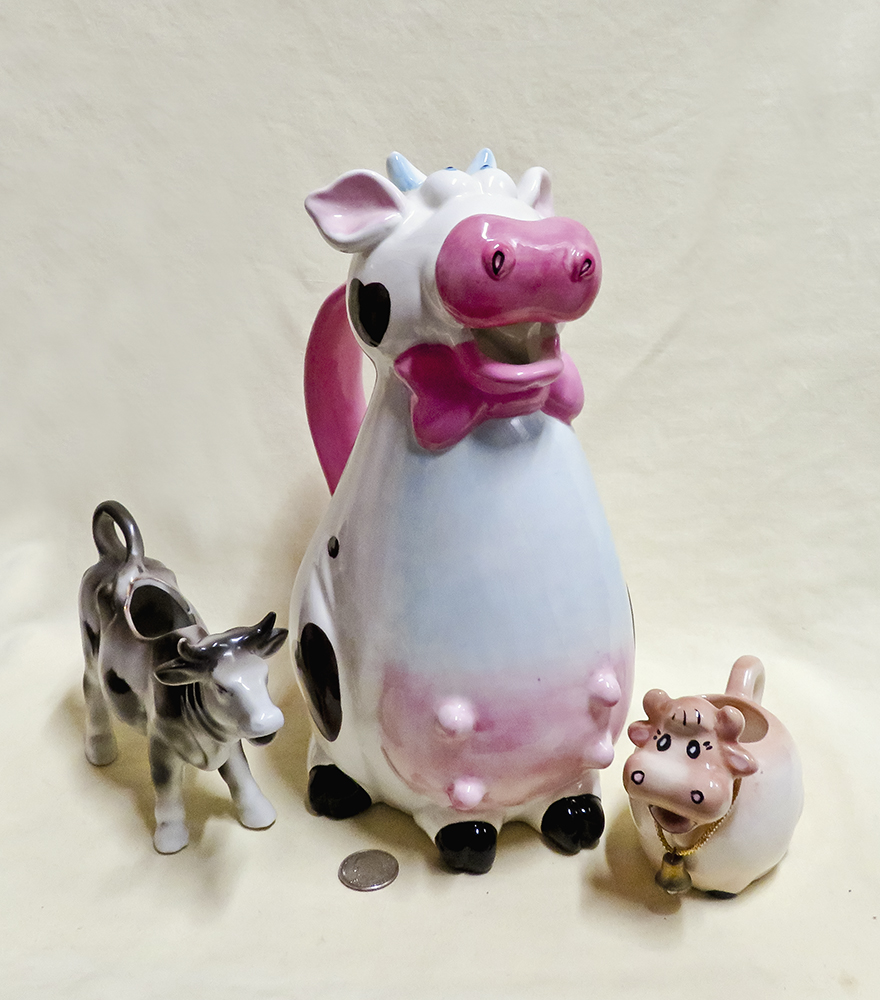
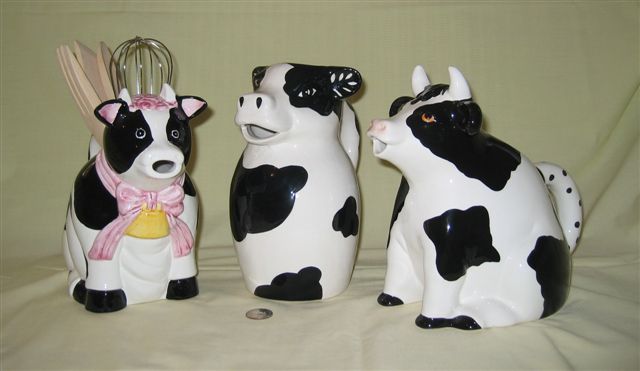
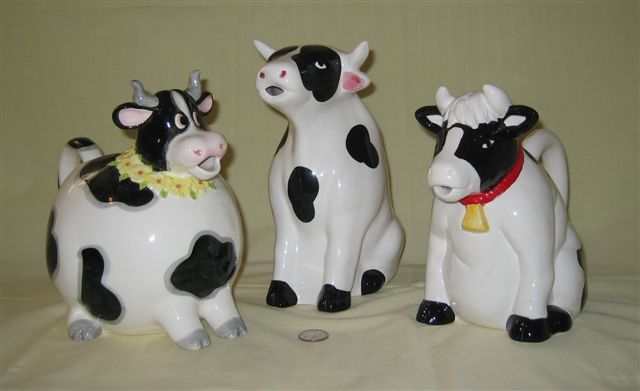
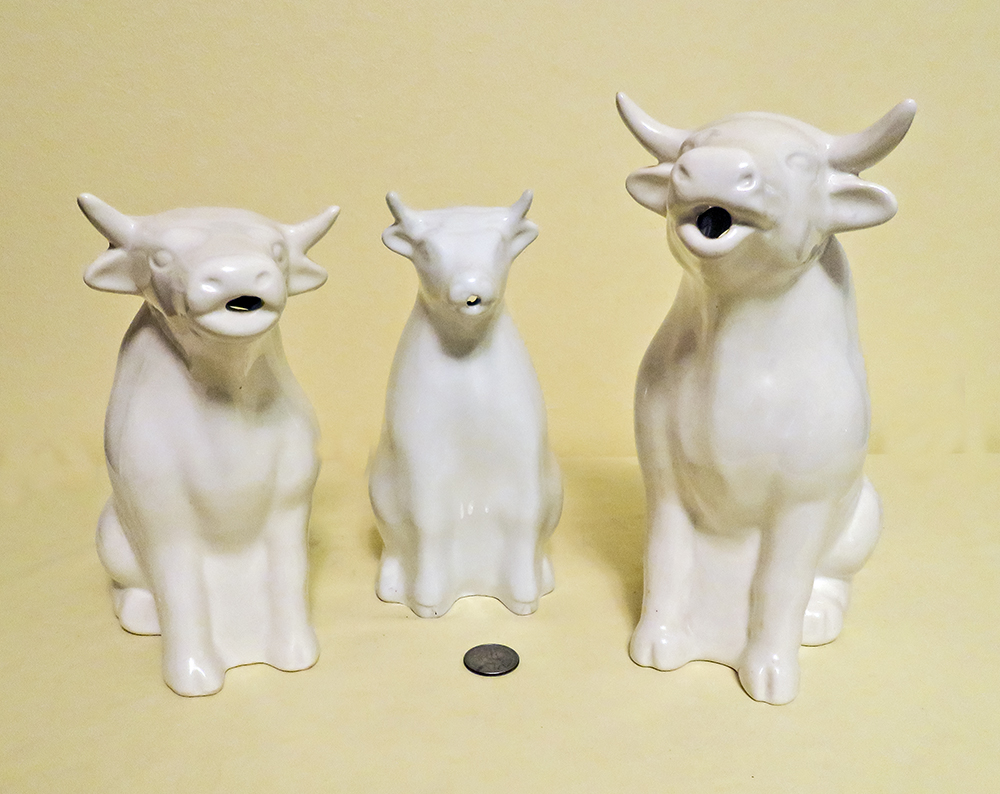
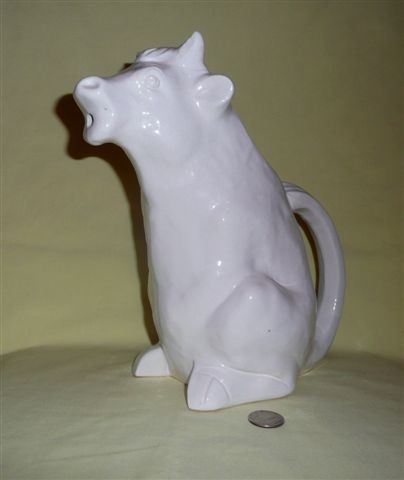
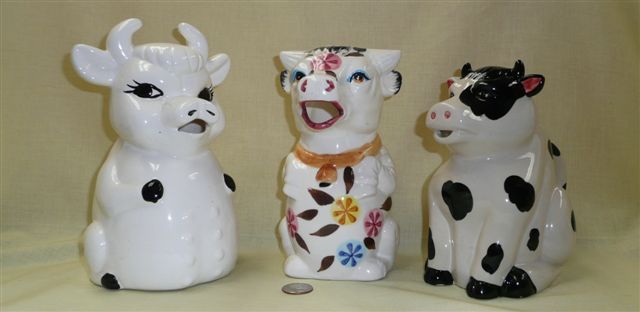
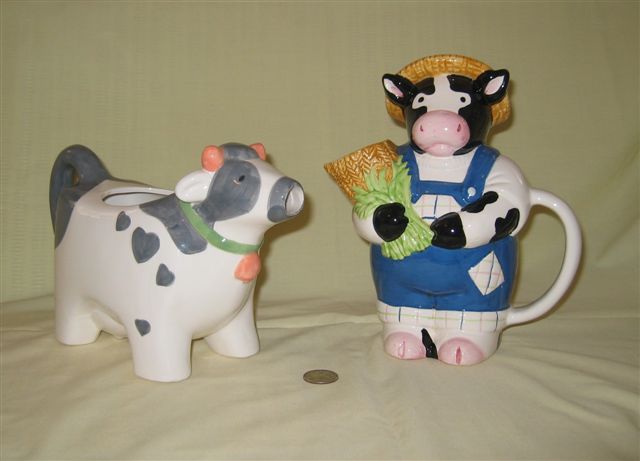
As noted in the theme descriptions, the main thing that distinguishes what I’m here calling ‘pitchers’ from ‘creamers’ is size. Many of these are a foot or more tall and hold over a quart, so pretty obviously they were designed to hold water or milk (or wine in some cases), not cream. The one in the middle here which is almost 12" tall, weird as it may be, is thus a pitcher. It's surrounded by a couple normal sized creamers for comparison. There are also some traditional 'pitchers', meaning vessels with a single hole, plus a lip of sorts to guide the liquid when pouring. All of these of course have to be either a whole cow or a head...with minor exceptions for a couple that I found irresistable. There are of course some of the one-hole pitchers on other pages - e.g., all the Elsie heads could be here, and there are also several that accompany teapots.
As a reminder, click on any thumbnail for a larger picture.
|
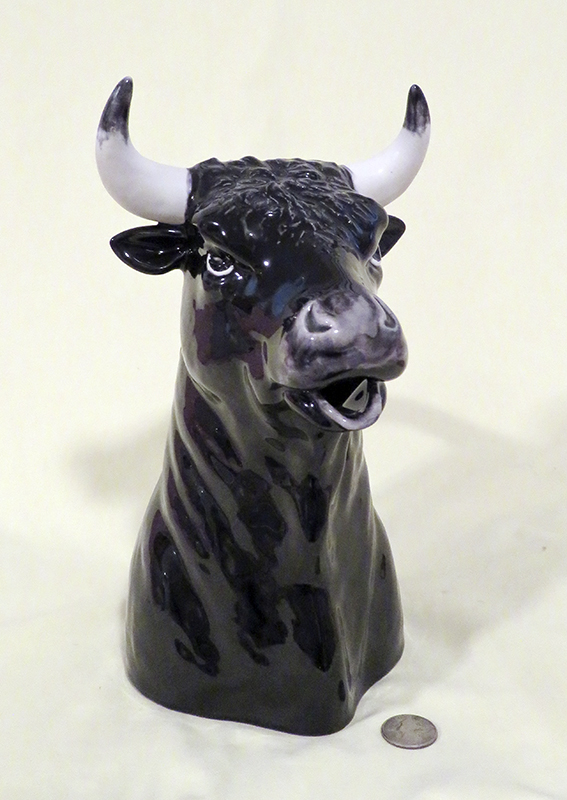
This massive and very handsome bull is a great example of a pitcher made for wine – ‘bull’s blood’ perhaps (albeit that famous dark red wine – Egri Bikaver – is from Hungary, so maybe not since the pitcher hails from Portugal.) It bears a seal from Boidallo Pinheiro, Est 1884. They have an excellent web site (Google will translate it) which tells us that “Raphael Bordallo Pinheiro is one of the most influential people of nineteenth century Portuguese culture, with a remarkable production in relation to the areas of humoristic drawing, caricature and ceramic creation. His work represents an unsettling, timely reality and a fundamental document for political, social, cultural and ideological study of a time period…In 1884 Bordallo began his ceramics production at the Fábrica de Faianças in Caldas, revealing pieces of great technical, artistic and creative quality, developing tiles, panels, pots, table centerpieces, vase busts, fountain basins, pitchers, plates, perfume bottles, vases and gigantic animals, etc.” as well as a lot more. |
|
|
 |
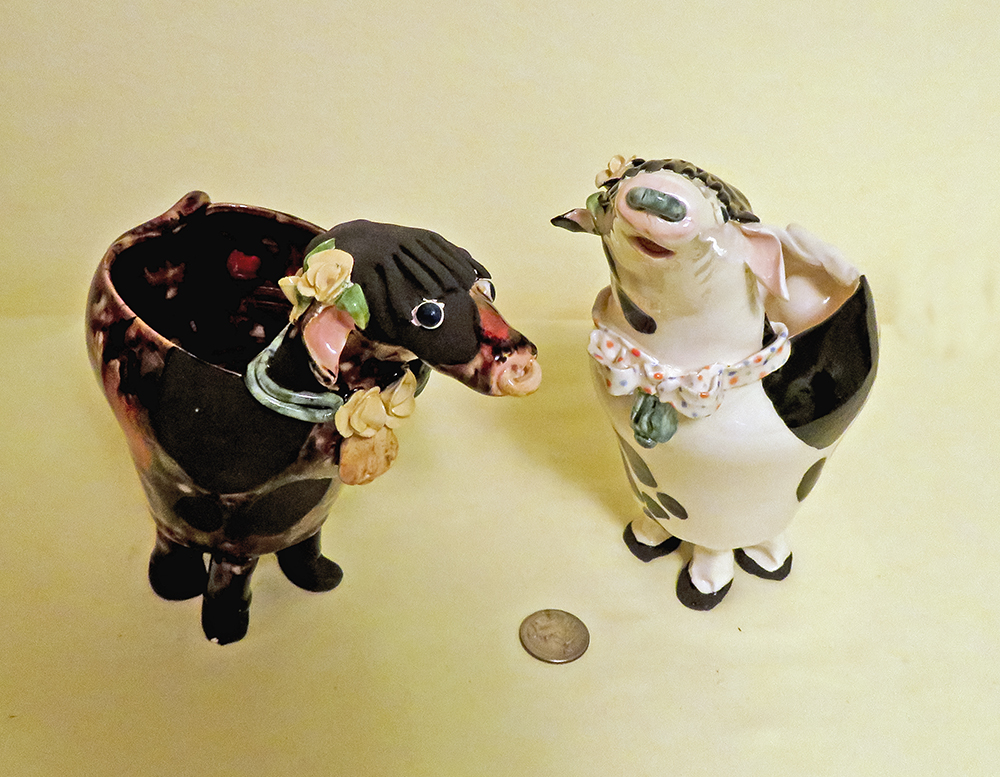
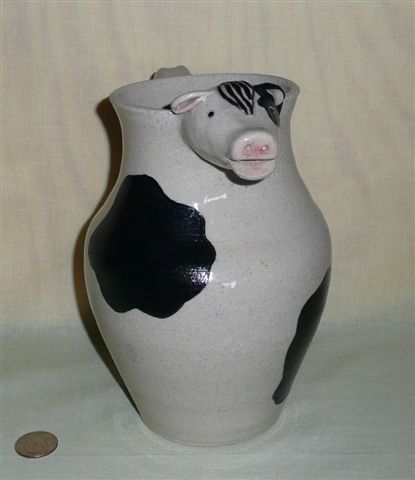
Here’s another hand-thrown pottery cow pitcher – it came from eBay, with no information beyond the“Kran” (or something like that) incised in script in its bottom. It’s probably no surprise that I was the only bidder…it wins the ugly prize. Many years later I saw another one just like it on eBay that had a tag that said Maco Crafts, Franklin NC, Handmade, so apparntly there are a bunch like it. I sure didn;t bid on it - one of these is more than enough! |
 |
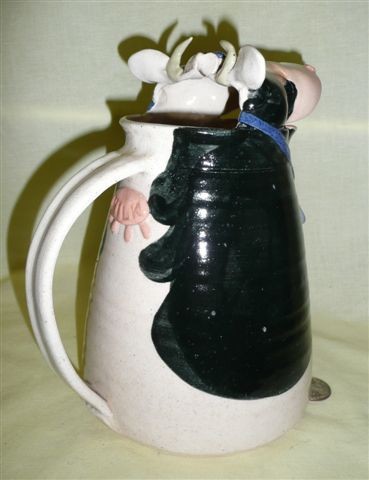
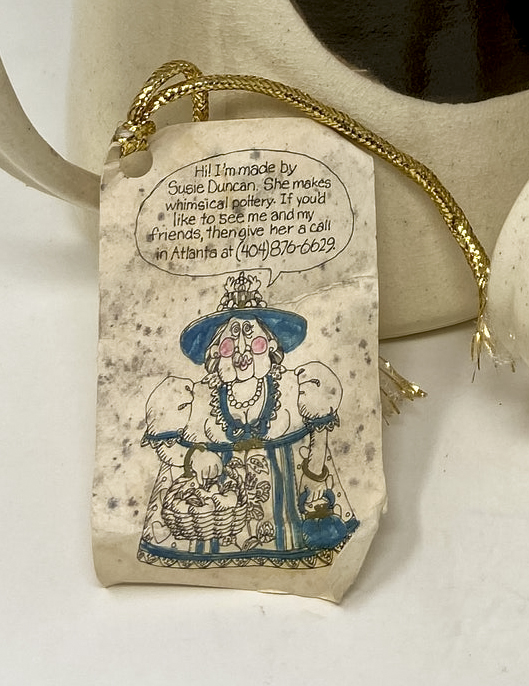
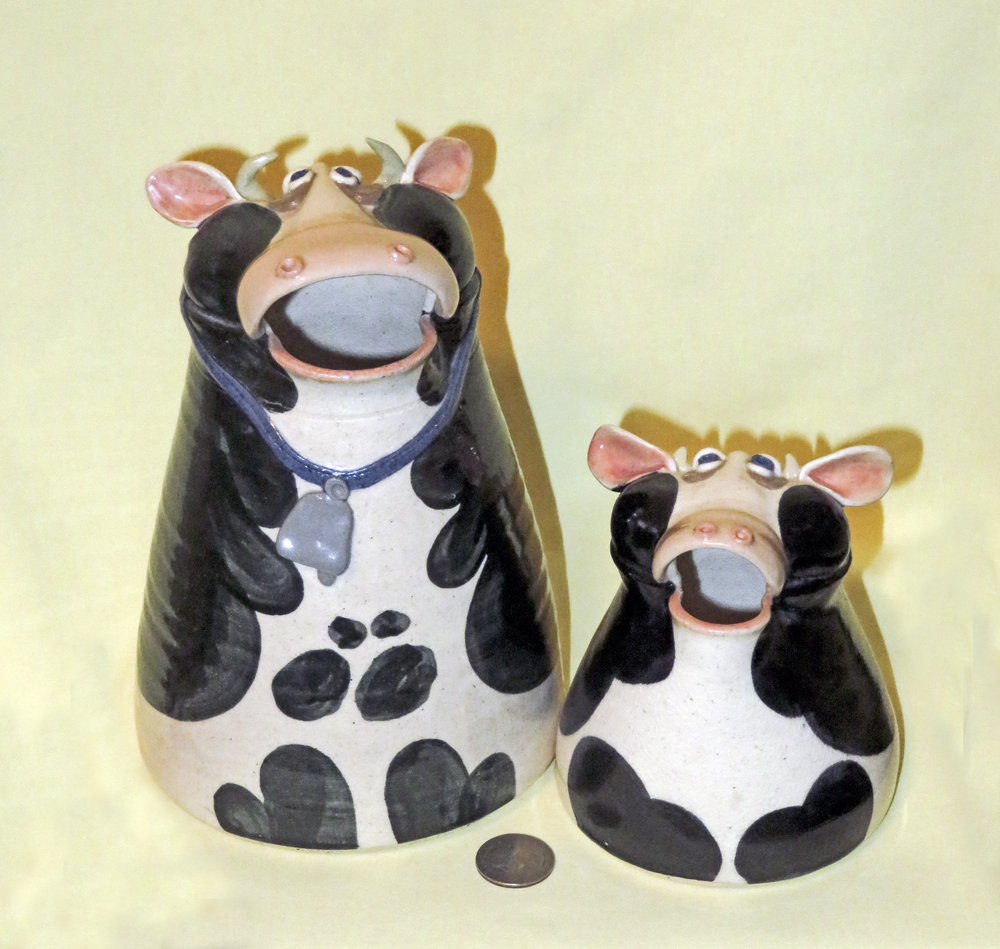
Yet a third hand made cow pitcher – this one a “Face Jug” signed by the maker Otis Norris of McBee, South Carolina (who is rather famous for such things) and dated 9-02. Face jugs are a southern US folk art specialty, and … |

 |
|
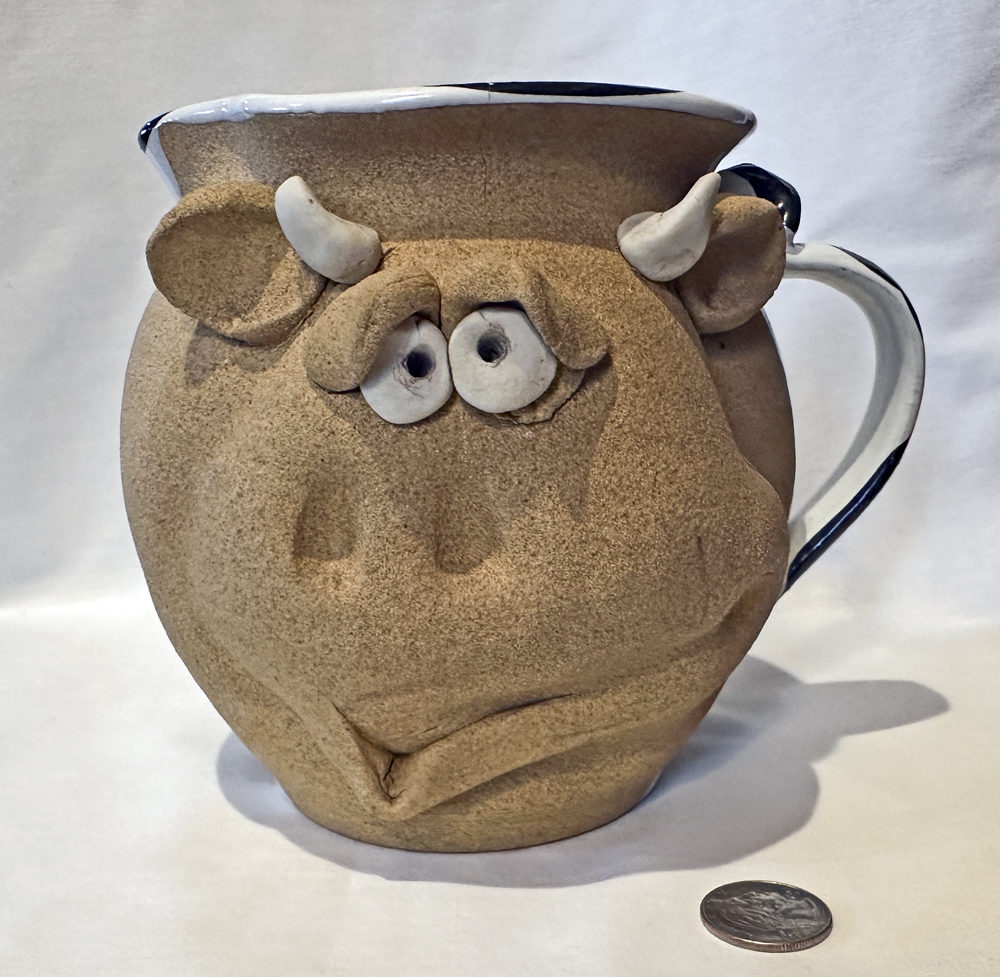
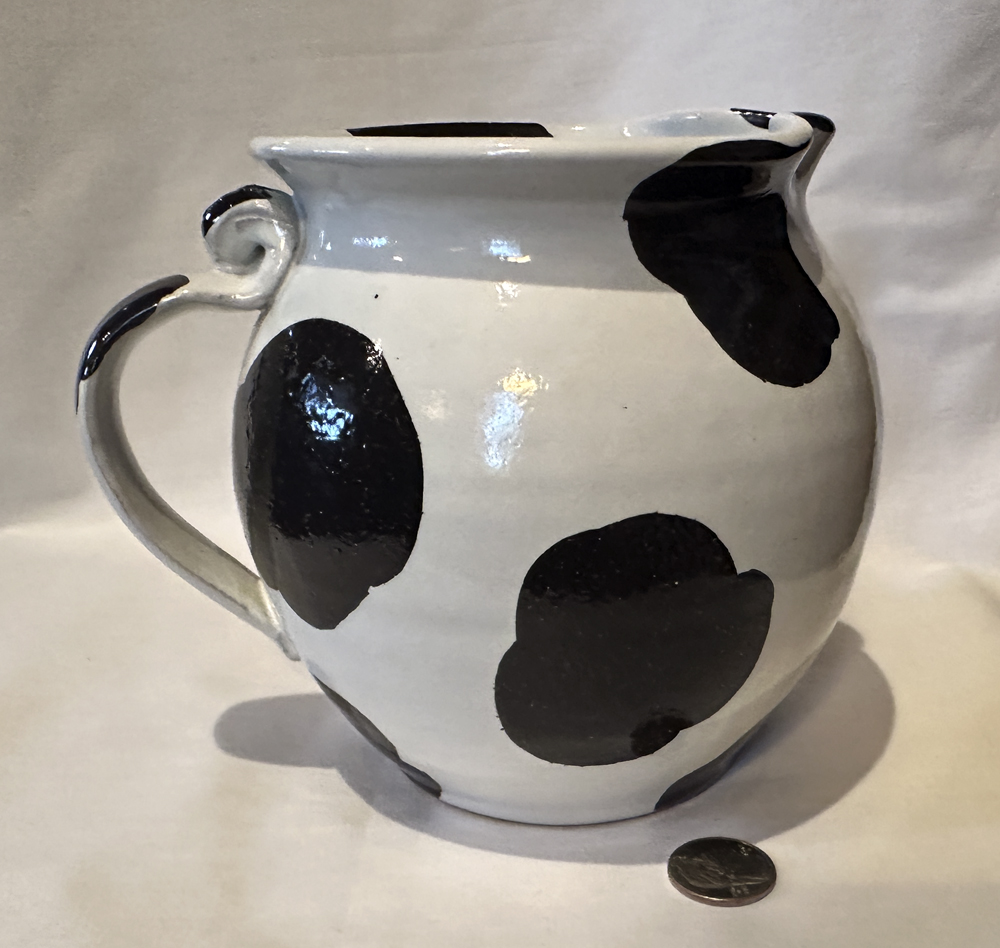
|
|
|
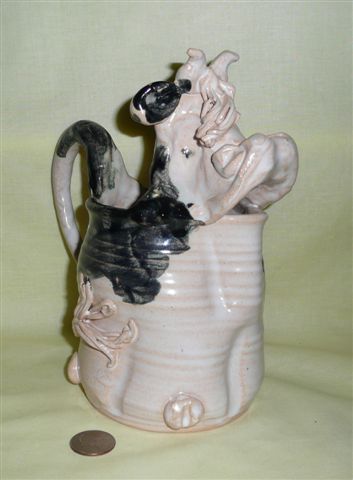
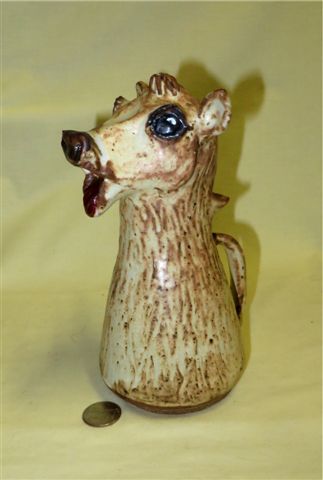
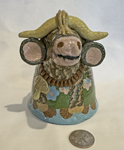
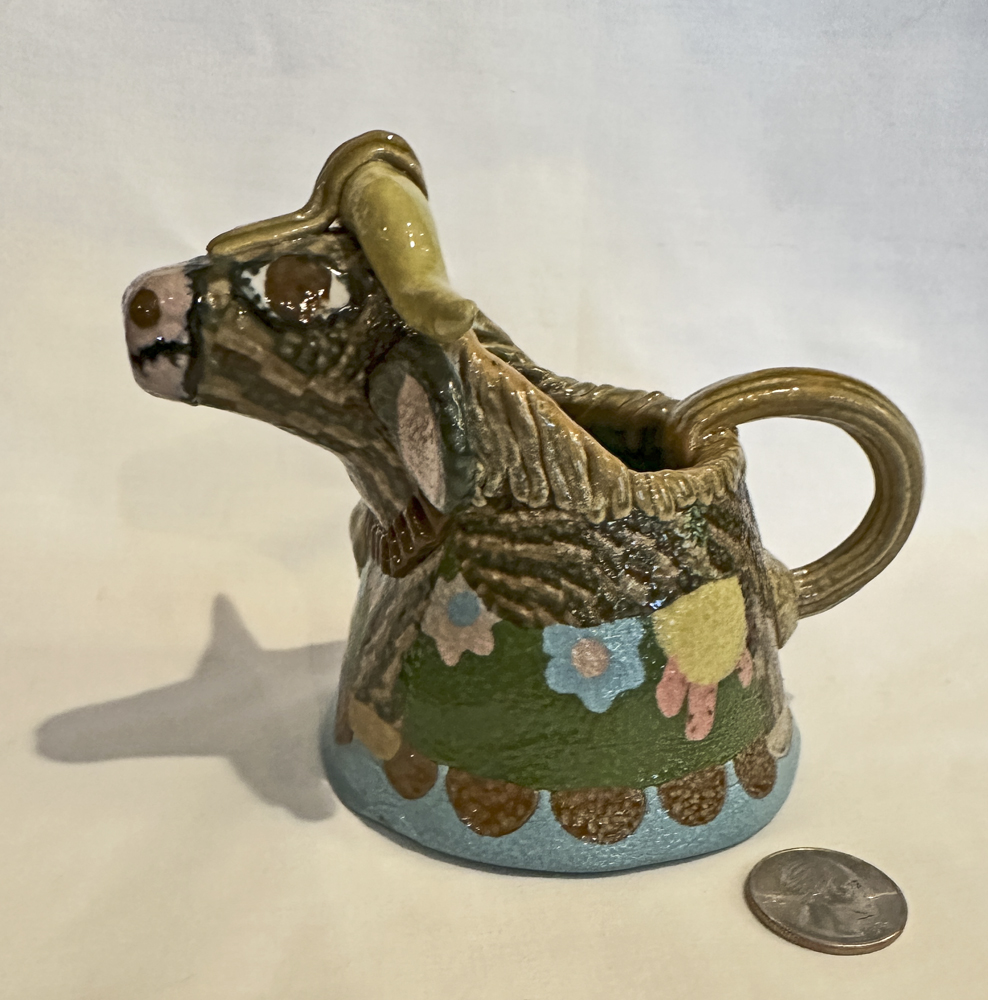
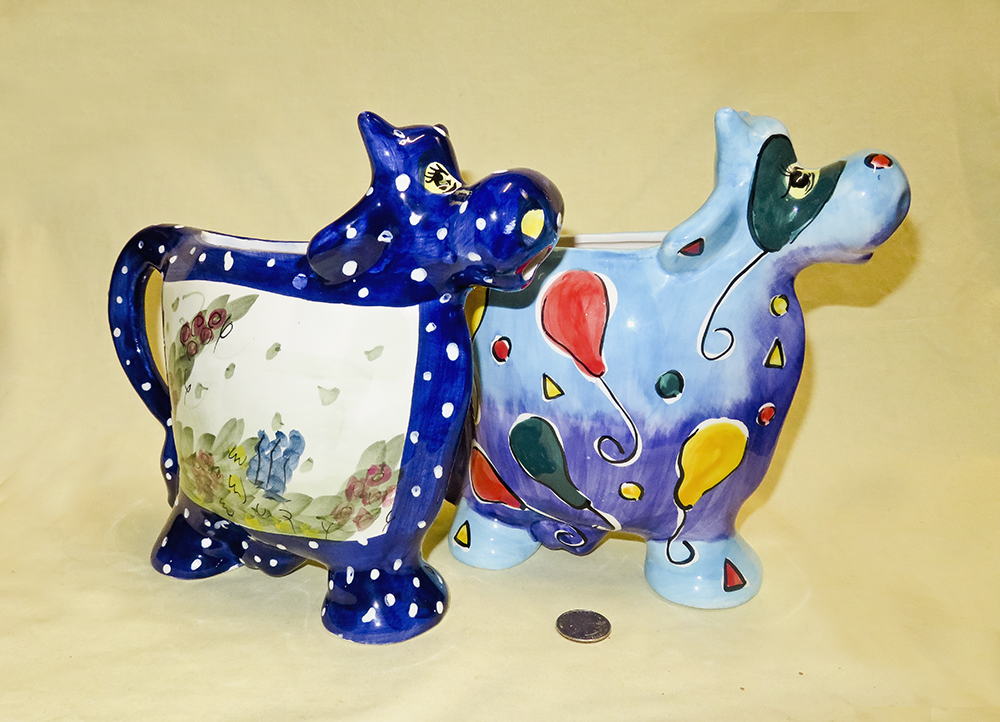
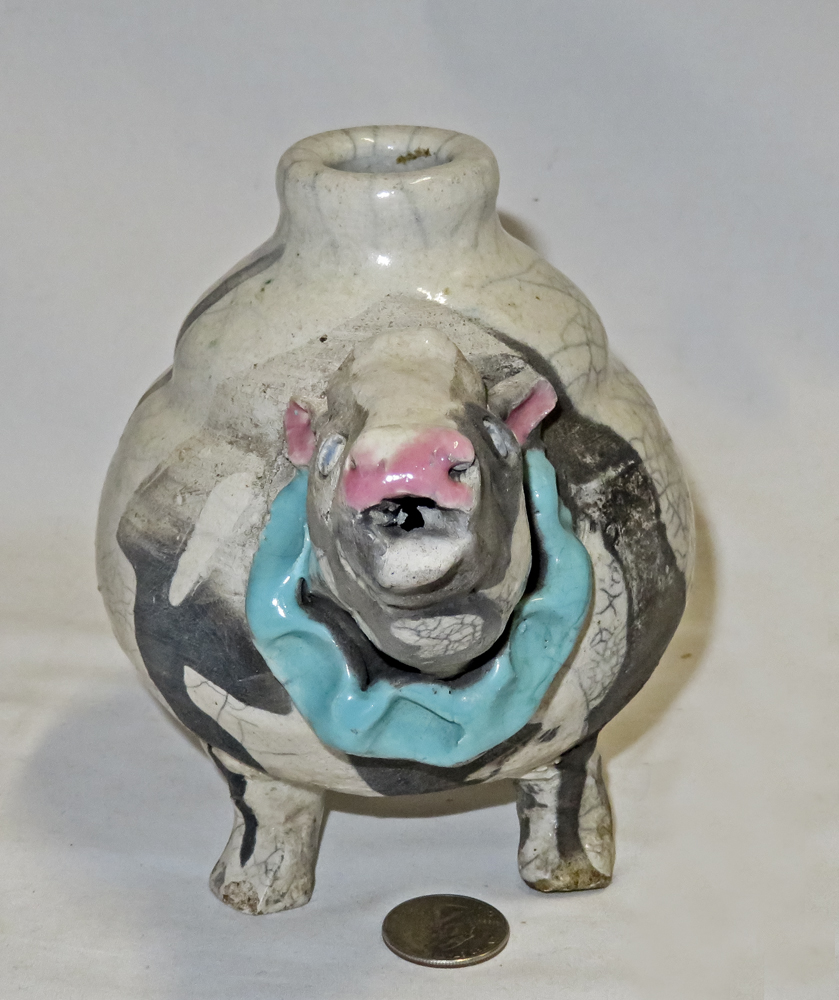
This pitcher may look somewhat like a giraffe, but I’m assured by the maker, Sherry Bergeron of Madison WI, that it’s a Jersey Cow – one of her “Critterpots”. Heavy ceramic and very nicely hand crafted. |
|
|
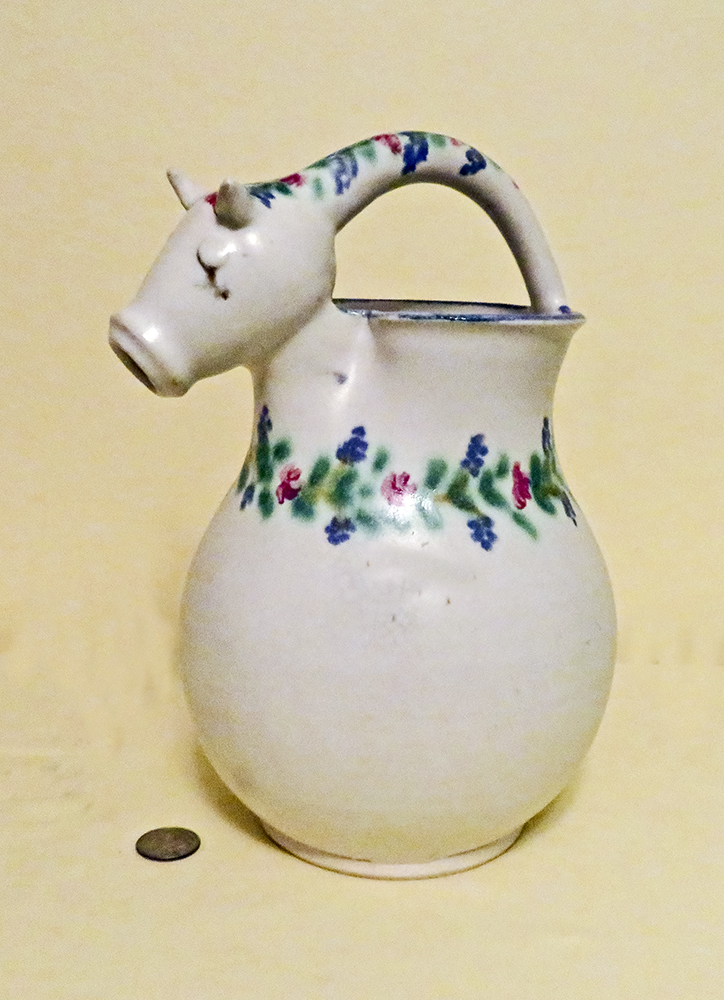 |
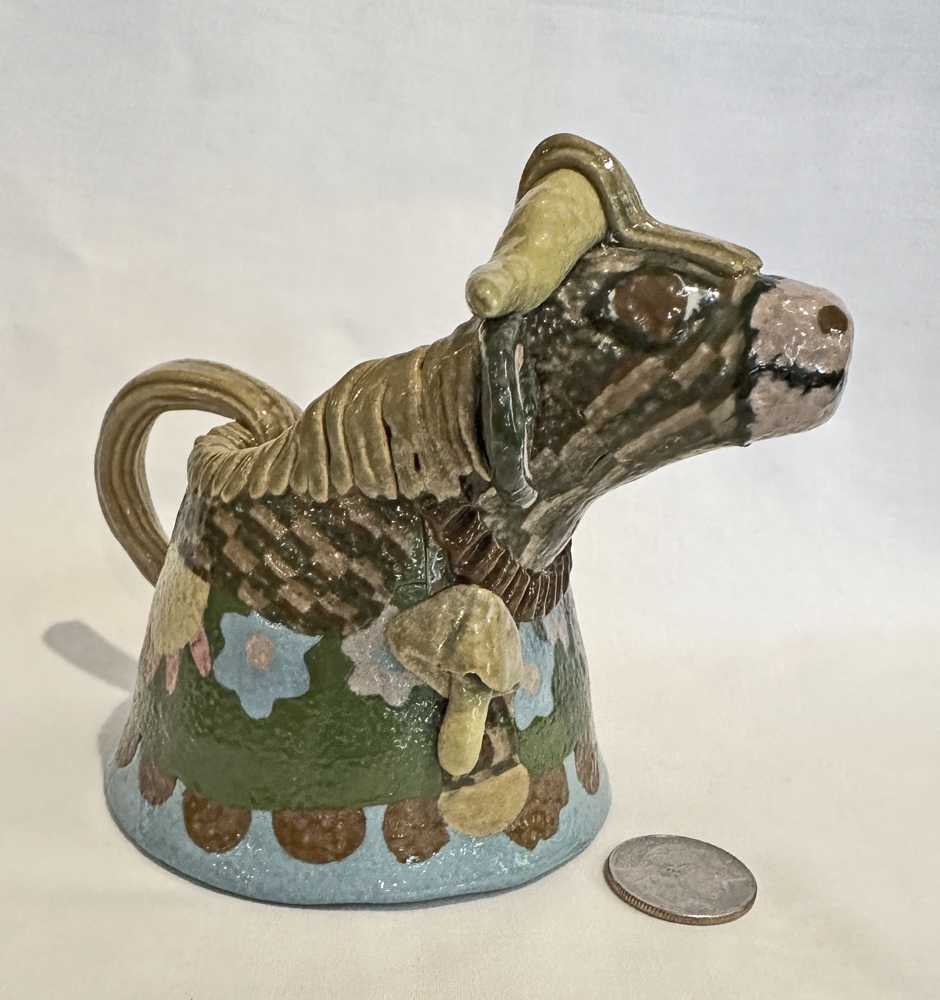
This rather winsome cow (or horse???) with her eyes closed and a spray of flowers on the handle and around the body is of very heavy clay and is marked “Peter K for Clouds Folsom”. Cloud’s Pottery’s gallery, according to their web site, is located at 608 ½ Sutter St in Folsom CA, immediately adjacent to the Power House Pub, so presumably you can grab a brew to put in your new jug from the pottery. Clouds opened in 1977. The ‘about us’ section of their web sites states “For 30 years G.F. and Penny Cloud have been making a wide variety of porcelain pottery. They have gathered together some of the most talented ceramic artists in the country, and most importantly, they have given them the place, tools and support to do the work they love and grow and prosper as artists. We make a promise to our clients…and that is to be true to our inspiration and to bring the fruit of our labor to you at a fair price and to never compromise our environmental standards, ethical standards or to falsely represent what we do or can do.” They show pictures of some of their recent artists, but nothing about Peter K. |
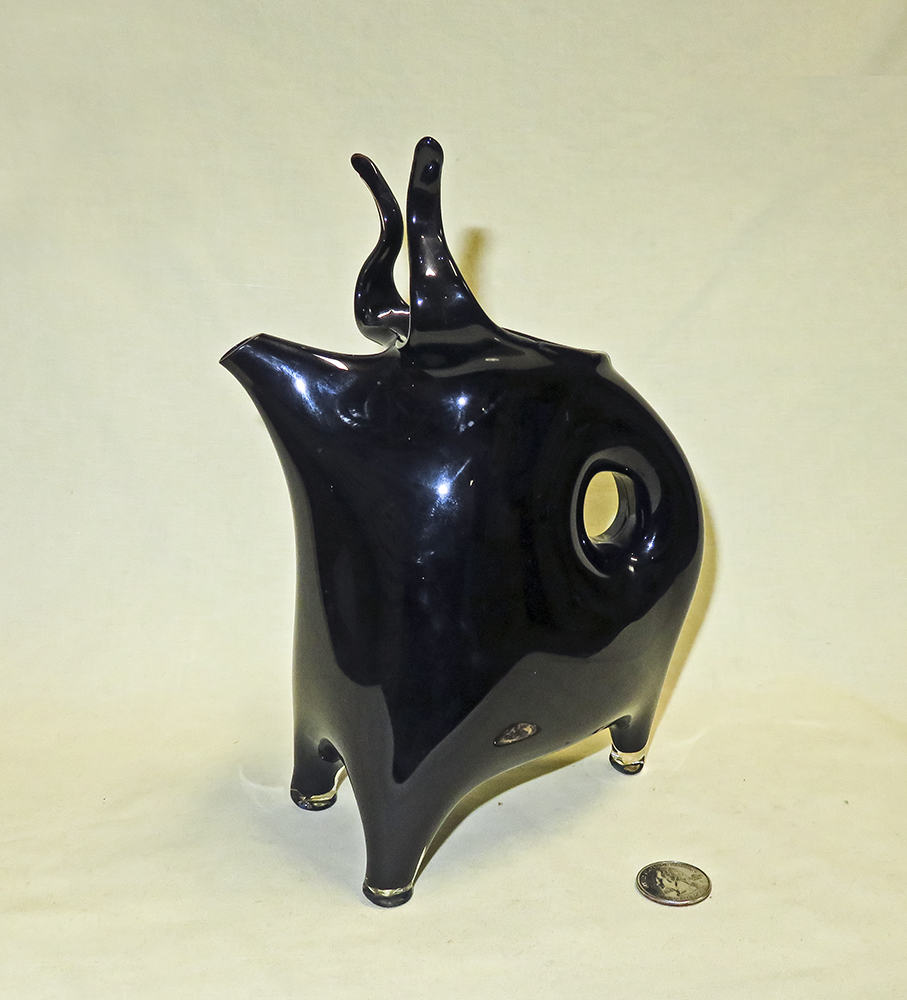 |
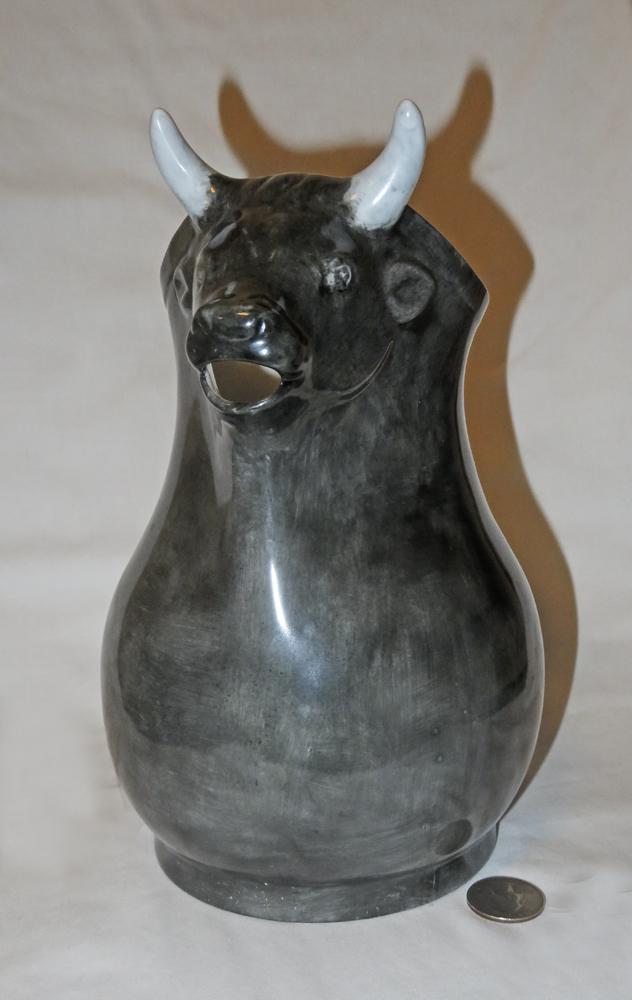
This is a lovely hand-blown art deco black bull pitcher signed “C.Jenkins 2007”. You can see more work by this artist, including bulls like this, other animals, and other beautiful art glass pieces, on his web site http://charliejenkins.com…from what I glean there, he worked out of Oakland until he married in 2007, then moved with his new wife to Dresden, Maine. Since the web site hasn’t been updated since the wedding, I assume this bull was made in California and he’s been somewhat busy since. My wife really liks this bull - she often puts flowers in it and puts it on prominent display in our home, while all the rest languish on shelves. |
|
|
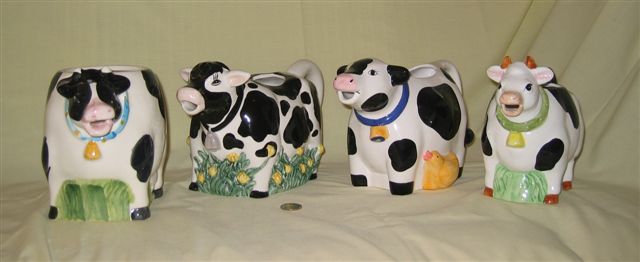 |
Here are four standing black and white cow pitchers, all with some sort of filler between their legs. The one on the left, with the blue collar and yellow bell standing in grass, is one of the few in the collection that was made in Brazil. Next to it, with the grass and yellow flowers, is one from ‘Young’s Exclusive’. It came in a box that says ‘Kitchen Creations’, is dated 1999 and was made in China. It actually has a matching sugar bowl, so in spite of its size it might as well have gone in the creamer pile. The cow with the chicken beside it is from Certified International Corporation, © Coco Dowley, and was made in Taiwan. The cow on the right is unmarked. |
|
|
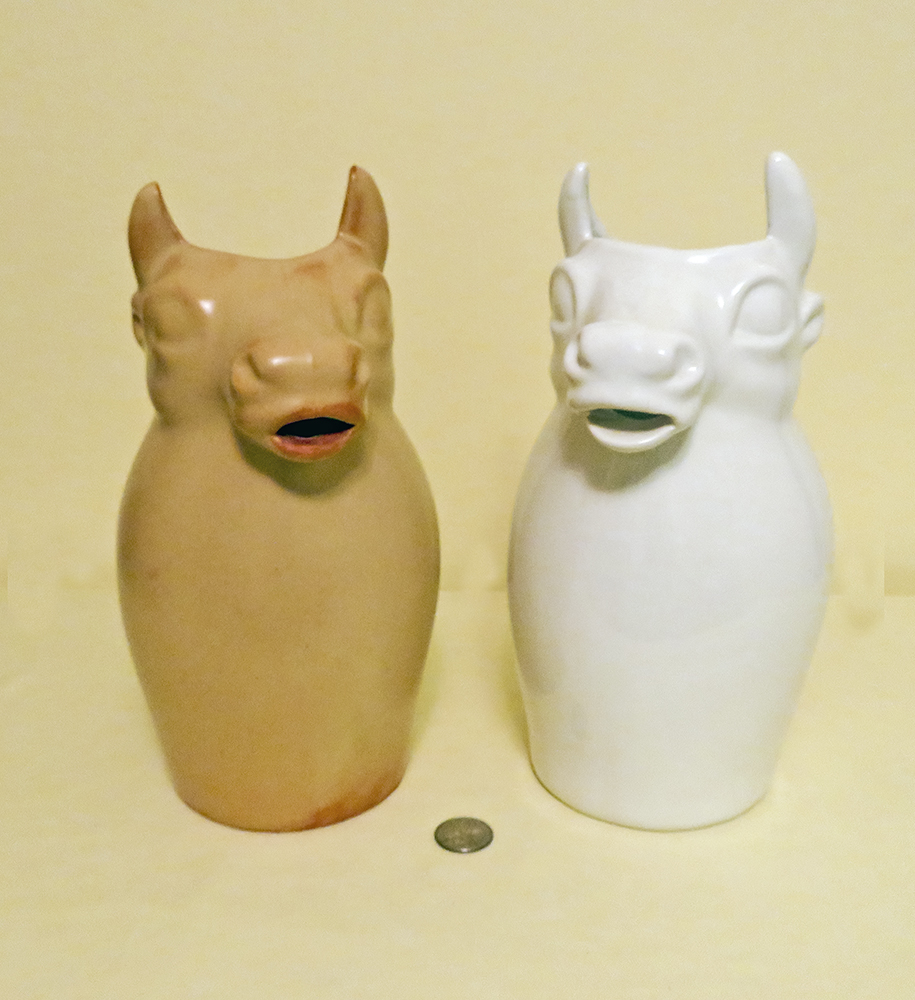 |
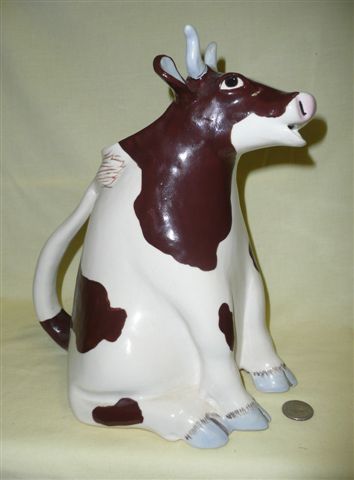
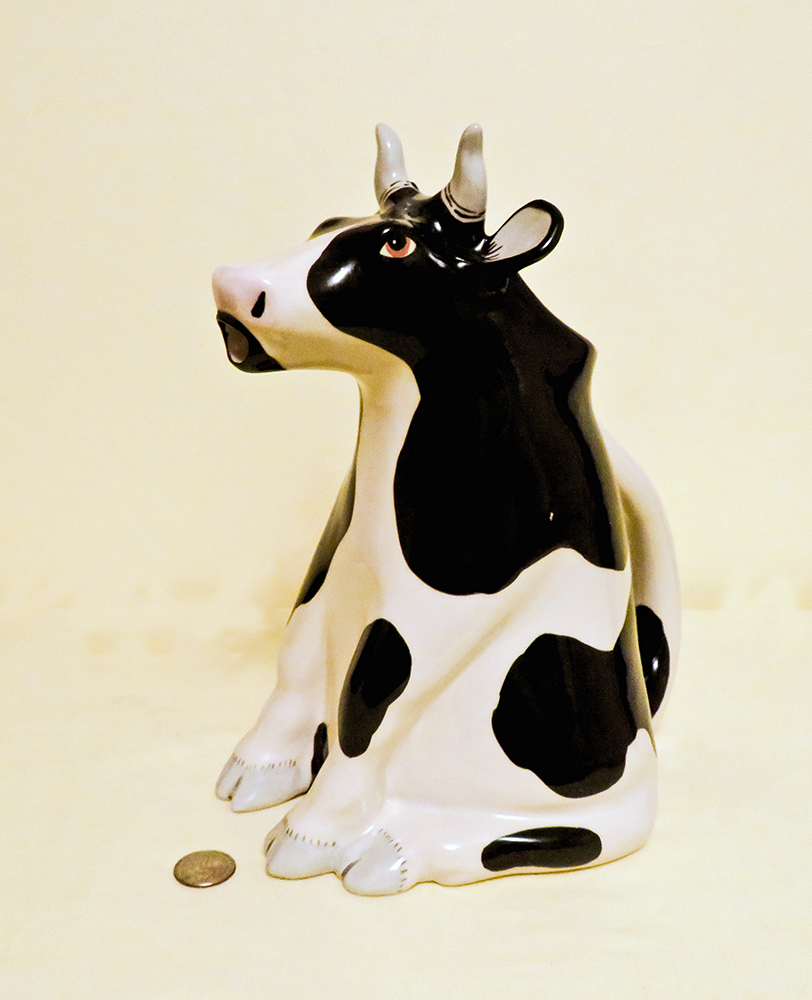
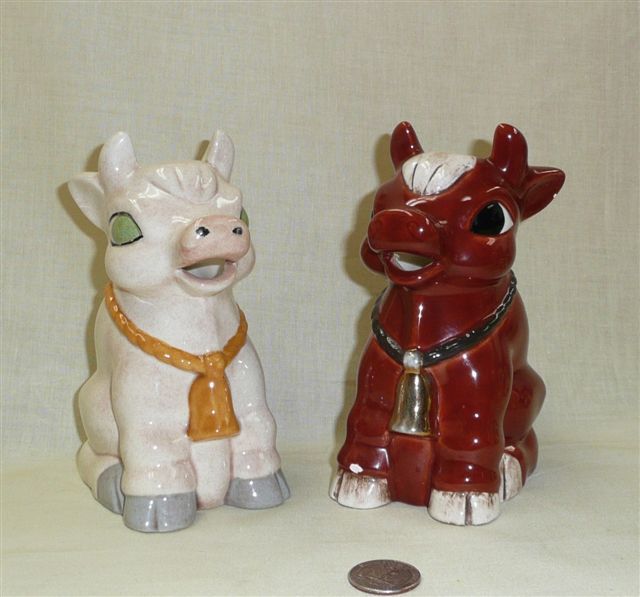
These two are both Italian. I've also seen them in red clay, and with flower decorations. Being Italian, I have a suspicion they are intended to hope some sort of liquid made from grapes rather than from cows. |
|
|
|
|
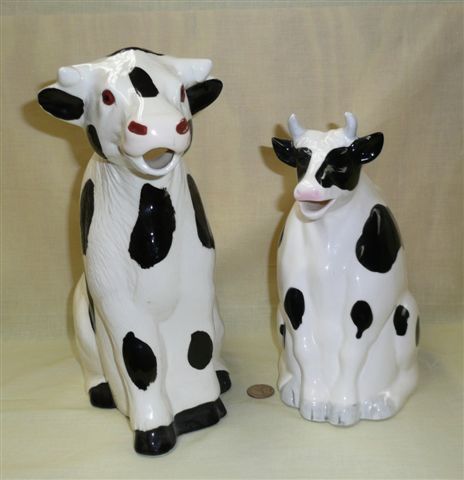 |
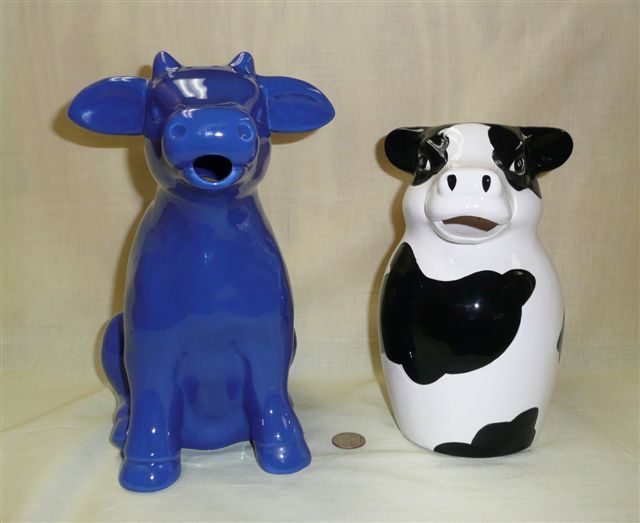
The foot-tall pitcher with brown eyes and nostrils is unmarked; the slightly smaller one to its right has a sticker that says “Designer: Pelzman Designs”. |
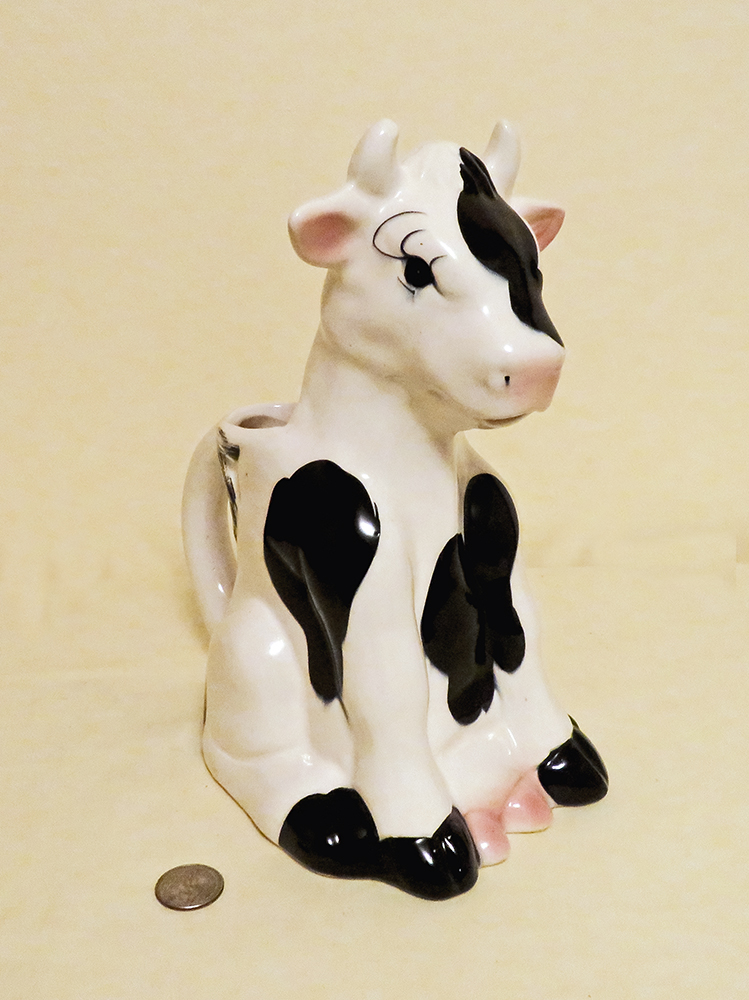
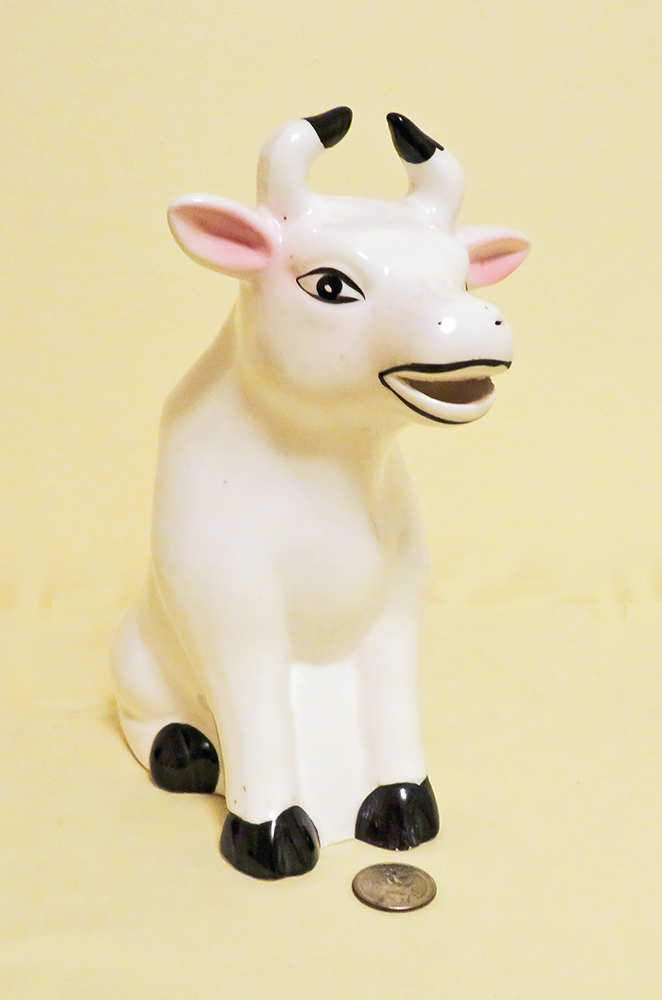
|
|
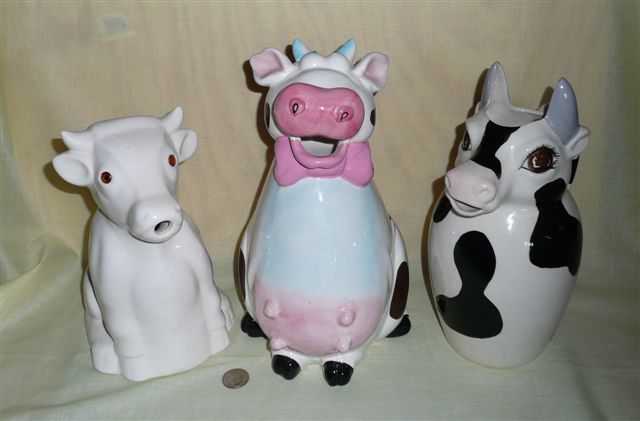 |
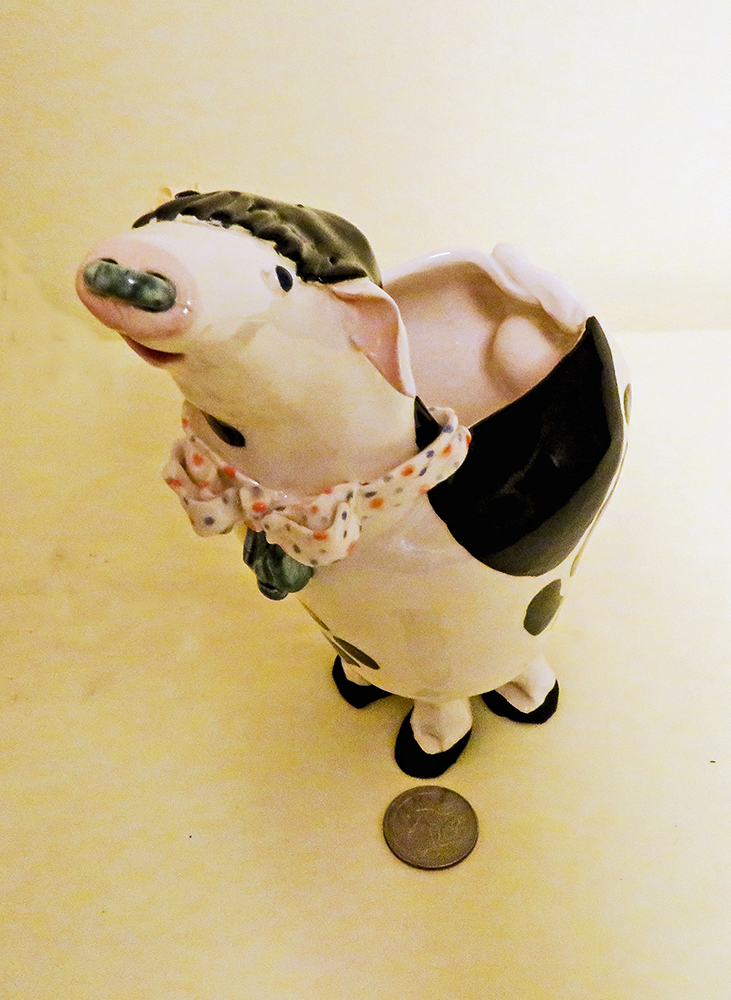
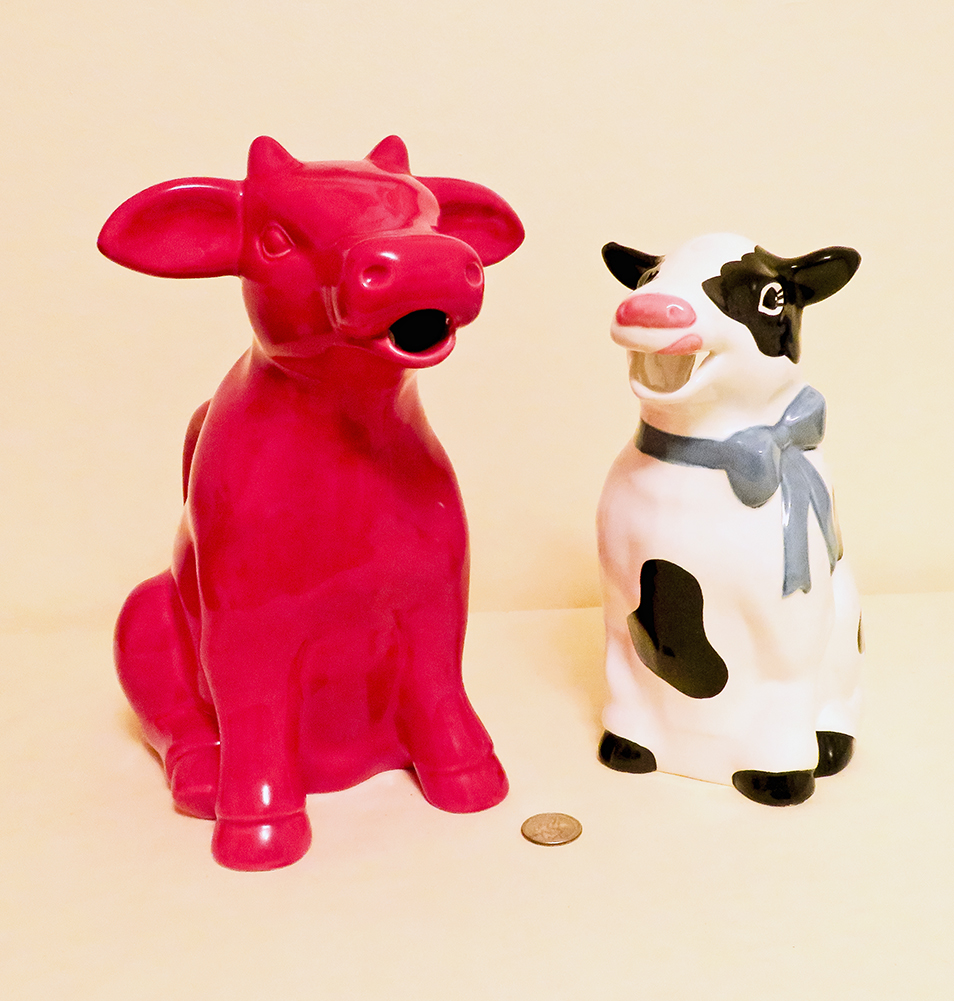
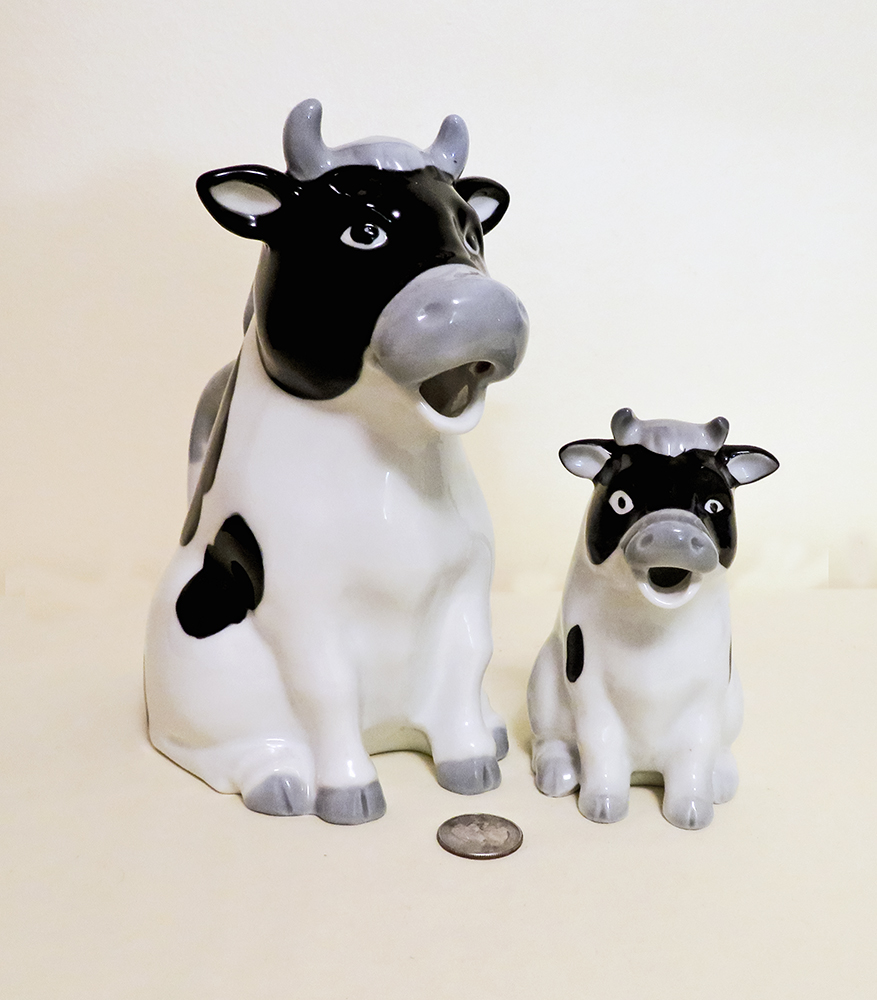
The white cow on the left has glued-on glass brown eyes and is marked “Marcia Ceramic USA DC-1 ©”. Next to it is a rather wild and unembarrassed interpretation with a prominent udder and blue horns and belly that’s looking straight up out of bulgy eyes, from China. It served as the model for size comparisons in the introduction. On the right is another version of the typically Italian pitcher, although this one bears no marks. |
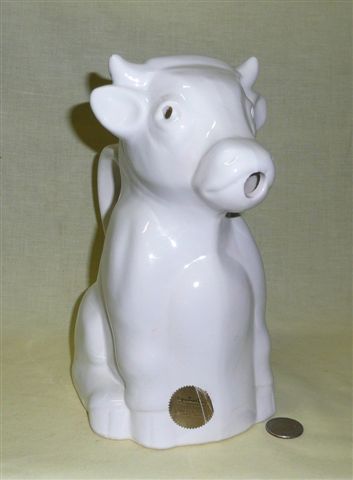 |
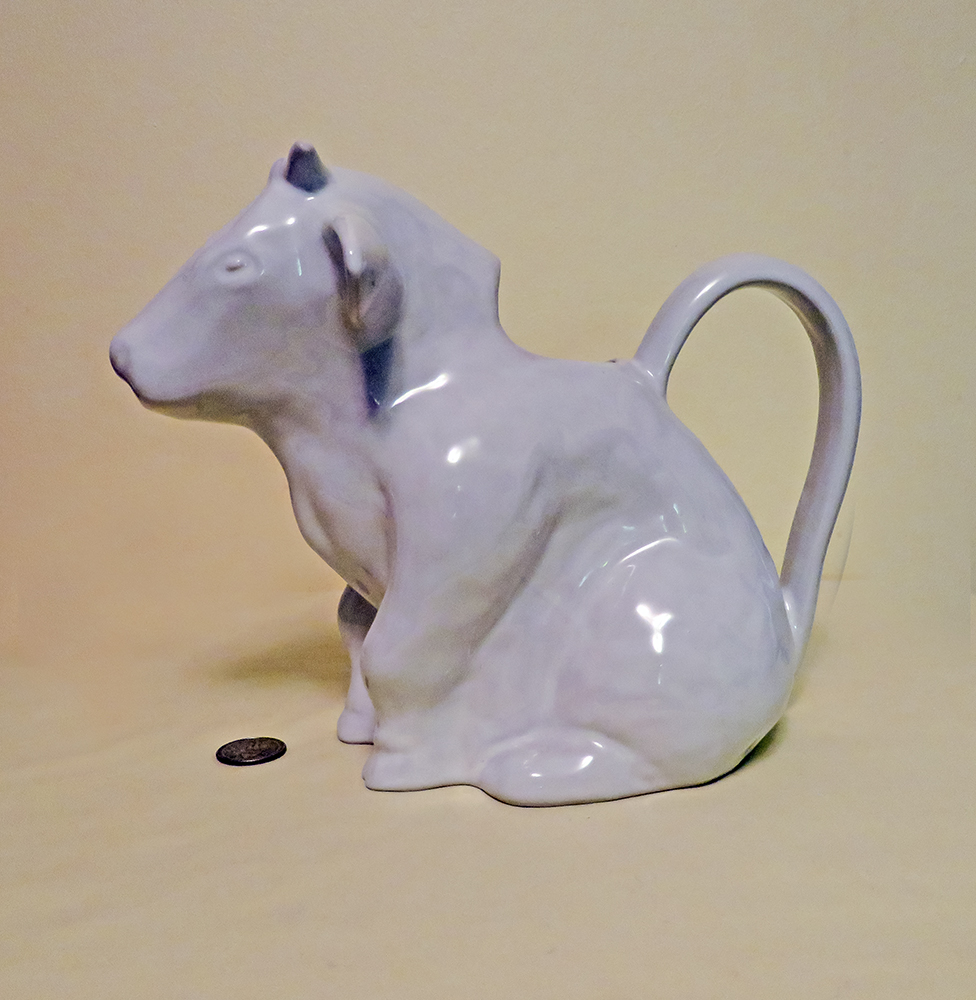
Here’s another version of the “Marcia” pitcher, but this time with a sticker, and holes instead of the glass eyes. From the “Potteries of California” web page, we learn that Marcia of California was owned by George Sigal, who with his sons produced fairly large items like this pitcher from the 1950s to 70s in a pottery located near the Cal State LA campus. I guess one would have to ask George why they used the name Marcia. |
 |
Taiwan must have some pretty strange looking cows if this one is a any example - it was made for Potterybarn and is dishwasher safe, although it's sufficiently large that is would take up most of a load. |
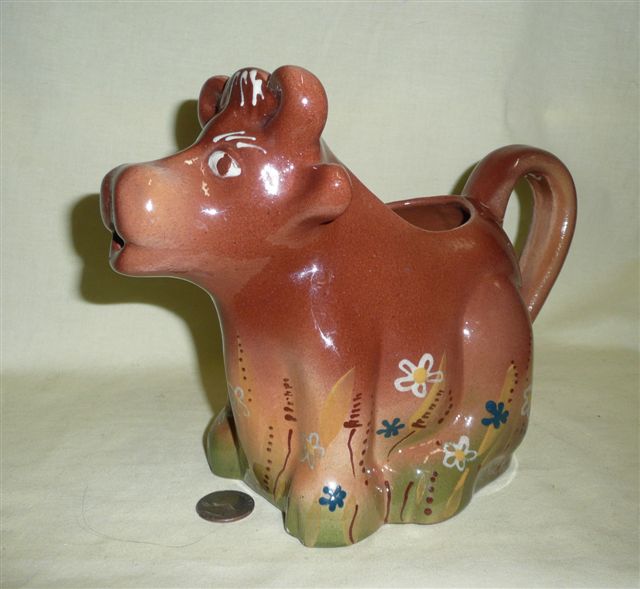 |
This very nice large brown pitcher, crafted of red clay, is my first and only cow from Latvia. |
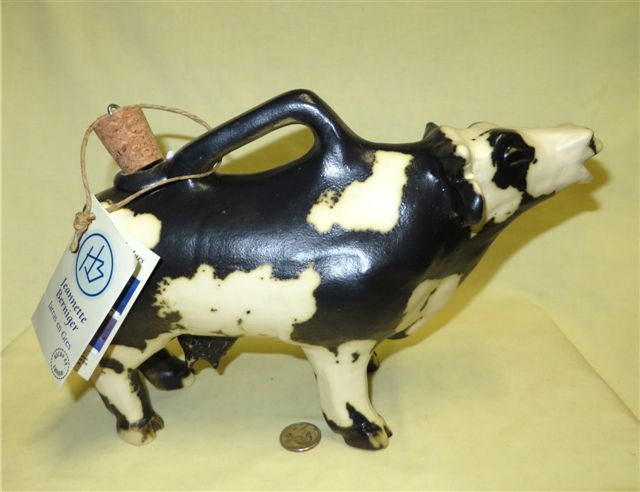 |
This is another ‘first and only’, from Uruguay. It’s very heavy and hard and bears the maker’s brand both on the right flank (behind the tab) and on the belly along with“Berniger Uruguay”. The tag reads “Jeanette Berniger, Jarras en Gres, Hecho en Uruguay” and has pictures of the 6 animal ‘jars’ in this series. There is bull in the series but I have yet to be able to find one to buy. |
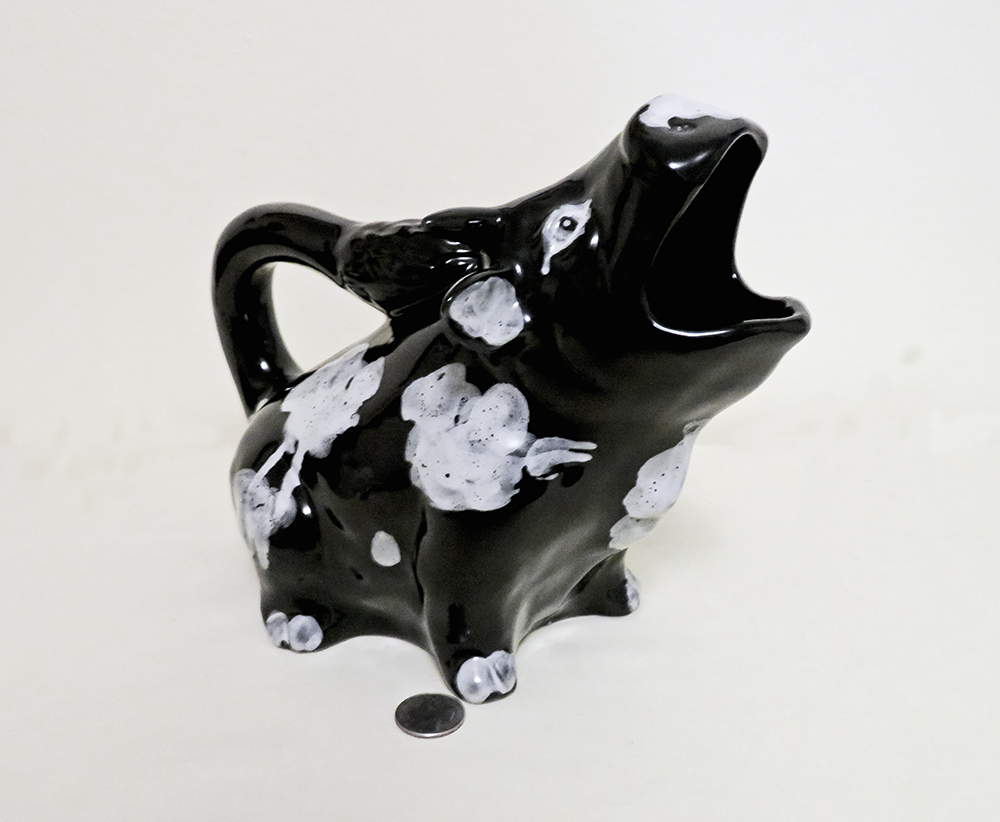 |
This is an Italian cow – quite lovely in her own way, and very nicely molded. It’s marked for Italy and has a mold number, but no information about the maker. I doubt greatly that it was intended to be utilitarian, given its size, but it certainly meets all my criteria. |
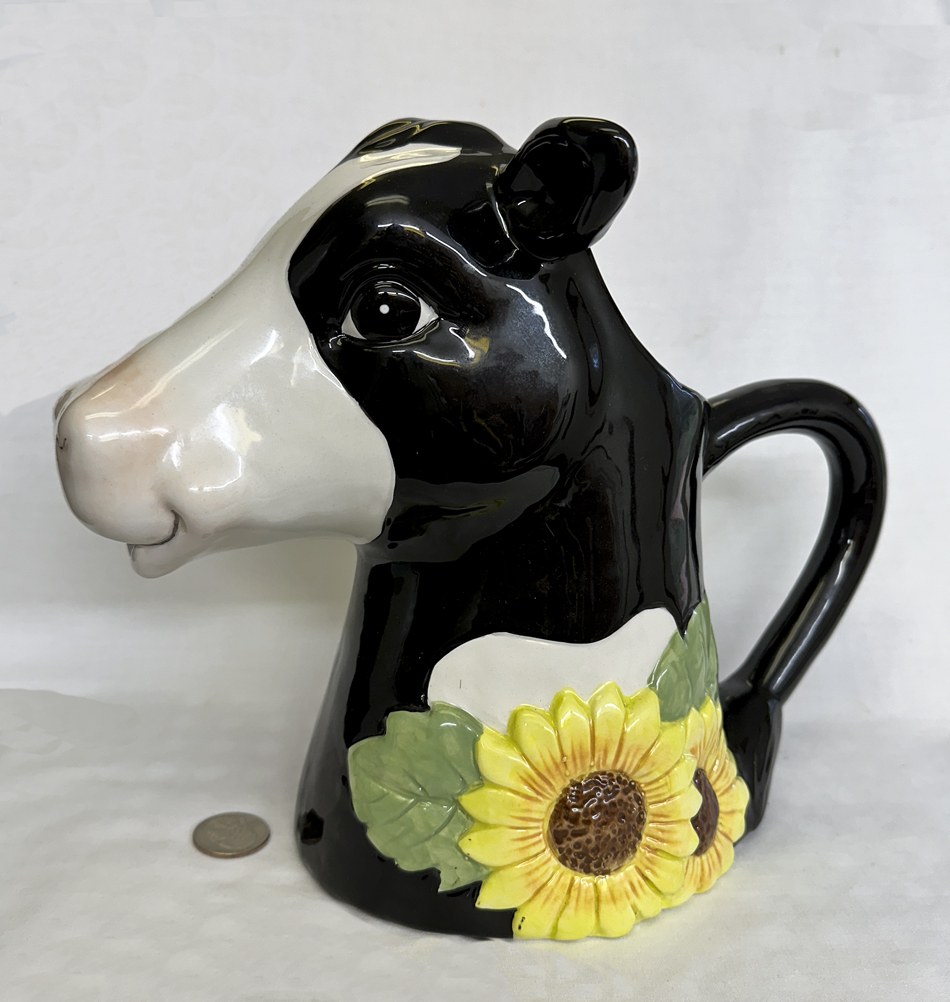 |
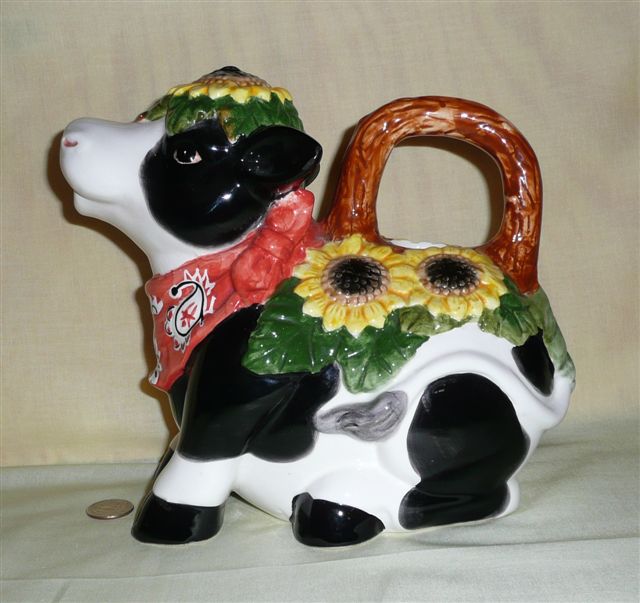
This pretty lady, of unknown origin, sports a pair of large sunflowers |
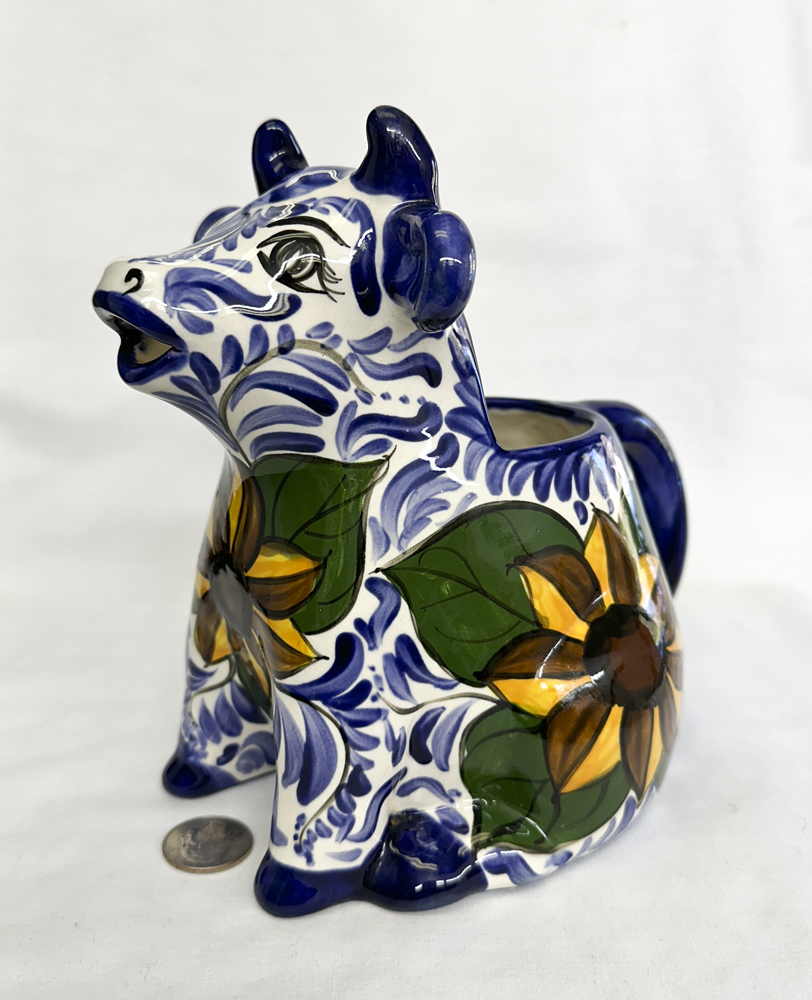 |
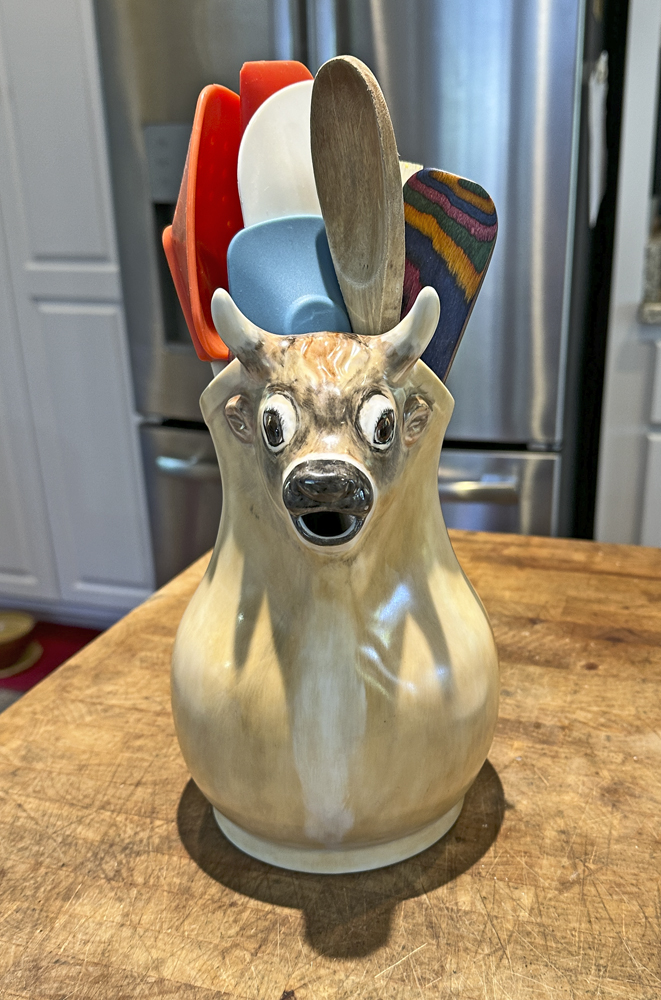
My wife immediately absconded with this blue Polish picther to help hold her kitchem implemnents. The cow seems content with that and I didn't dare object. Glad that she likes parts of this coillection and finds uses for some of them. Nice big flowers like the one just above. |
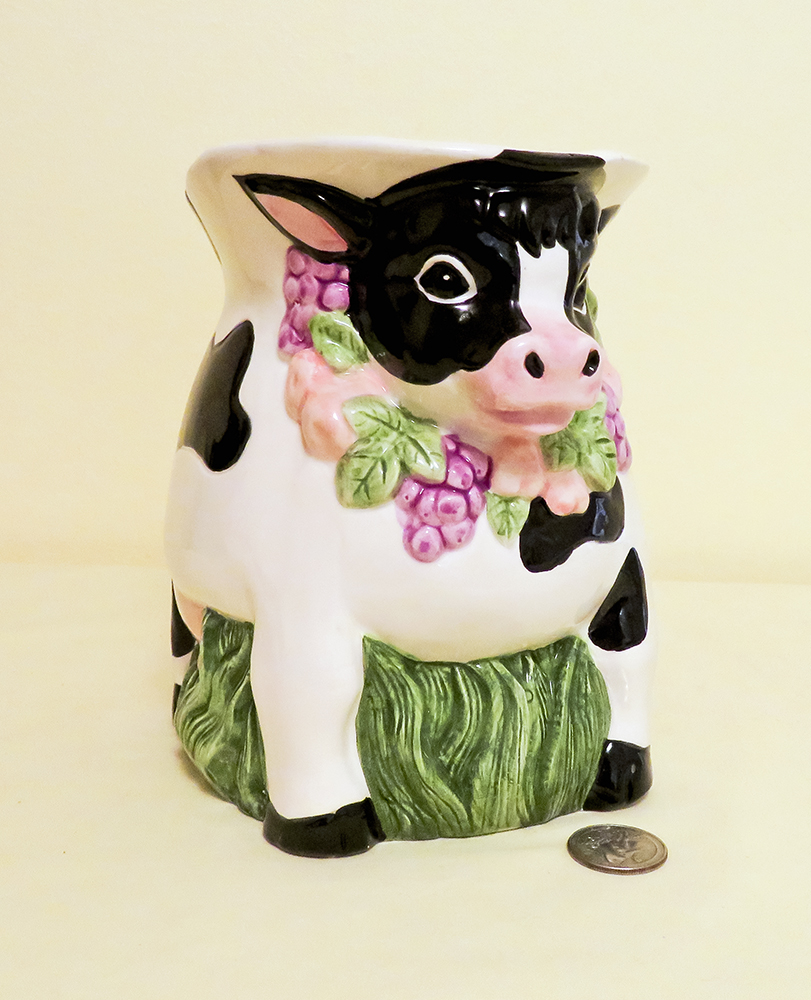 |
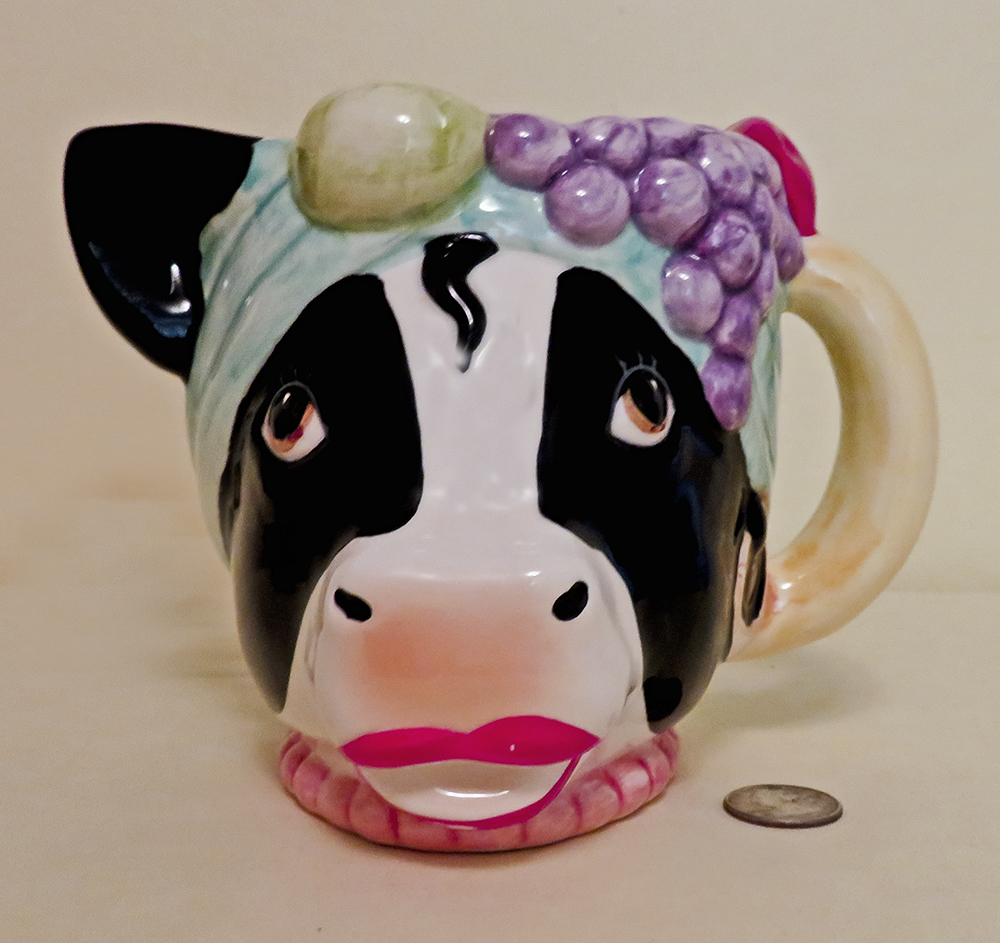
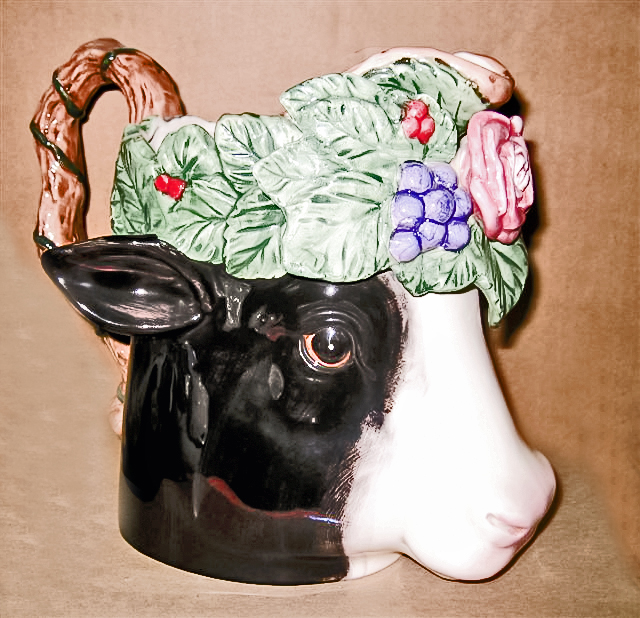
Truly a pitcher without a mouth hole, here's a cow with a wreath of grapes around its neck, marked with an incised “V COR” and bearing a decal for Wang’s International, Inc. |
|
|
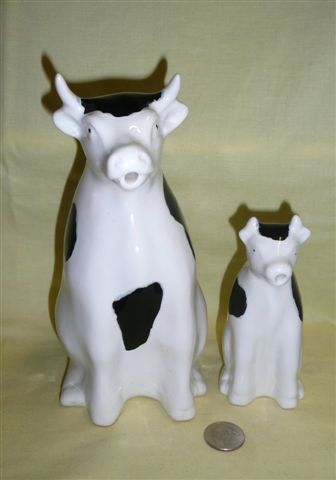 |
Here is Mr Frutuoso again, this time accompanied by a smaller relative marked for the same company. The little guy also appears with other black and white creamers on Page one of Modern Variations. |
 |
The rather piggish-looking cow on the left seems to have rather more than the normal allocation of teats. Makes you wonder if whoever designed it ever saw a real cow. The middle one with pinwheel designs is a Japanese version of the ‘begging’ cow that is featured in several more interpretations below. On the right is a very hefty cow that, although unmarked, arrived here (via eBay) from Dublin, Ireland |
|
|
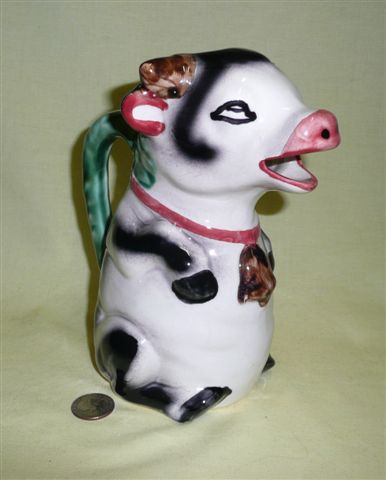 |
This is another Portuguese beggar with the same inscriptions as the one above, but this time with a sticker for Andrea by Sadek. This gift, tableware and home furnishings company, also known as Charles Sadek Import Company or j.willfred, was founded in 1936 by Norman and Charles Sadek and is still operated by the Sadek family. Their headquarters are in New Rochelle NY, and they have 7 showrooms across the US. |
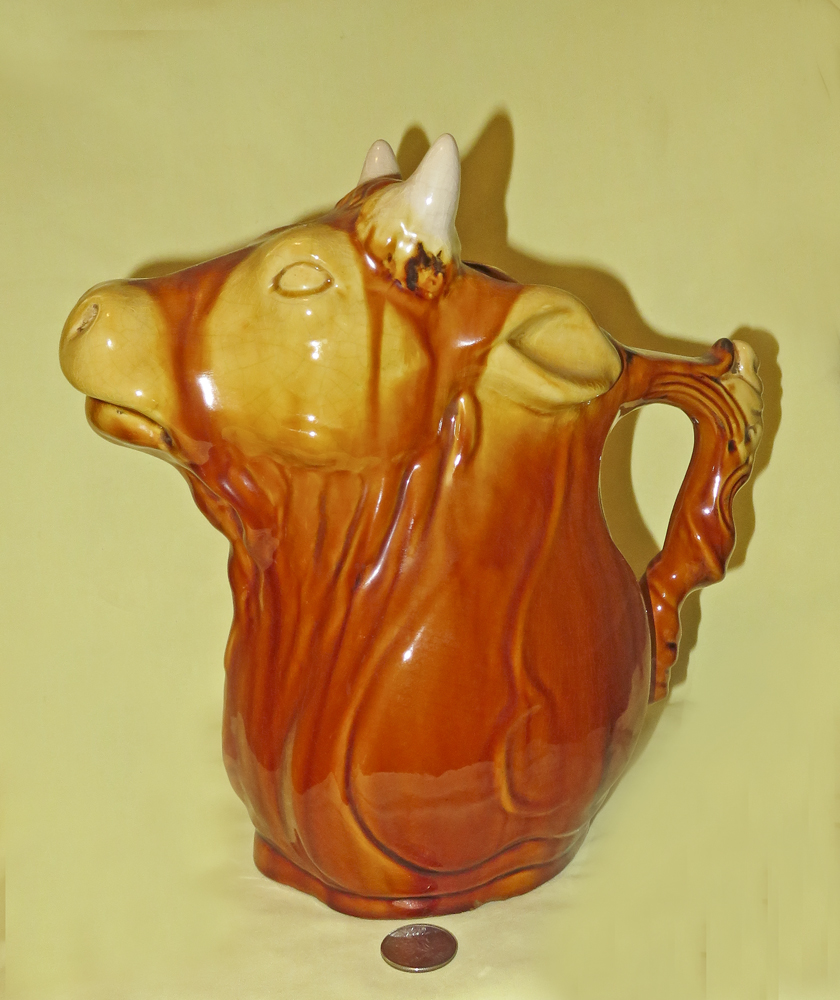 |
This large - 10"x10" - and heavy brown cow pitcher, made in China, should have been added to these pages many years ago. Somehow, large as it is, it hid. Thus I now have two, since when another cropped up on eBay, although it looked familiar, I couldn;t find this one. Oh well...what's one more cow in a herd of a few thousand, and it is indeed a nice and useful large pitcher.. |
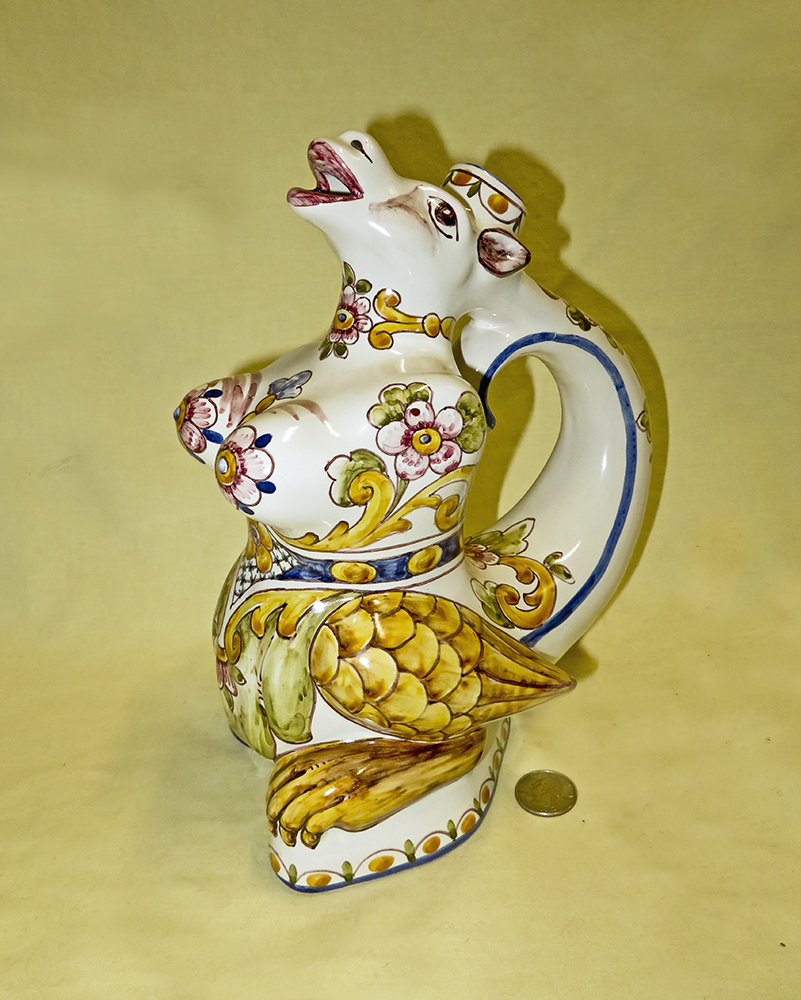 |
This has to rate as one of the more fantastic, or at least imaginative, pieces in the collection. Cow? Horse? Mythical beast? Well it was sold as a ‘cow with breasts and wings’, and it certainly has those in plenty. It came to me from France. Actually it is Portuguese, clearly marked for Fabrica Sant’Anna, one of the oldest traditional, high-end Lisbon ceramic factories, established in 1741 and deriving its name from its original location. This piece is dated 2004, and was created with traditional Portuguese techniques. |
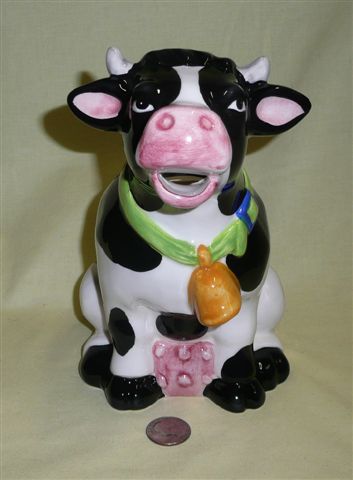 |
Here’s another anatomical wonder…I can understand the plaintive look on her face. Perhaps her parents were grazing too near Chernobyl. |
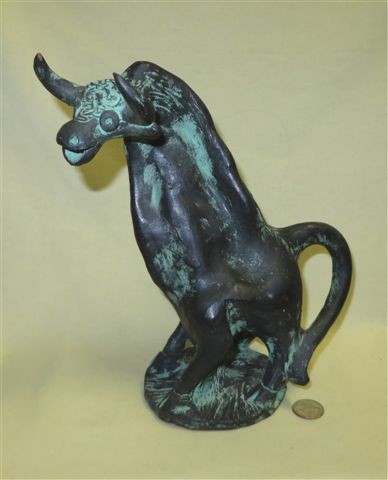 |
This tall metal bull pitcher – albeit for sure designed more for display than use, and indeed useless for holding liquids because of an open flaw in the bottom between its legs – is marked for Cuenca, as well as for the artist or studio, which I believe to be Adci Hem (??). Although there is a Cuenca in Ecuador as well as Spain, I’m pretty sure this fanciful beast is Spanish, and will continue to try to find out more about it. |
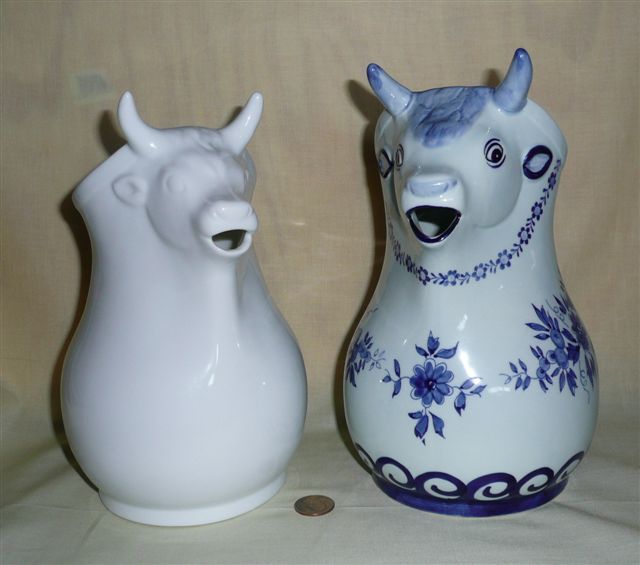 |
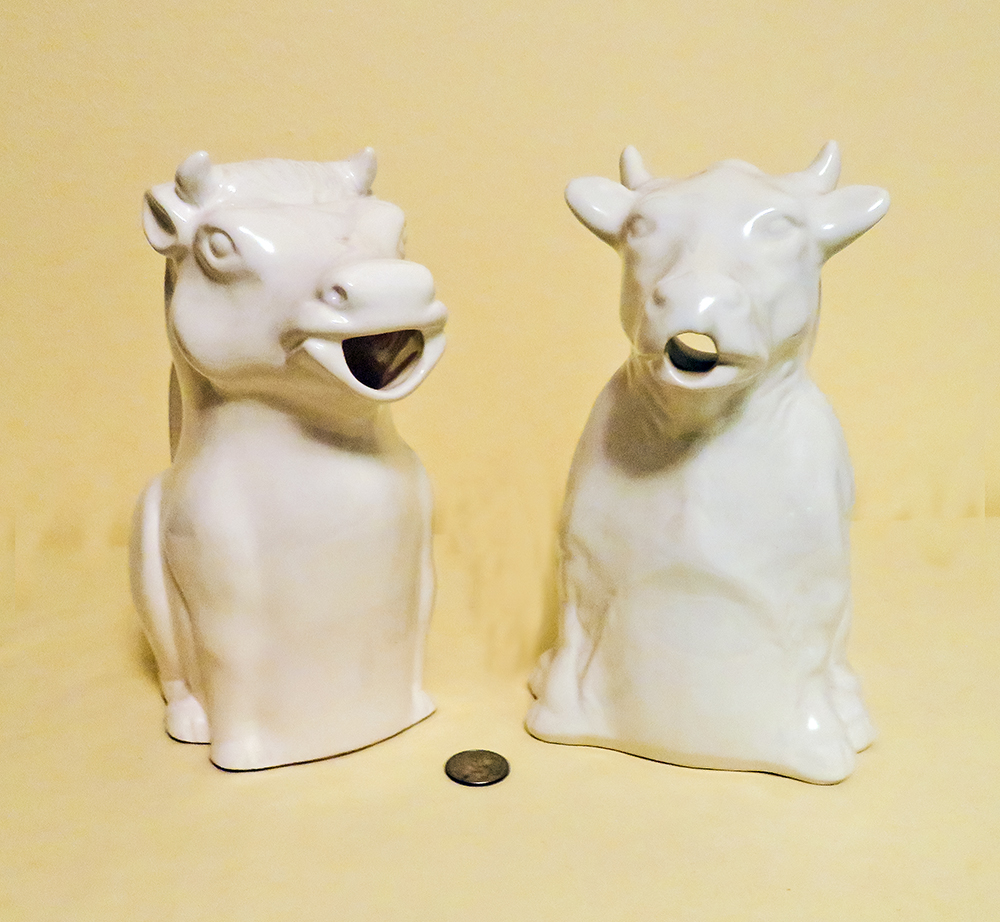
These two are also from similar molds. The one on the right, which would appear to be from the same mold as a pitcher shown in the Delft theme, has a stamp that states “Biltmore Estate Collection, Genuine Delft”. The Biltmore estate was built by George Vanderbilt and is in Ashville, NC. You can visit the house and hardens, tour, eat, stay there(3 levels of accomodation from expensive to oh-my-god), and buy all kinds of stuff. It's actually quite nice, if ostentatious. The white pitcher bears the stamp of “Maryland China, Taiwan”, and I’d guess is made from a copy of the Delft mold. At least I’d be willing to bet the Dutch didn’t copy the Taiwanese in this case…albeit the Delft blue coloring does of course have a Chinese origin. Maryland China has a showroom in Reisterstown, MD but I assume most of their products are made overseas; they have a nice web page to peddle their products but it doesn't tell a lot about them except that they started in 1910. |
|
|
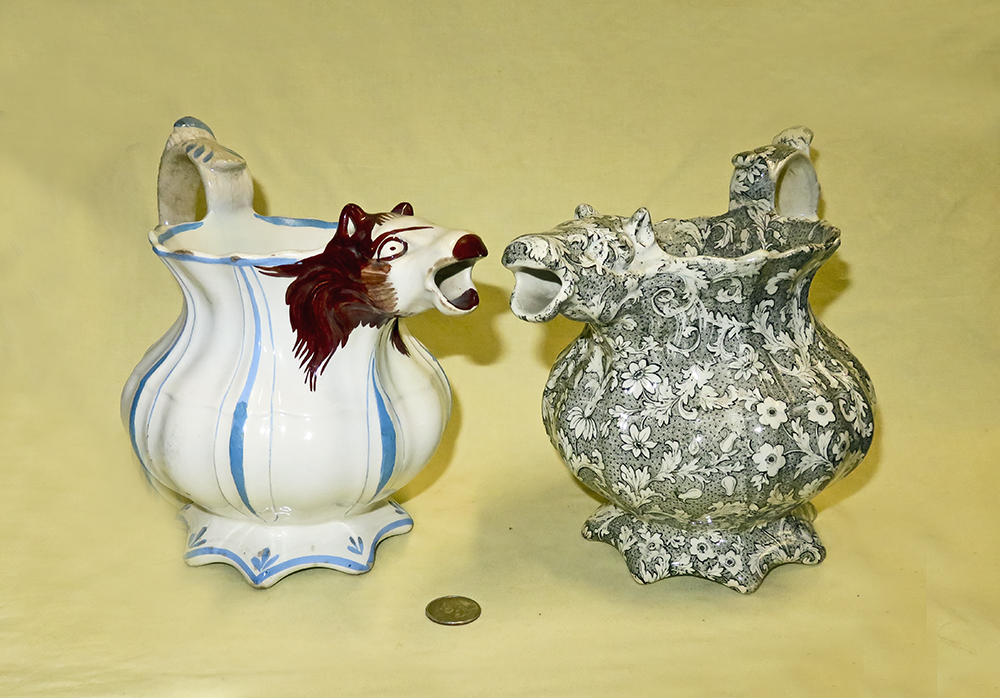 |
This interesting pair are 19c Victorian era. The grey one was sold by a knowledgeable UK antique dealer as Swansea pottery. Quite frankly I think the heads look as much if not more like a fox than a cow, but both were sold as cow pitchers and who am I to argue. |
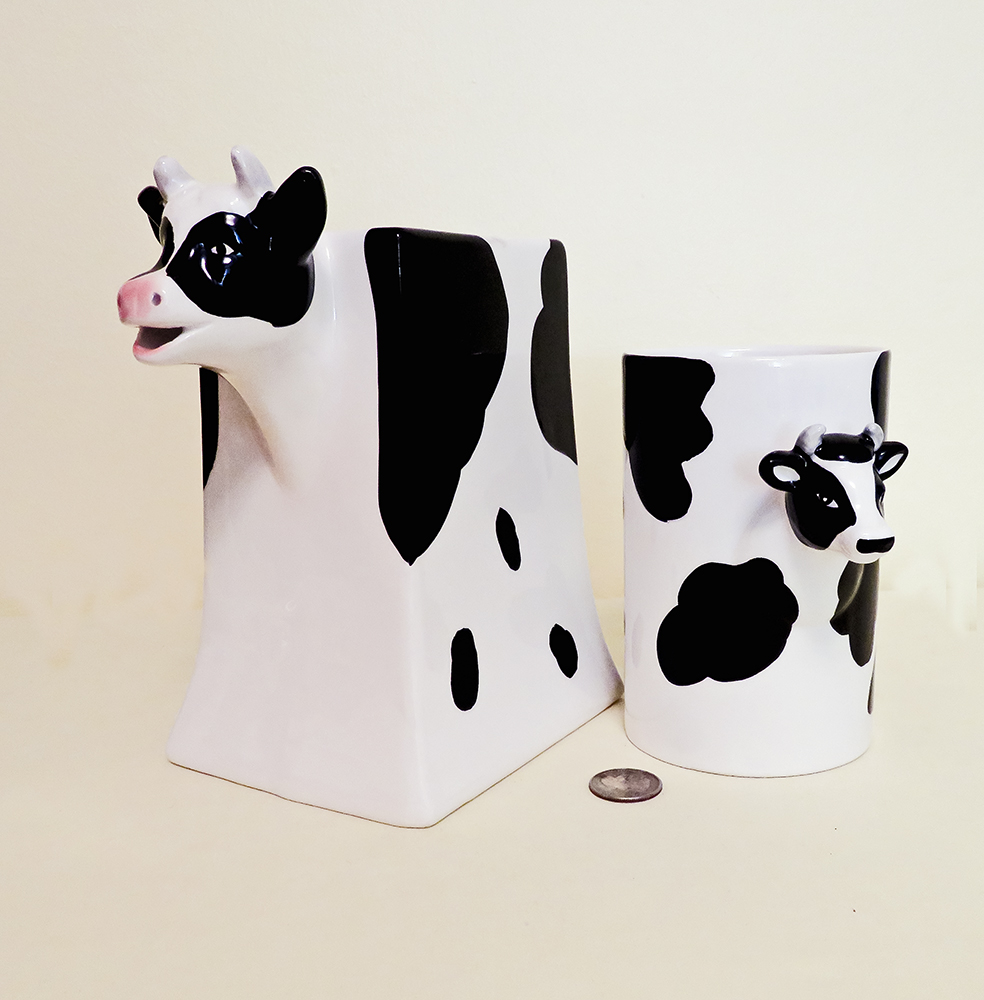
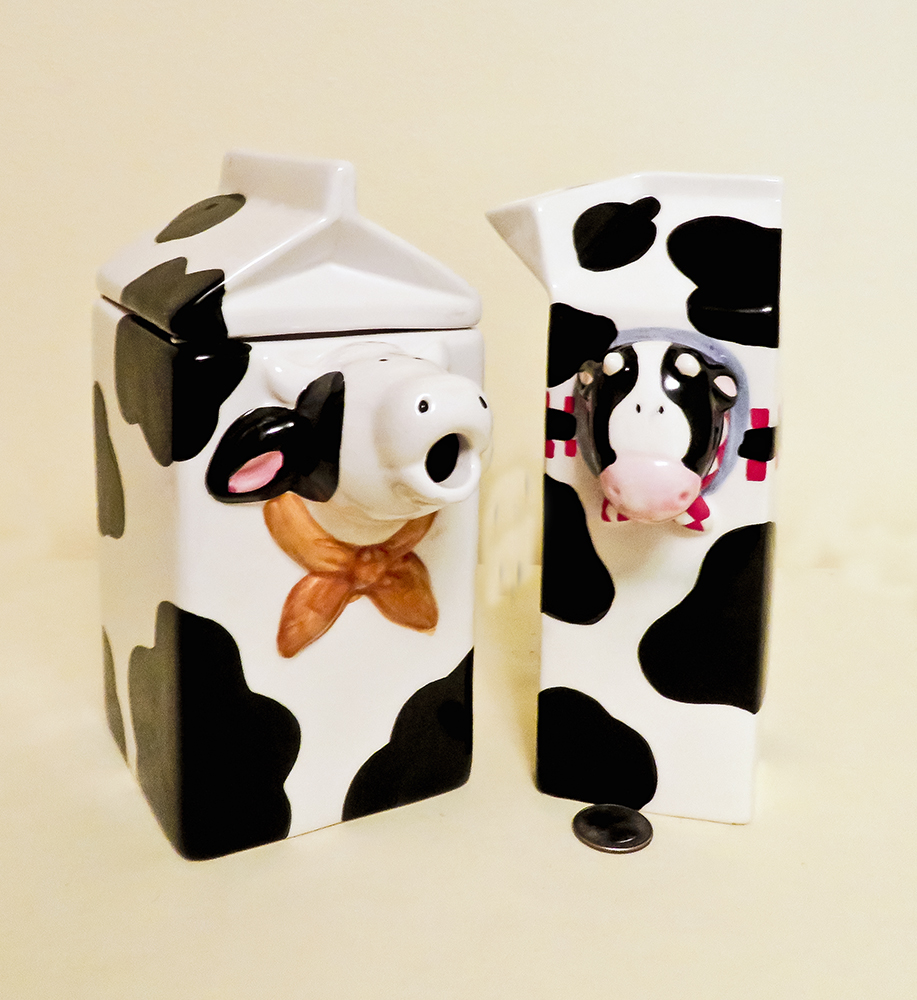
|
|
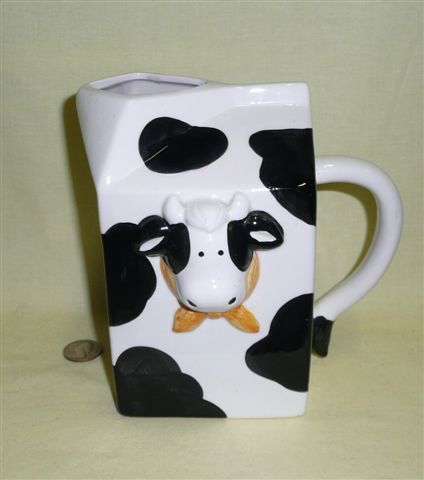 |
Here’s a very similar interpretation, from Enesco Designed Giftware. |
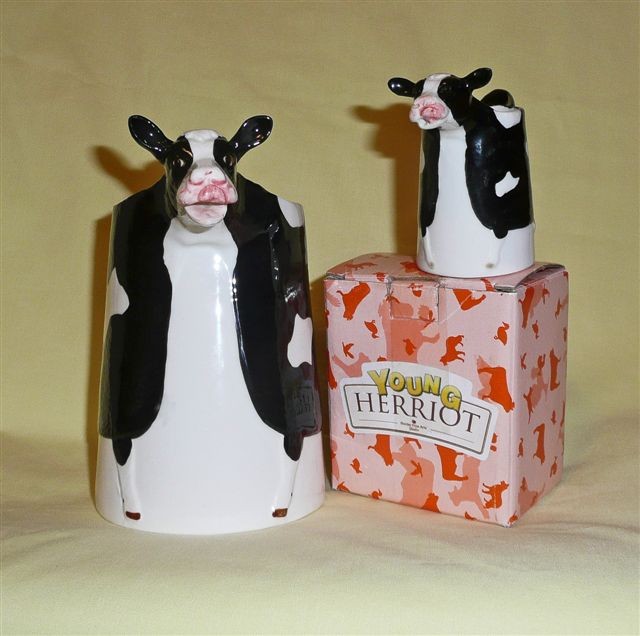 |
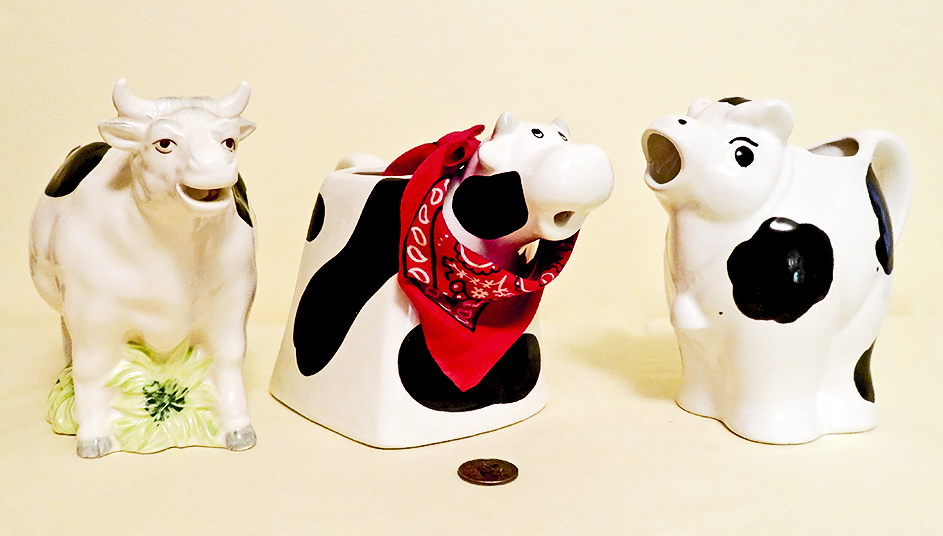
Here are a couple of ‘Brits – medium and mini lip-licking calf jugs from Enesco, Ltd’s “The Young Herriot Studio Collection”, Border Fine Arts Studio, ©2008, Carlisle. If you're interested, you can learn more about them at about the 5th section down of page 3 of Modern Variations where there is a picture of 4 sitting cows. |
|
|
 > >
|
|
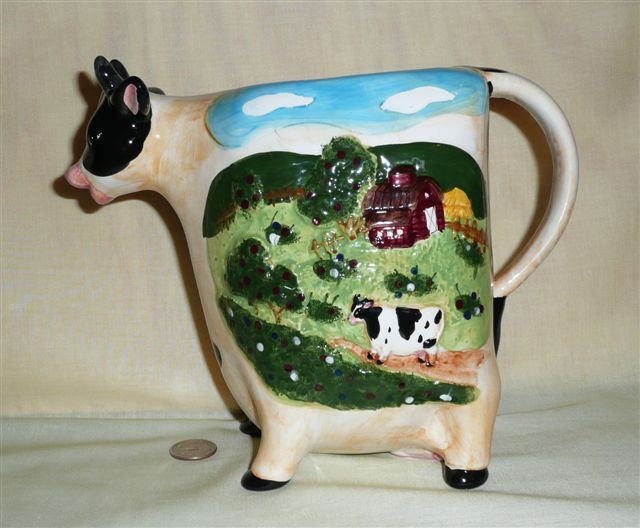 |
This large pitcher with the raised farm scene on the side is from “style.eyes by Baum Bros, Country Fair Collection, China”. It is similar in size to the four above, but much more nicely crafted. |
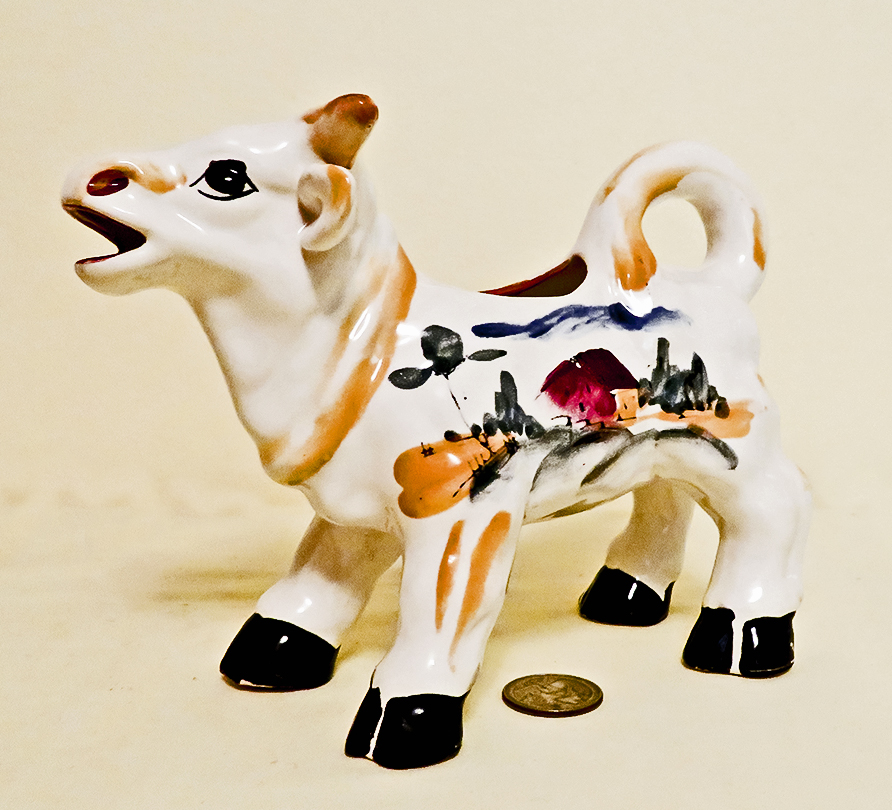
|
Here's another farm scene, this time on the side of a very sturdy Japanese cow. It has a tree on the right. From the nature of the picture I would have guessed this one to be from southern Europe, but for the giveaway stamp." |
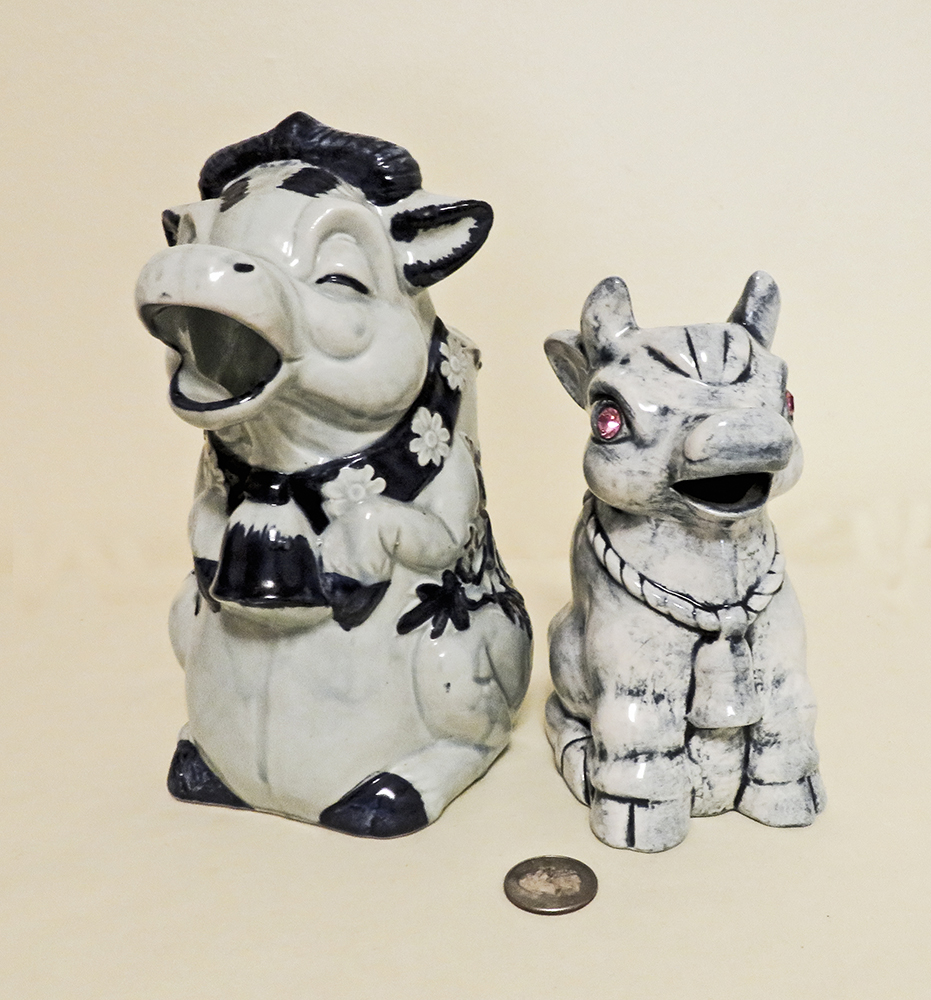 |
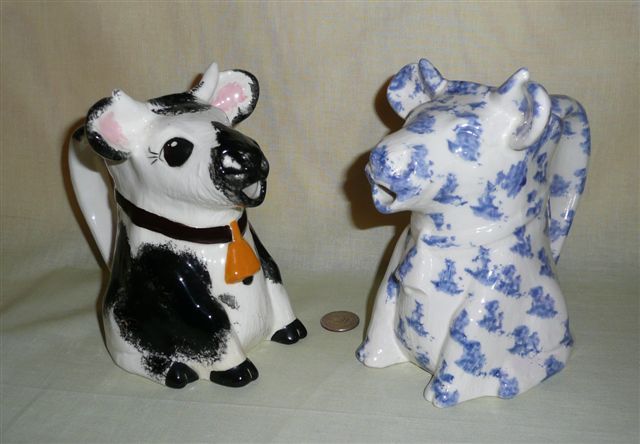
These aren’t the most beautiful cows in the collection, but they are unusual. The one on the right, which has purple rhinestone eyes, says ‘Dunbar” in script. I guess whoever made it was proud of it. |
|
|
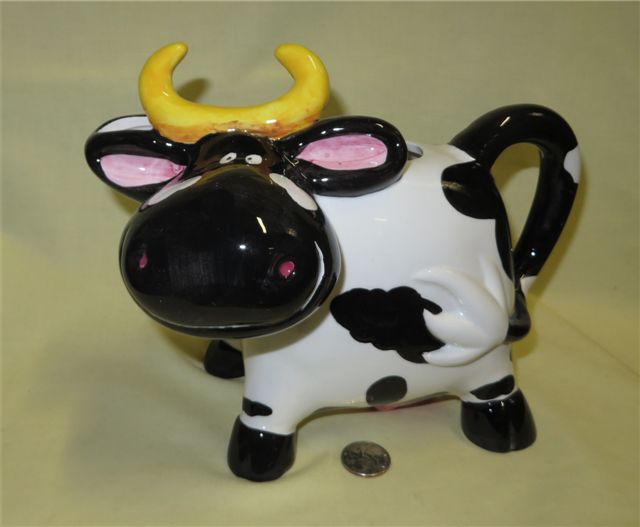 |
No marks on this one, but it wins a prize for biggest nose. |
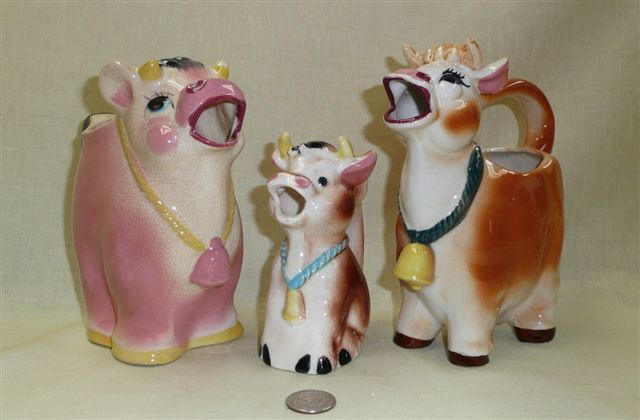 |
Three Japanese caricatures, unrelated but more or less with the same basic idea. The middle one has a faint “TS” impressed inside what looks to me like a tank, and the one on the right is stamped B901. |
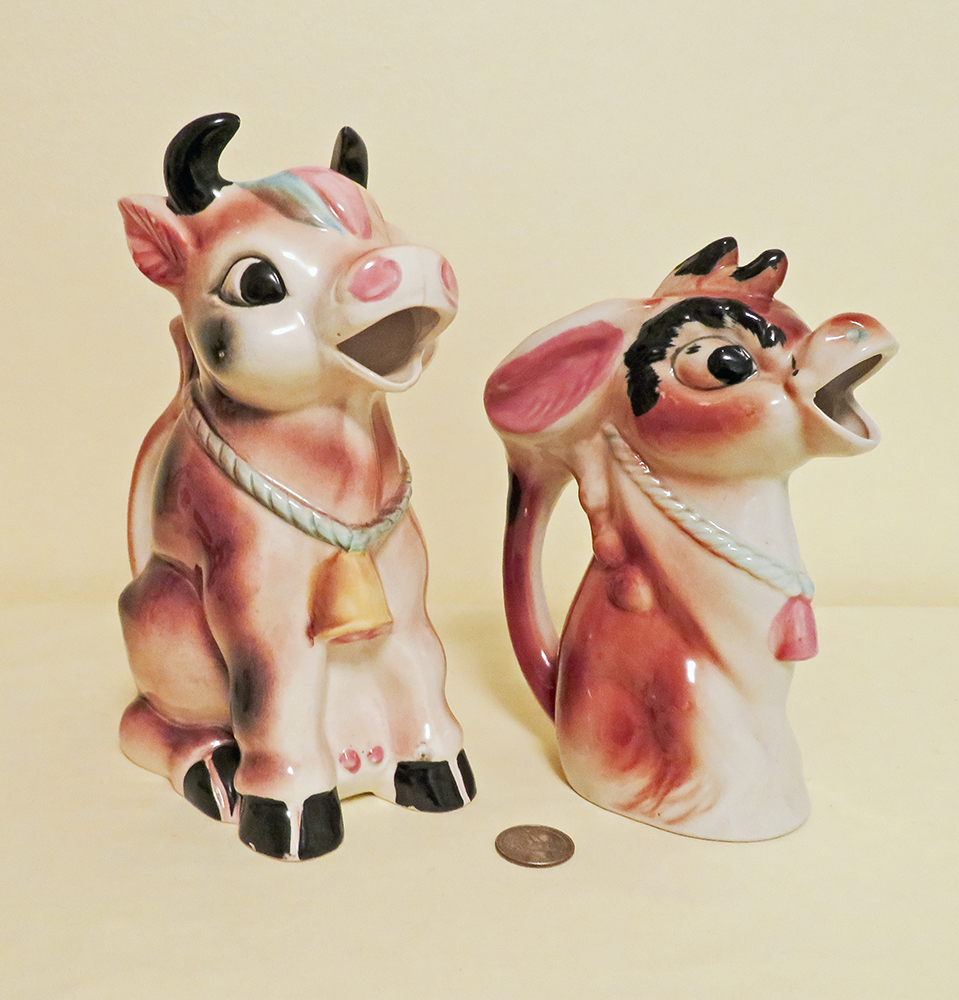 |
Two more Japanese caricatures, the larger of which was also in a shot higher up on the page. The real queer one here is on the right - I guess it's supposed to be a cow (sold as one) but the ears and eyebrows are excessively huge, and its horns are in a line on top of its head. Wierd. Another one I probably should have passed up. |
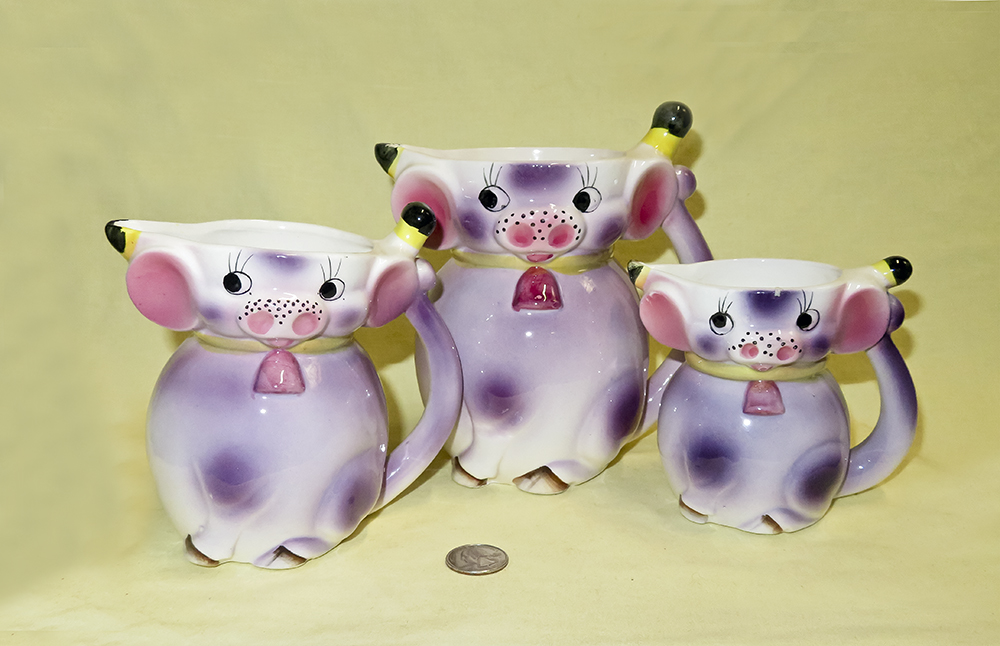 |
Well, they have to be cows because cows have horns and mice don't. I'd guess them to be 1950's or so Japanese - no other country seems to produce such fanciful cows. The only marks on them are numbers, 9198 on the biggest and 8721 on the other two. |
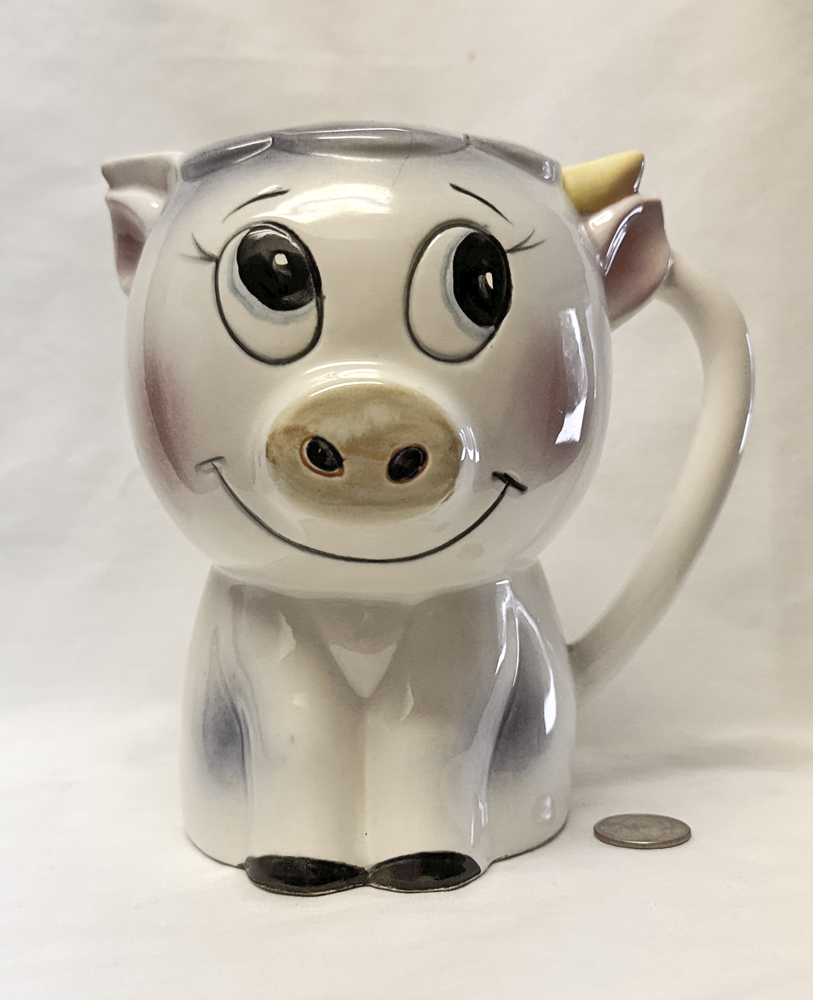 |
Pigs don't have horns either, so this also must be a cow. It.s stamped for Japan, no surprise. As I have noted elsewhere, in the post WWII era, the Japanese pottery companies were trying to start back up, and made things they thought might appeal to the American occupiers and general public. Thus some pretty strange lokling things, to us these days. It must have worked, because they sold a bunch of them and folks apparently kept them because they keep cropping up on eBay. |
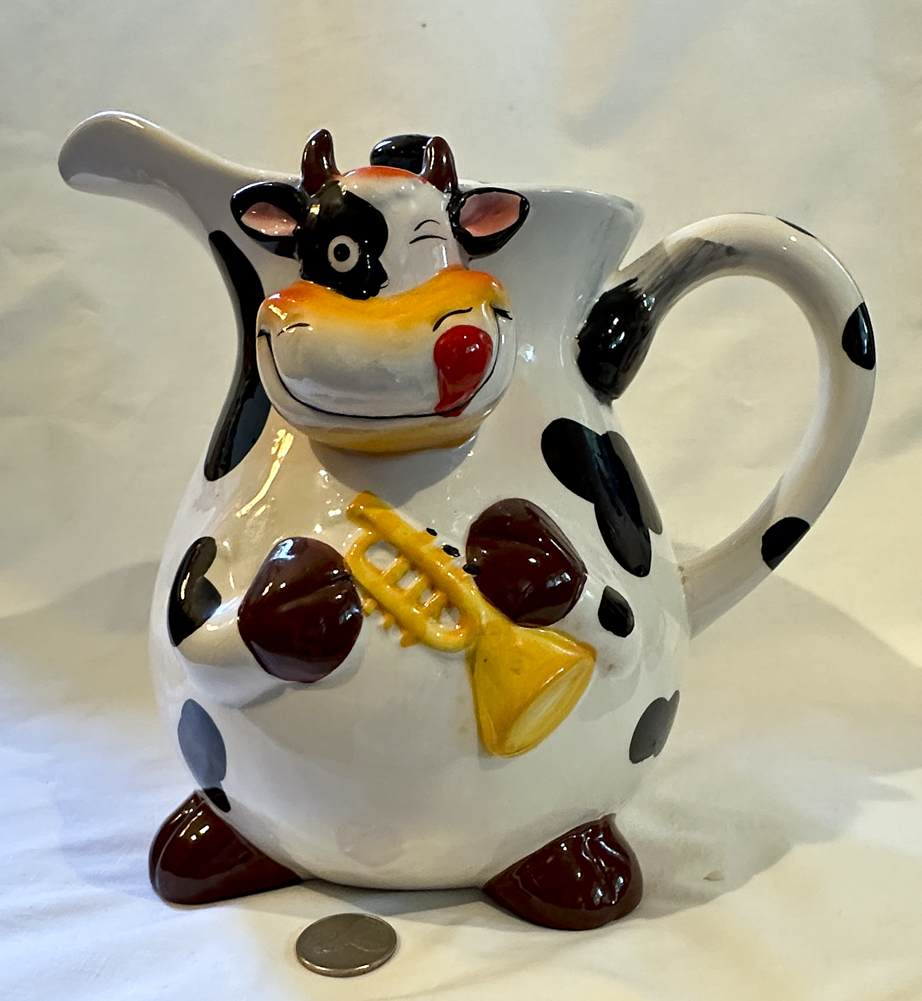 |
Straight from the P.R.C. comes this 'Loren's' caricature pitcher with trumpet. I often, like with this one, regret that I haven;t limuited the collection to 'cute' or otherwise appealing cows. Oh well..., |
|
|
|
|
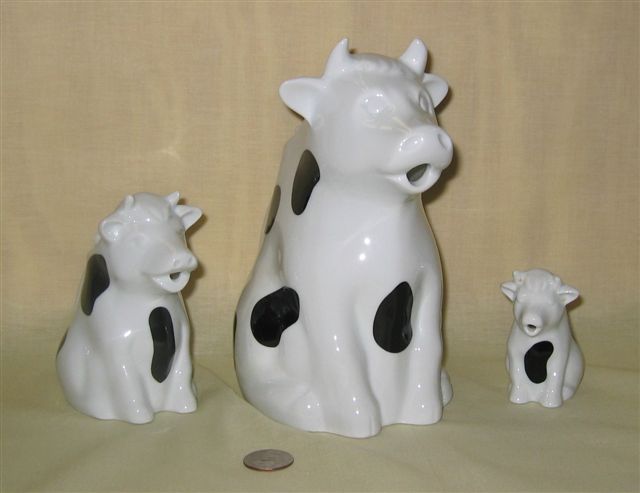 |
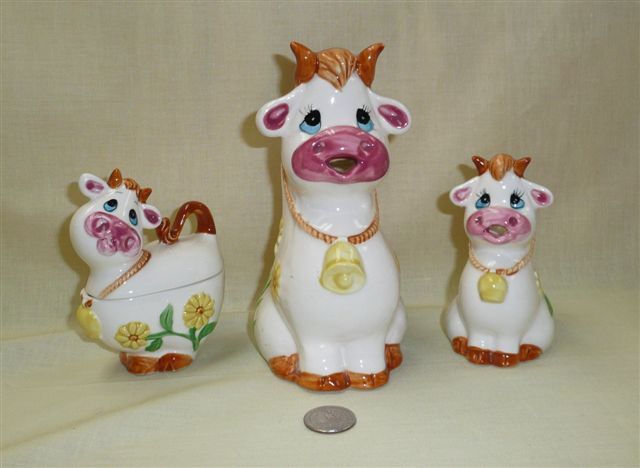
This is the first of several ‘sets’. The little ones are creamers, but the biggest is a pitcher so I chose to put them here. The sticker on their bottom says they’re from Stonewall Kitchen, Made in Spain. A quick look at the web indicates they are a specialty food producer based in York, Maine that started at a farmer's market and now sells in 42 countries. Not sure how or why they produced cow pitchers. |
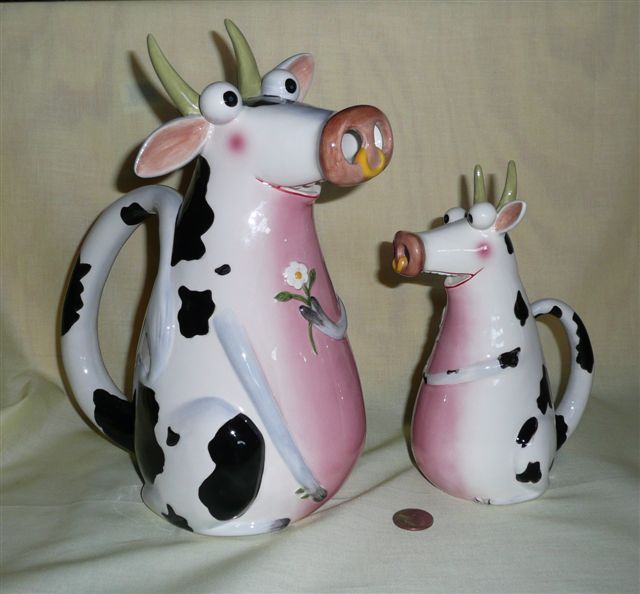 |
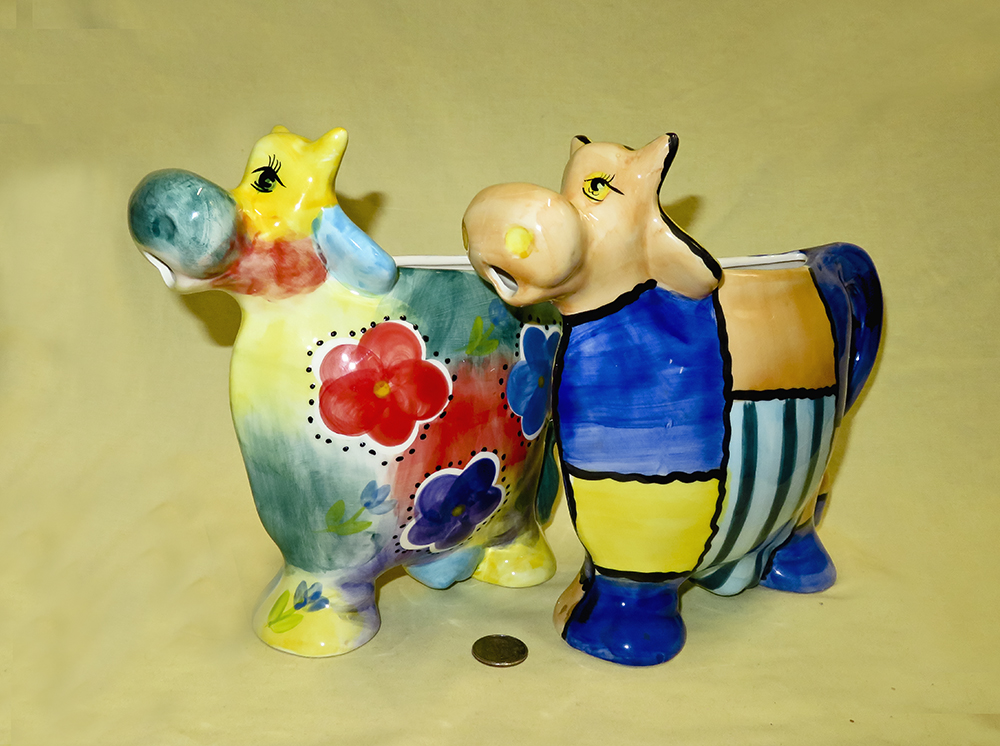
The tag on these rather wild interpretations says they’re “Bee Happy by Claire Mackie, a collection of Department 56”. The smaller cow must be intended to be a creamer, since it came with a pink udder-shaped sugar bowl and a spoon with a daisy on top. Dept. 56 has produced quite a number of cows, but these are by far their most imaginative. They’ve been around since 1976, and make giftware, collectibles, and holiday decorating items. Check out www.department56.com if you like ‘stuff’. |
 |
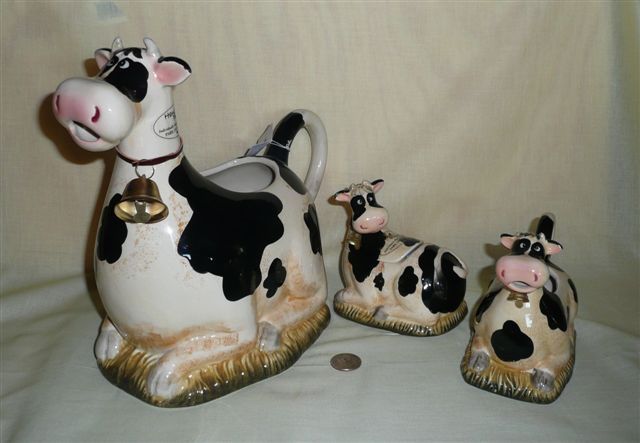
This set (actually I bought the pitcher separately from the cream and sugar, but they match) are stamped for Japan, and bear a silver gift-box shaped tag that reads “imported by Giftcraft, Toronto”. They seem to be somewhat patterned after geo.z.lefton’s cows. |
 |
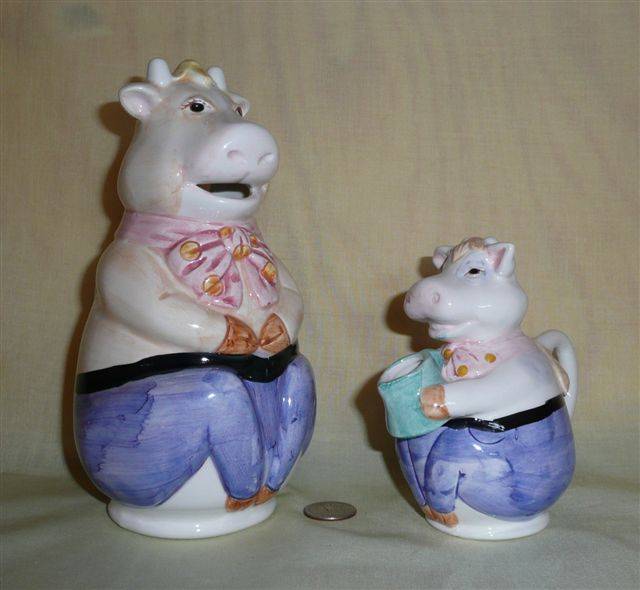
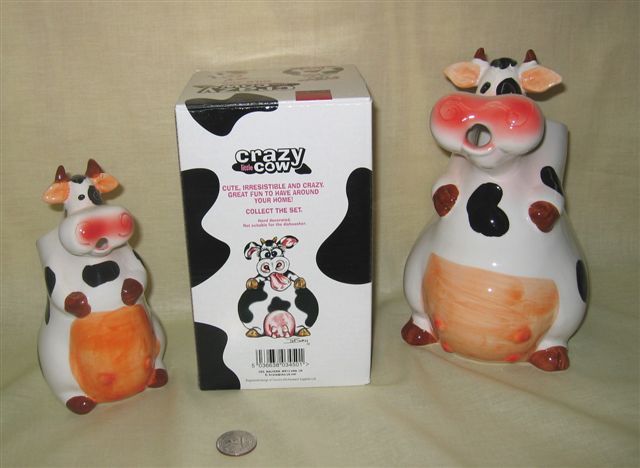
Here’s another fanciful pitcher, creamer and sugar set, made in China, with stamps that read “Milk Cow© Collection exclusively by Park Designs, Goldsboro, NC”. Interestingly their web site is a '.net' instead of a ".com' but it does indeed try to sell you stuff, at least if you're a wholesaler. They've been around for some 20+ and seem to purvey home and kitchen textile, accessories and lighting. All kinds of stuff, actually. |
|
|
|
|
 |
These big nosed caricatures come from “Home Essentials and Beyond”’s “Happy Cow Collection, Made in China”. The smaller one is also in the Modern Variations page, but then its big brother arrived so it ended up here as well. They say on their web site that that "HOME ESSENTIALS & BEYOND has been the innovative, global resource for trend-forward housewares, tabletop, gift, home décor and lifestyle product for over 25 years..." They have a 20,000 sq ft showroom and 400,000 sq ft warehouse in Jersey City NJ, plus scattered showrooms around the country. They sell many many things, including apparently the odd cow or two.. |
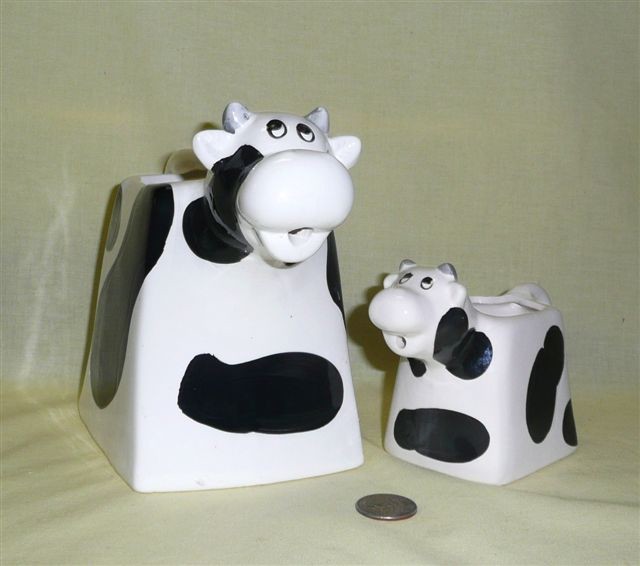 |
Here’s a square set, “Made in Taiwan”, purchased separately and I didn’t notice they went together until I was dusting the collection (yes, I do the dusting…and the polishing…though I can’t really understand why my wife won’t help) |
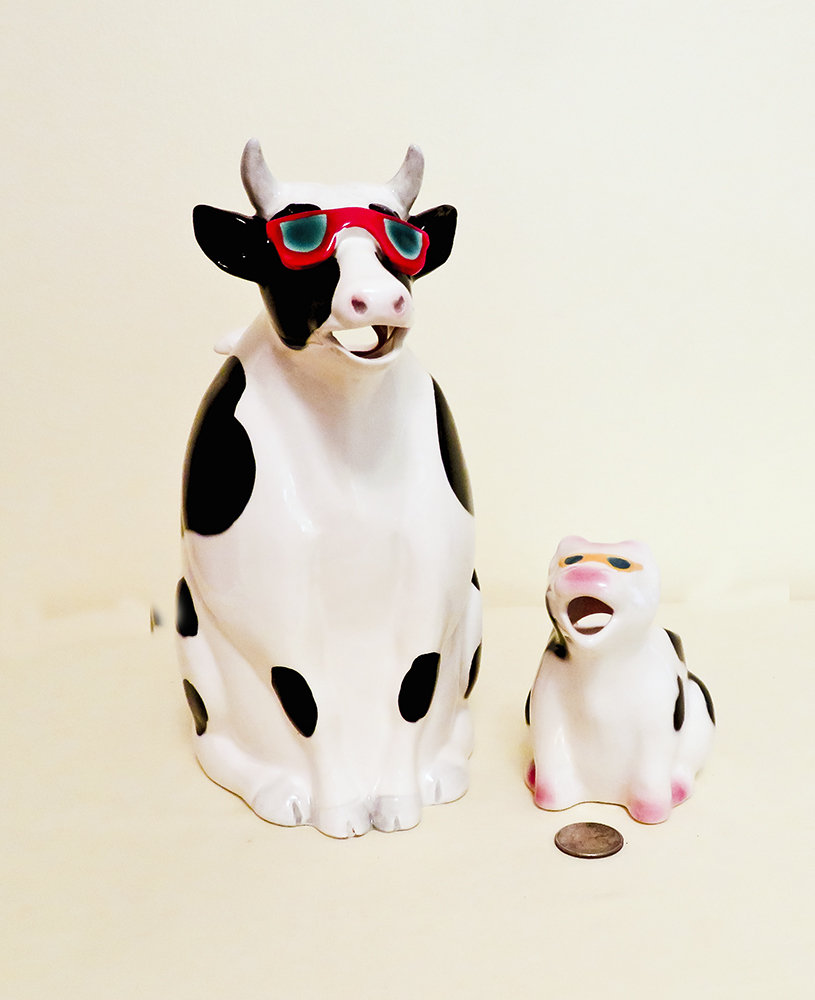 |
Some cows like to sit in the sun but have sensitive eyes. The big black and white cow with the red sunglasses is from Vandor, dated 1987. We got it in Hamburg, Germany. Its small friend with the green and yellow shades is marked “Bonnie’s Ceramic Company, Inc., Handpainted, Made in USA”. a quick web search turns up a number of Bonnies who do ceramics and I'm not at all sure which one may want to take credit for this creation. |
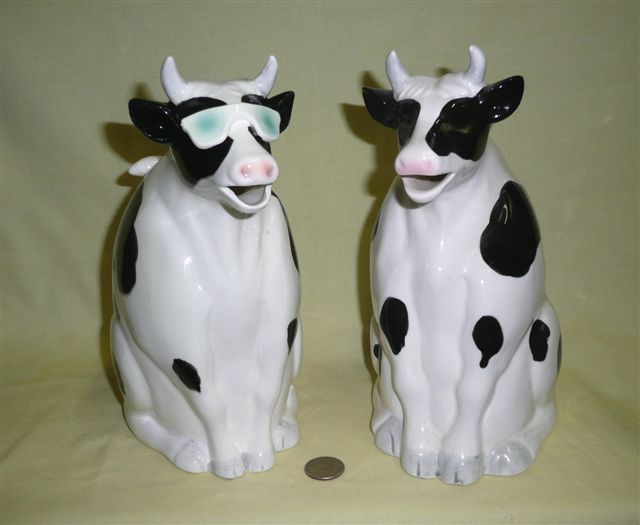 |
Some Vandor 1987 cows have red shades, some have green shades. I’ve included it here next to the one shown above as coming from Pelzman Designs, because it turns out this Vandor cow also has a Pelzman designs sticker. They’re quite similar, but the one without the sunglasses has significantly larger front legs and, although you can’t see it here, a larger tail tip. Apparently Vandor has an affinity for skinny legs. www.vandorproducts.com notes that they’re proud of “making retro cool since 1957…suppliers of hip and functional products”. They create and distribute over 150 designs per year, and are based in Salt Lake City with offices in Hong Kong, China, and the Philippines. I haven’t been able to find out much about Pelzman, but an eBay search indicates that they do a whole lot of work for Vandor, presumably among others. |
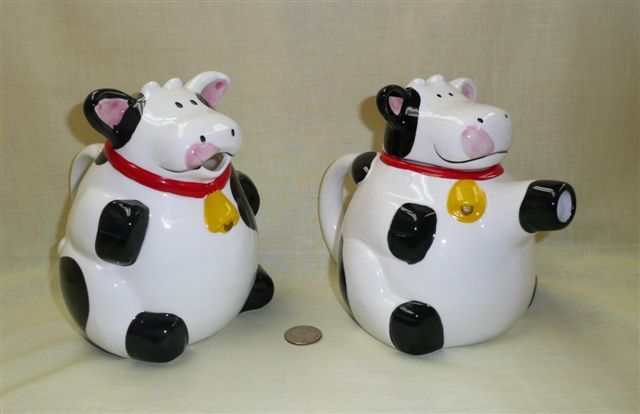 |
Here are an unmarked pitcher and teapot that bear some distinct similarities; enough that at first I thought they were from a set, but on closer inspection just seem to have come from folks with similar ideas. |
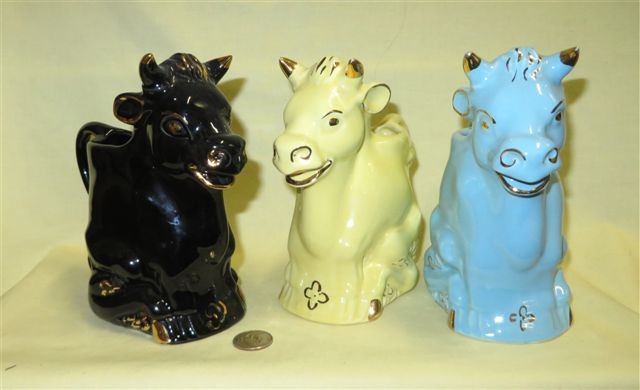
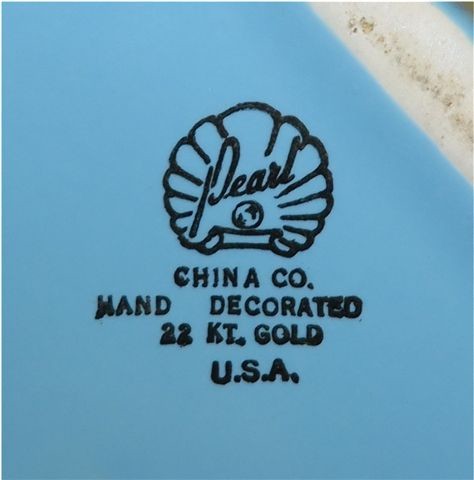
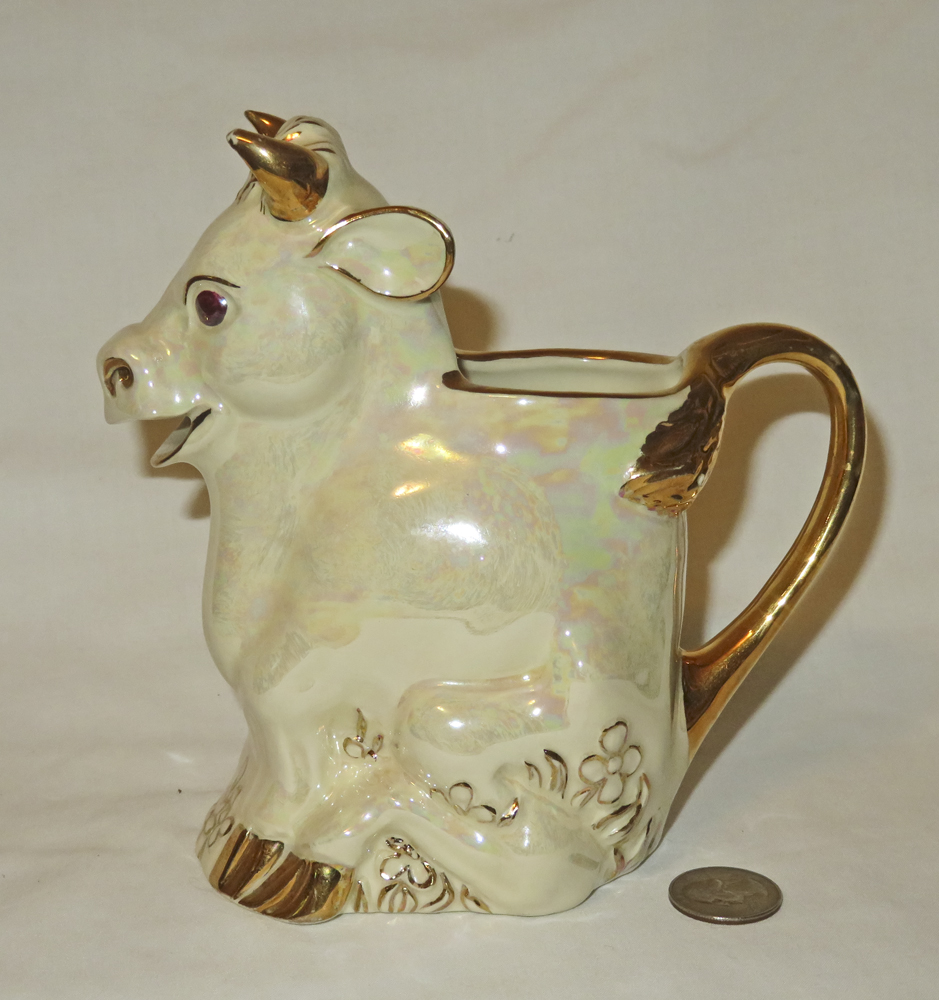
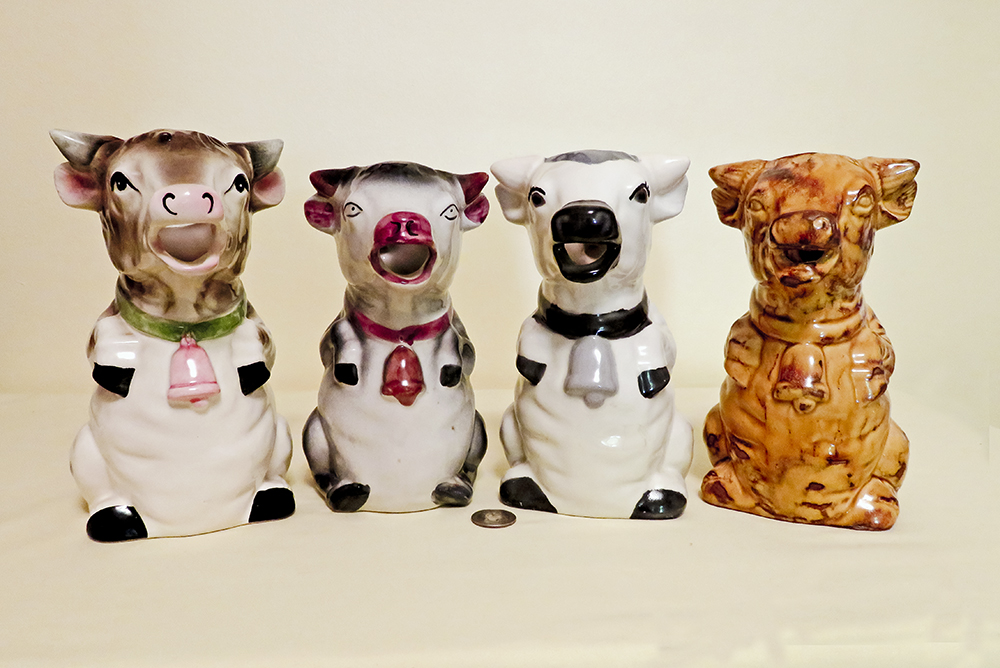
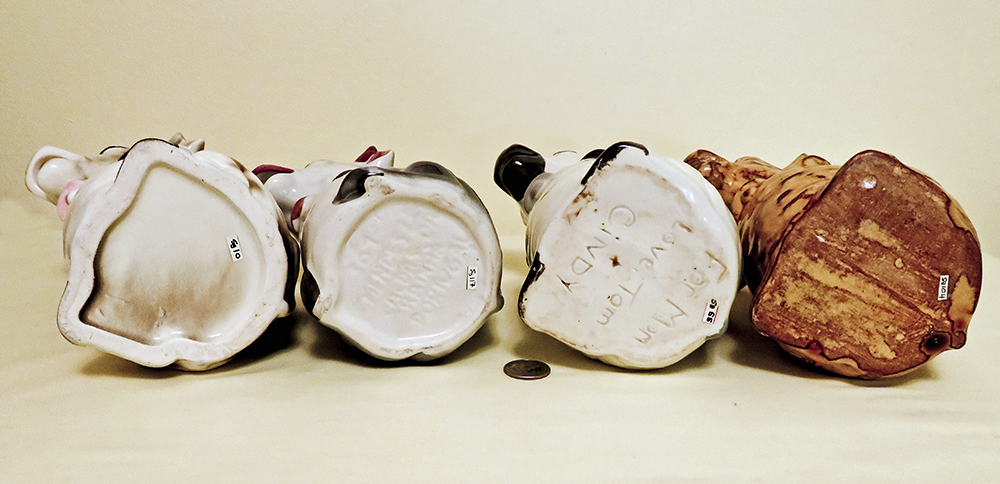
As the mark here clearly shows, these four rather fierce looking cows come from the Pearl China Company. The ‘Pearl China and Pottery Company’ was established by Dennis and George Singer in 1931, in East Liverpool, Ohio. This city is sometimes known as the ‘Pottery Capitol of the Nation’, and its Museum of Ceramics lists dozens of pottery companies that operated there. Pearl Co. was designed to serve both as a pottery and as a distributor of goods from other manufacturers. Pottery production stopped in 1960, but the company remained open as a popular retail outlet until late summer 2009, switching owners to friends of the Singers a couple times before the last owner retired. As far as I know this was the only cow mold (#635) that Pearl used, and the ones shown togeher = black, yellow and blue - were the only three colors in which they were produced. From the frequency with which they appear on eBay, they were quite popular at one time. Well, some decades later I find there was also a lustre one so I just had to get him to complete - I hope - the set. Pearl apparently did make some for other locations or organizations to sell as souvenirs –a yellow one with a Pikes Peak picture is shown on the Advertising and Souvenirs page. |
|
|
|
 |
This farmer in blue overalls is another that looks like it should be a teapot but has a hole in the back of the head and an arm for the spout, so it must be a pitcher. |
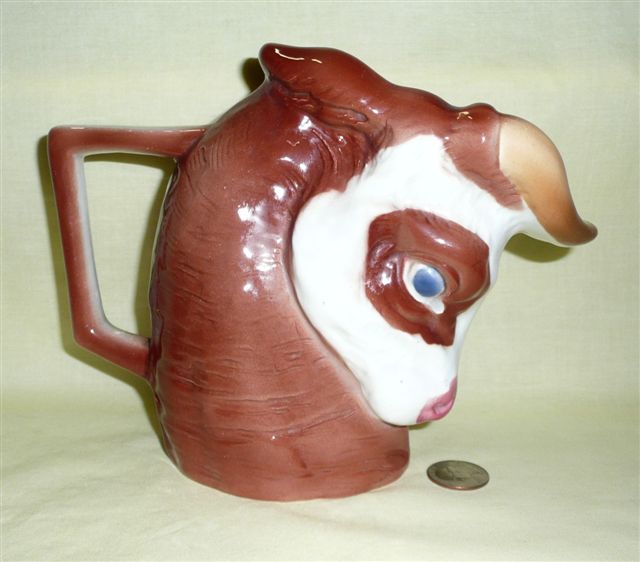 |
This fierce looking blue eyed Czechoslovakian (green circular stamp) bull appears to be contemplating George Washington.
|
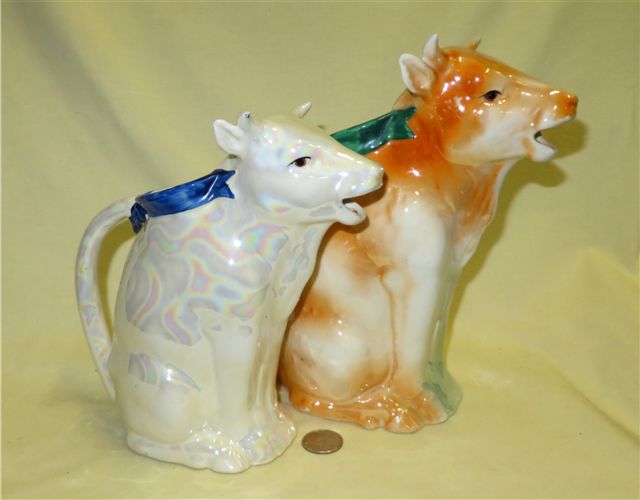 |
Here are two more pitchers from Czechoslovakia. They are similar to many of the Czech sitting cow creamers, but much larger – 8 ½” tall for the brown one, 7 ½” for the white one. |
| |
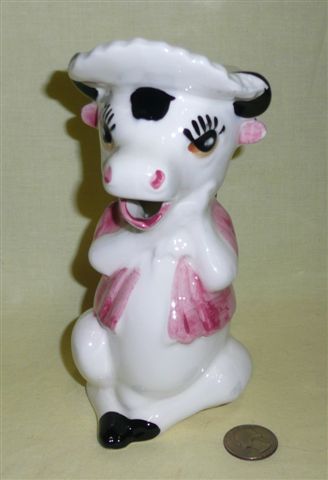 |
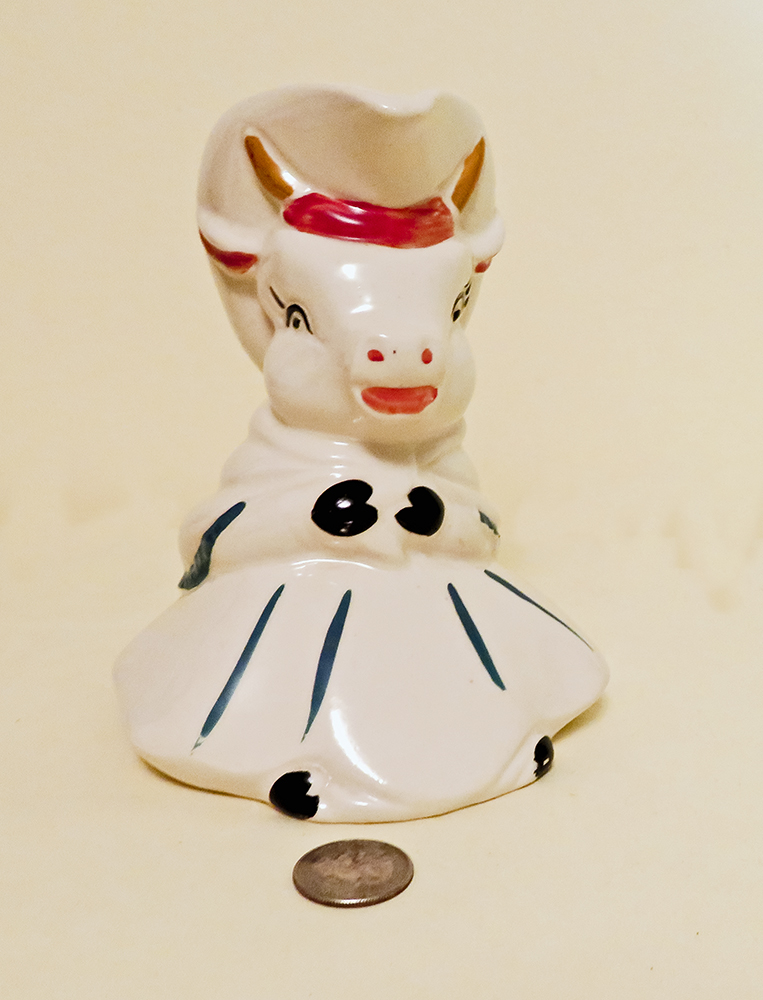
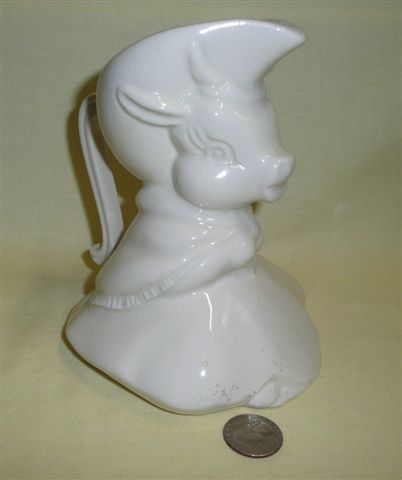
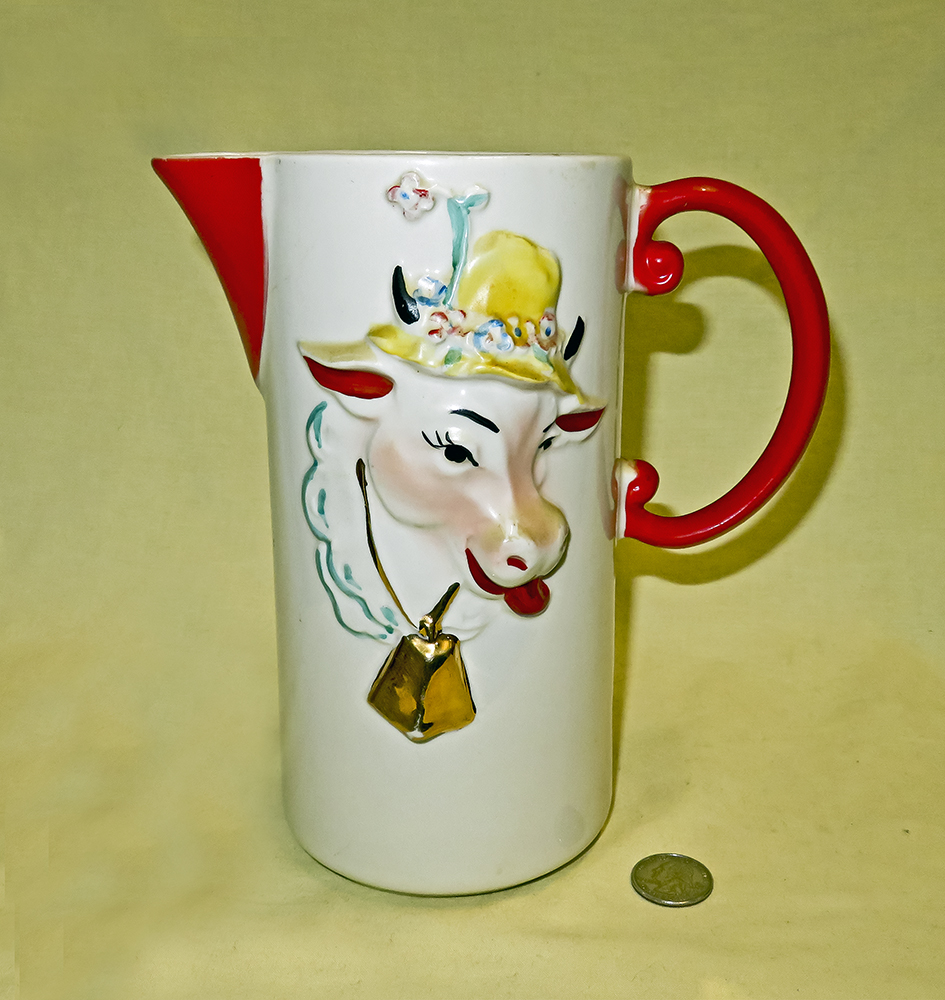
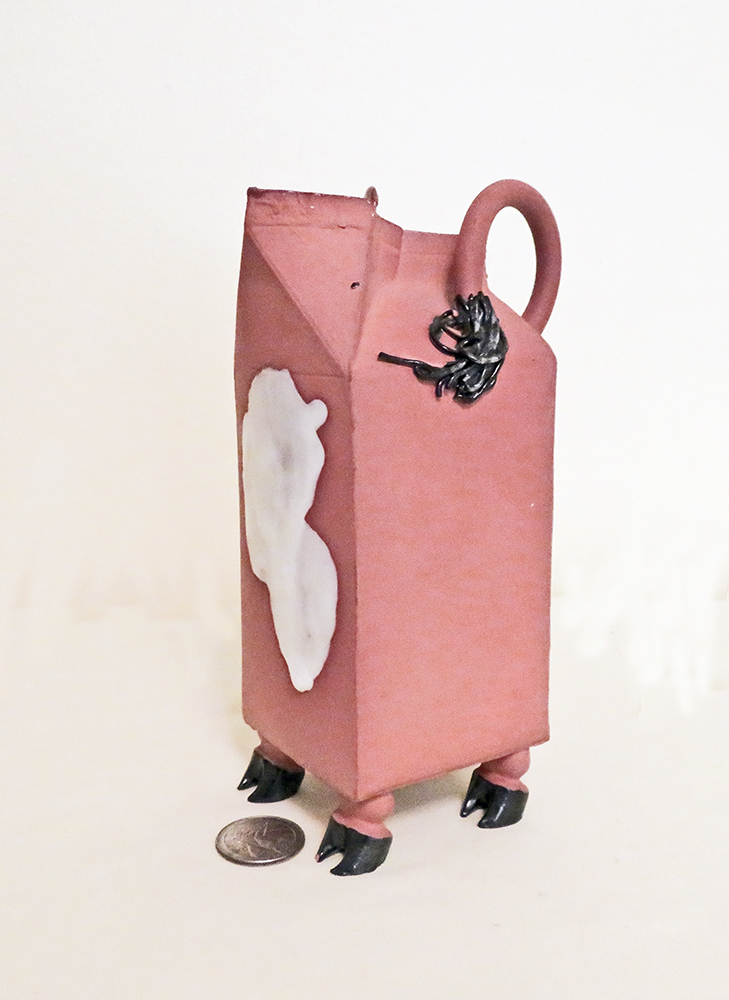
I’m not sure what to make of this one - big floppy hat, long eyelashes, red jacket and ‘hands’ to cheek as if to say ‘oh my!’…No marks, and the seller thought it may have been home-made but I have my doubts. |
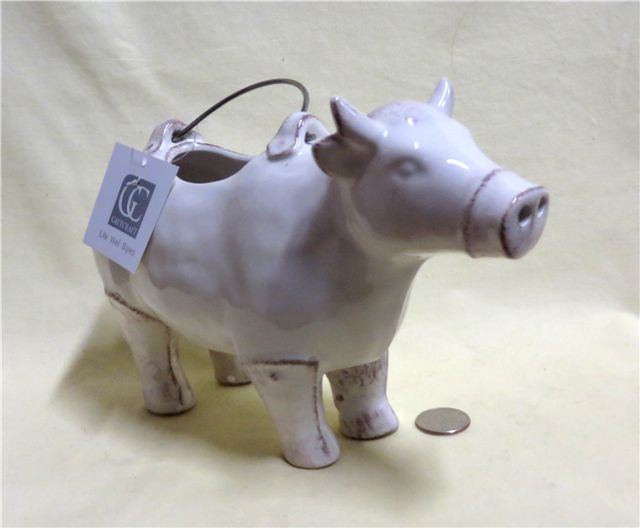 |
This large nicely molded cow is distinguished from many others by the two holes in the nose – must tickle, pouring milk through your nose. At any rate its tag says it is from “Giftcraft, Life Well Styled”, and was Made in China. I got it from Amazon - they have quite a number of cow creamers on offer, but this is the first that I have purchased from them. |
|
|
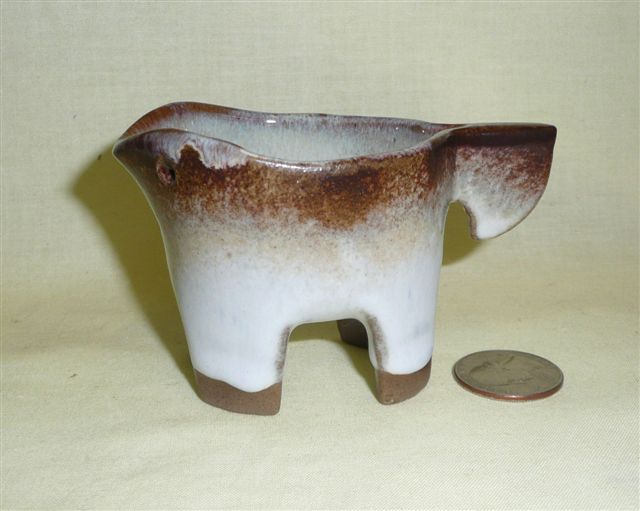 |
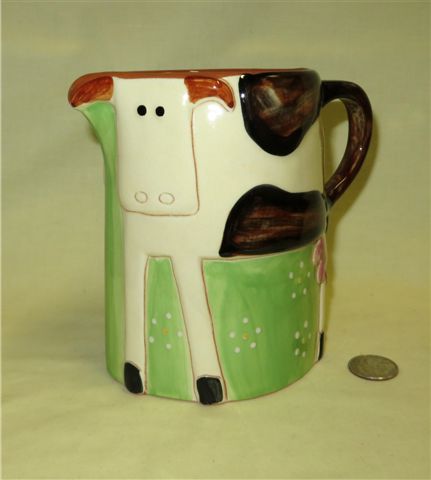
This little modern guy was also too cute to pass up. It comes from the Peter Pots Pottery, whose web site notes that they have been making stoneware in Rhode Island since 1948, and since 1954 have been located in the “historic Glen Rock Mill” in West Kingston. |
 |
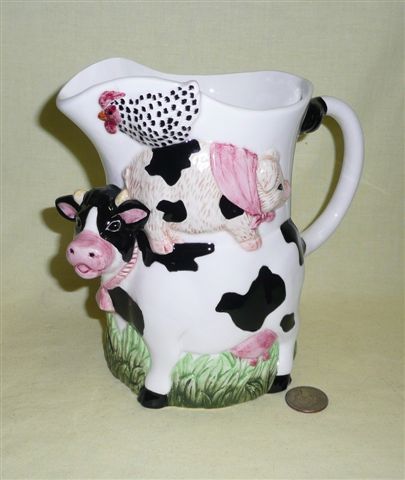
I debated about this one but finally decided to get it (from a seller in the UK) because it is a least partially cow shaped – the horns (there’s a similar cow on the other side) form the spout. . It’s marked for St. Michael, mold #2233. From Wikipedia I learned that the St Michael brand was introduced in 1928 to designate quality items made by the firm of N. Corah & Sons of Leicester and sold through Marks & Spenser. By 1950, Wikipedia notes, “virtually all goods in Marks & Spenser were sold under the St Michael brand”, which was used as a ‘quality guarantee’. In 2000, Marks & Spenser dropped the St Michael name in favor of their own brand. |
 |
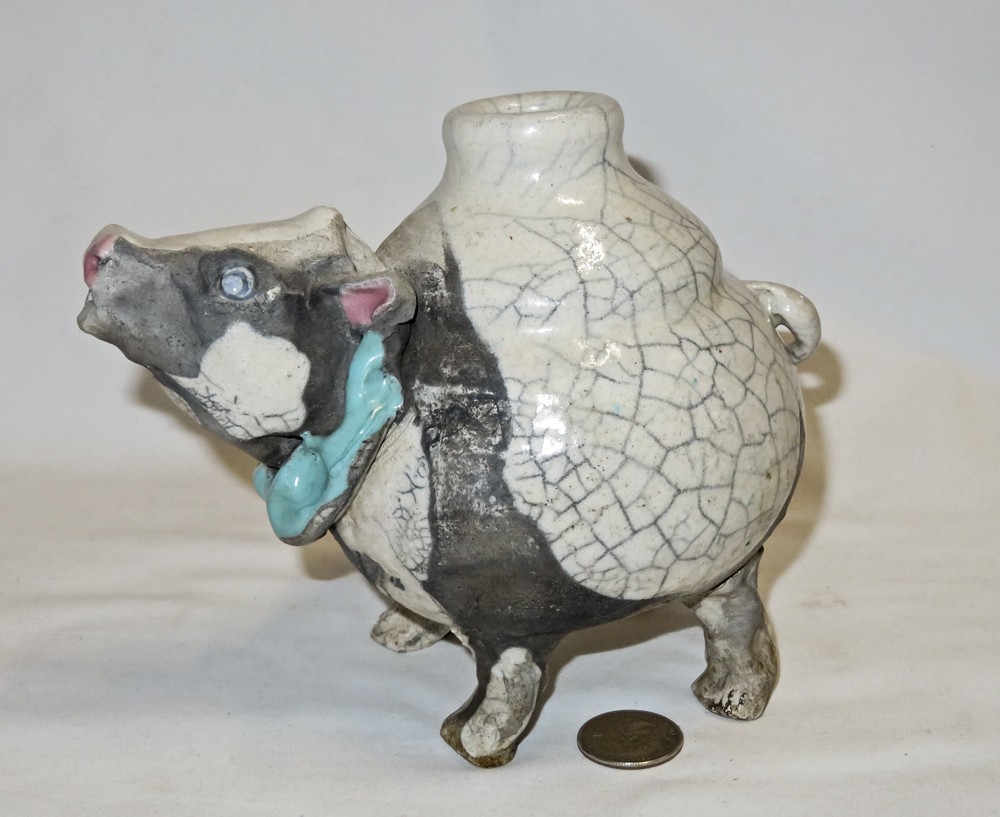
I debated about this one also, but the cow is sufficiently part of the shape that I guess it qualifies for the collection…it’s marked for “T-J-Maxx” which mostly does clothes, but I guess a few other things as well. |
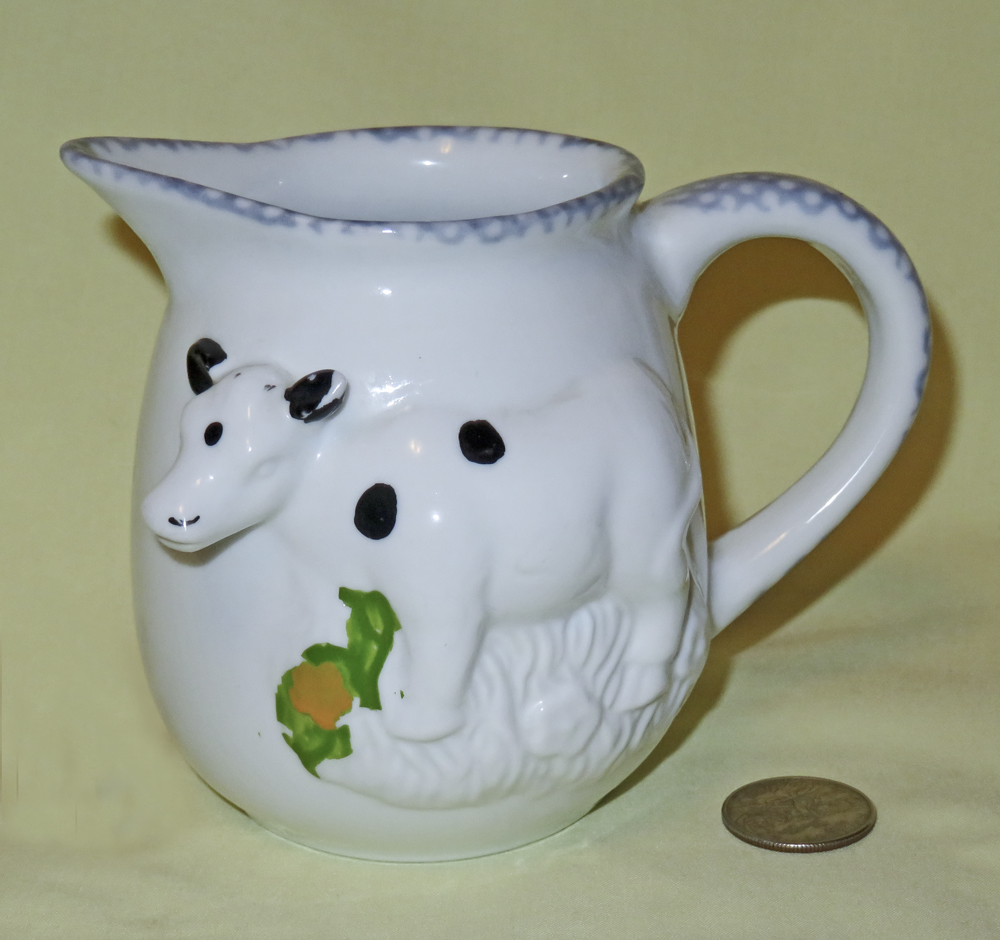 |
Here is another simple pitcher with a cow sticking out the side. It has a couple numbers on the base but nothing else. It has obviously been well used since a lot of the paint on the cow has been rubbed off. |
|
|
|
|
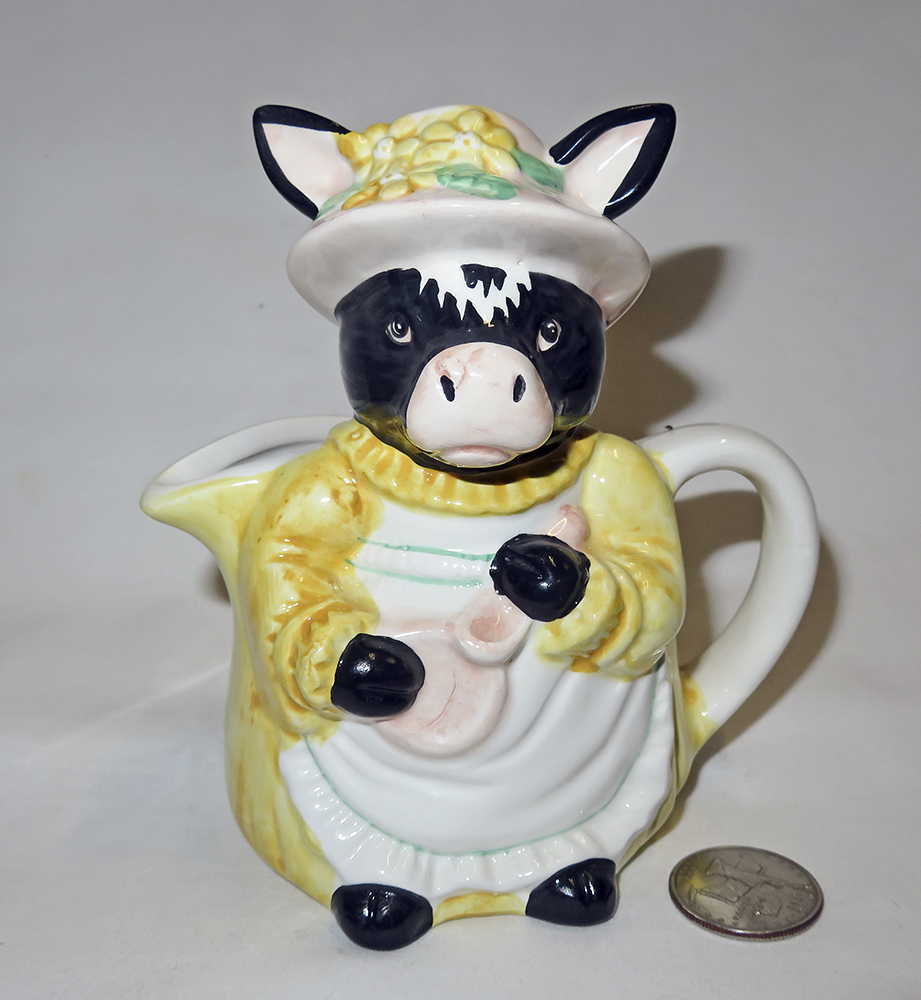
|
|
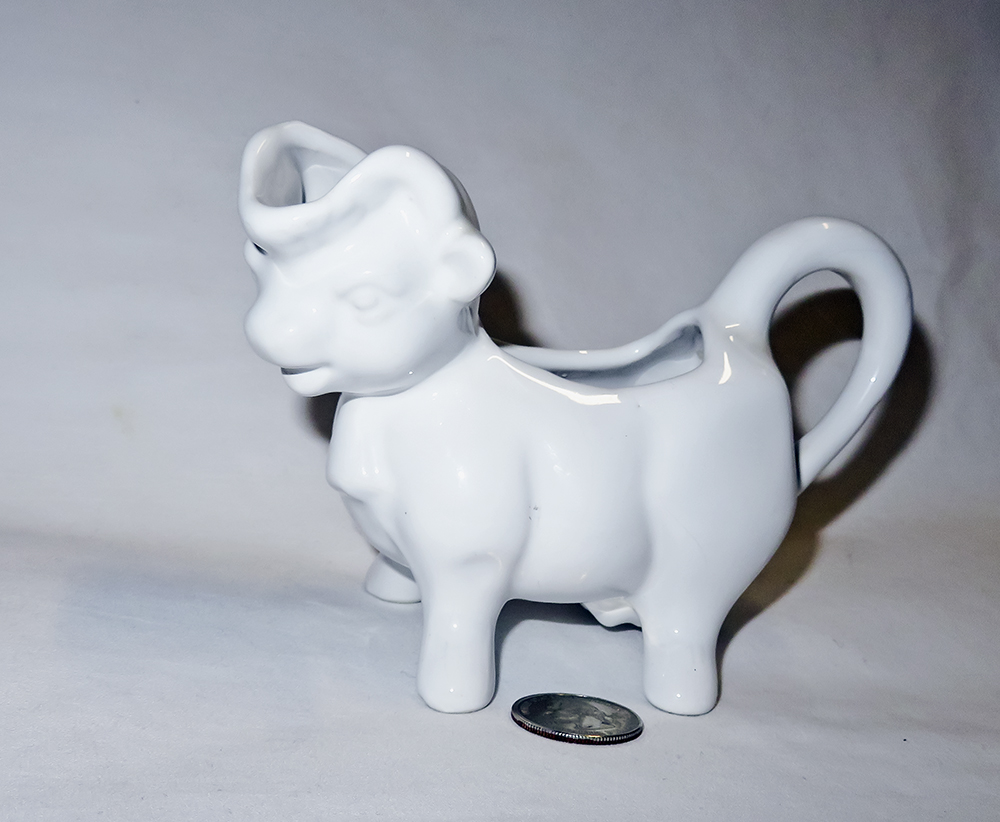 |
This plain white cow has a huge opening in her back which extends up to her forehead for pouring. There is a faint stamp on the bottom that reads "Made in Portugal"> |
|
|
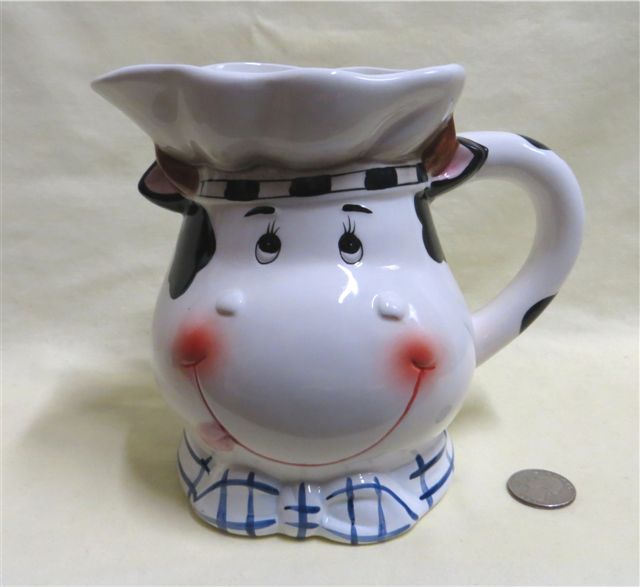 |
This smiling chef is big enough to hold almost a quart. I sometimes wonder why I buy these things! |
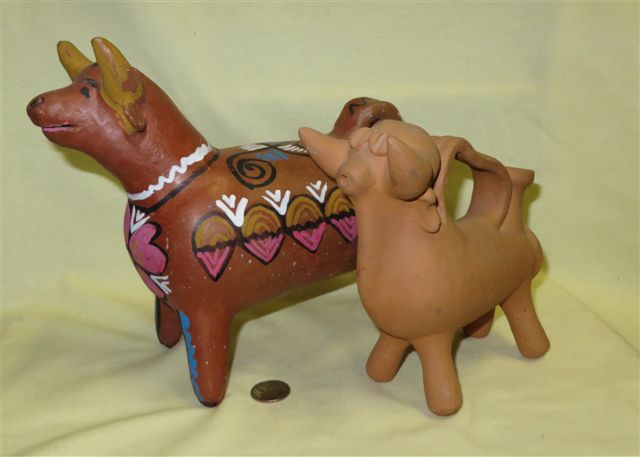 |
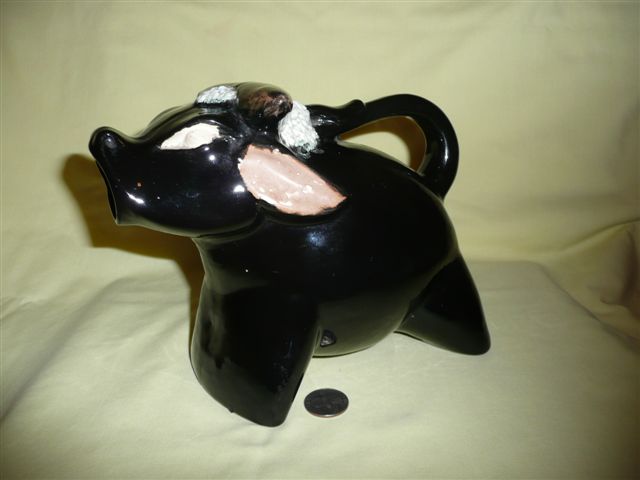
Here begins a series of clay wine (or perhaps just tourista catchers) jugs, some plain, some colored or glazed. I believe the larger one is from Mexico, and would appear to be simply a souvenir type jug. The smaller and very simple red clay one is a traditional 'Toro Iberico' or Iberian Bull from Cuenca in Spain. |
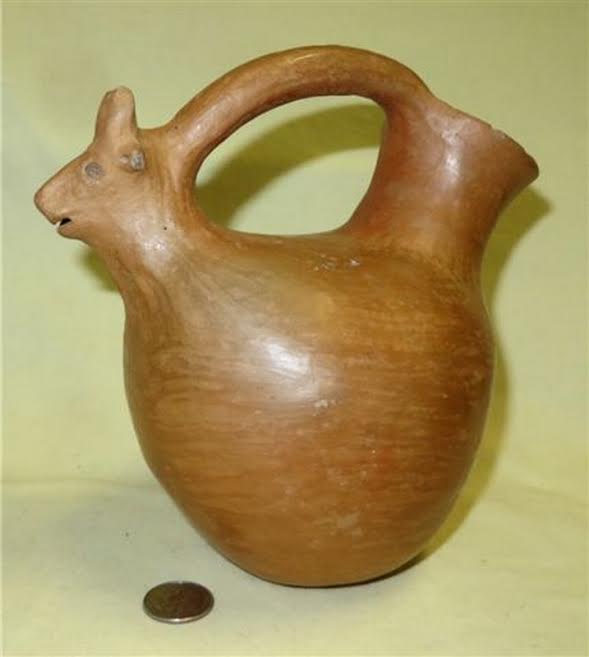 |
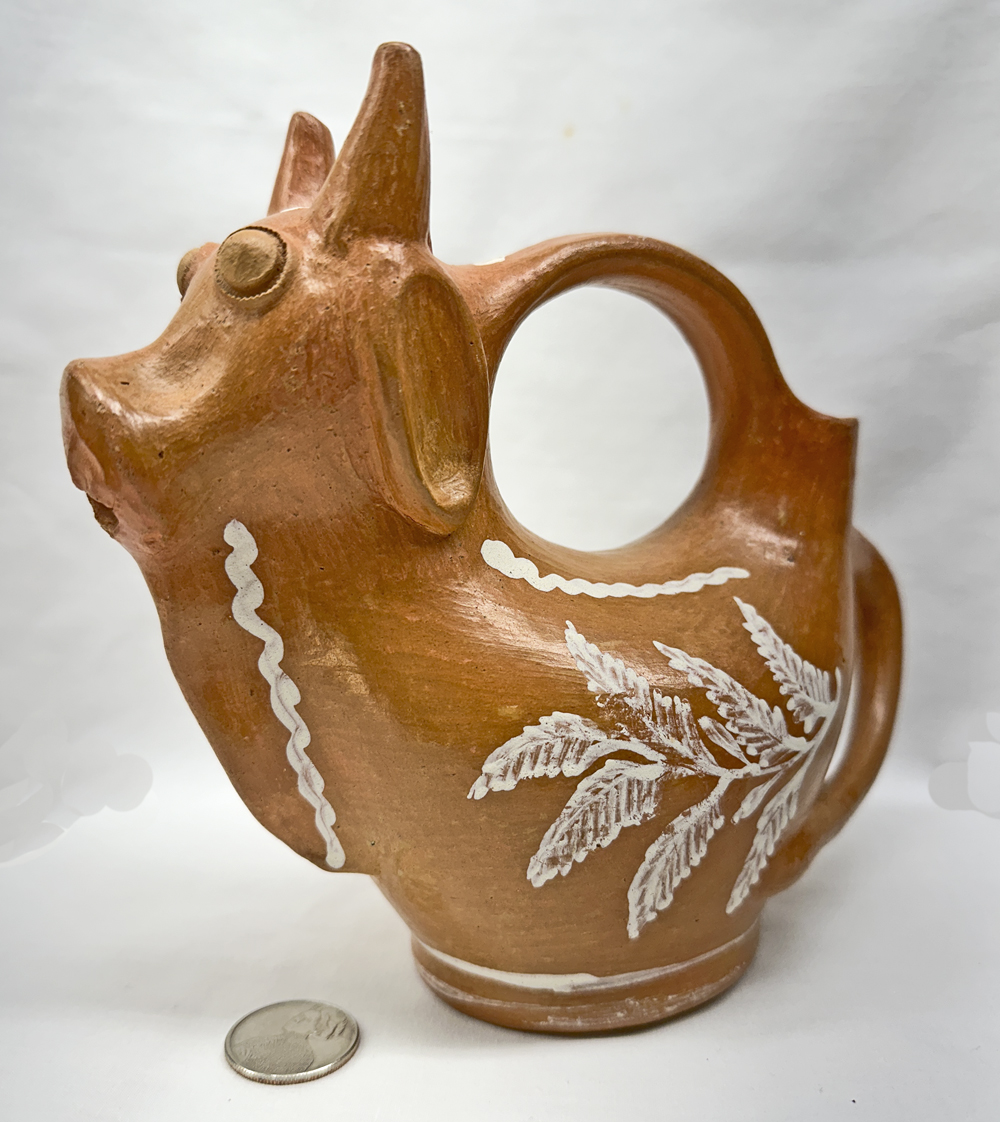
This is a simple utilitarian clay cow-headed jug that I believe most likely comes from either the US southwest, or Mexico. |
|
|
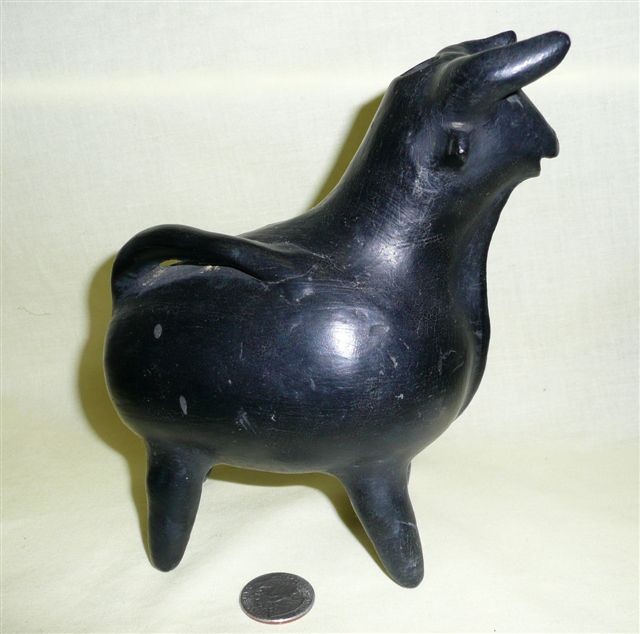 |
Not hard to tell where this little black clay cow came from – it has Mexico in large white letters on its tummy. |
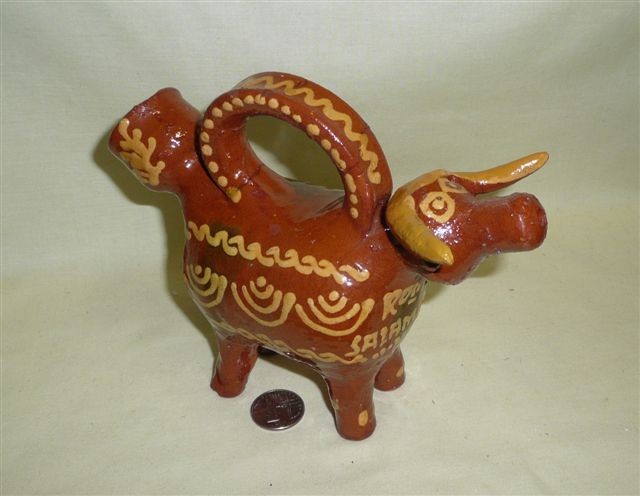 |
This unusually shaped, hard red clay cow or bull reads “Ron de Salamanca” on its chest. There are Salamancas in both Spain and Mexico, but given that this bull is made to tote Ron (rum), as well as its shape and coloration, I’m betting on the latter. And I’m guessing that the Ron was for drinking, not pouring on the ground. It nearly didn’t make it into the collection because it came with the handle badly broken in shipping (thus the eBay seller refunded the price), as well as a missing horn. Then I broke the other horn. But it was so unusual that I decided to see if I could patch it up, and here it is, looking not too bad at least from a distance. |
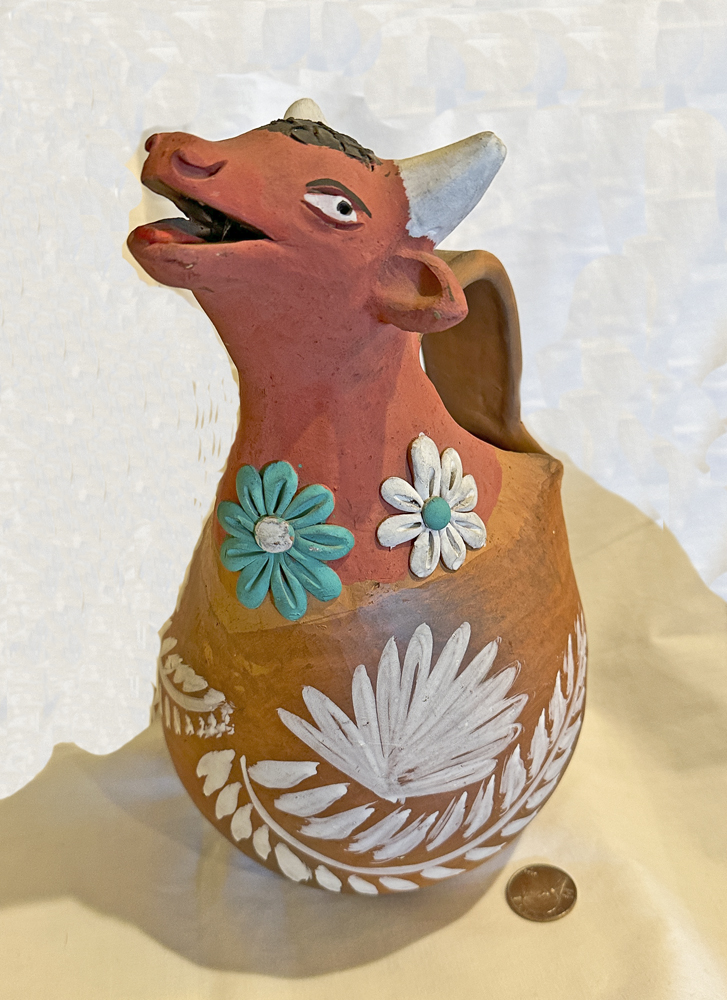 |
Happy happy, plus nice flowers. Mexican, and proud it' |
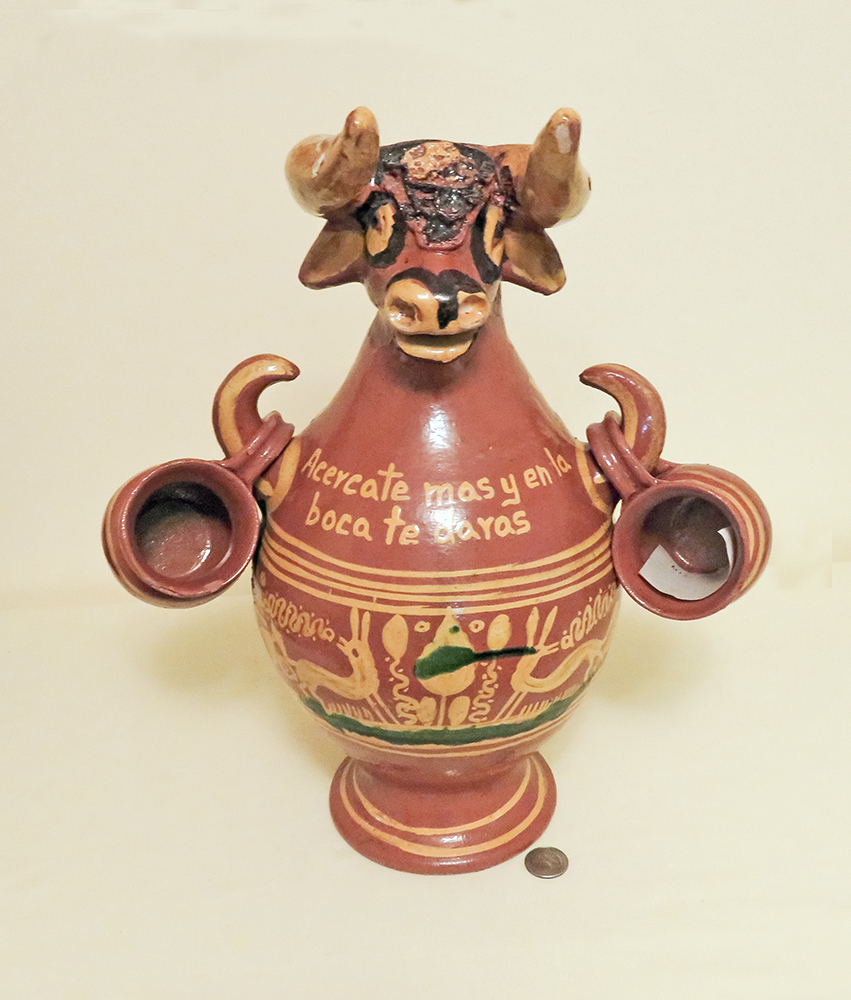 |
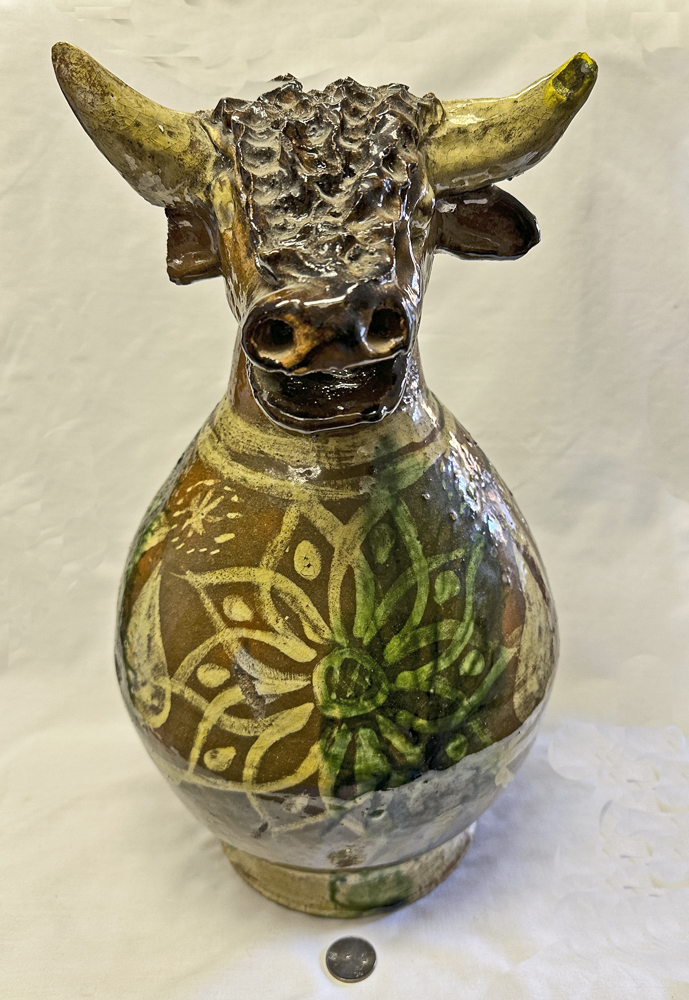
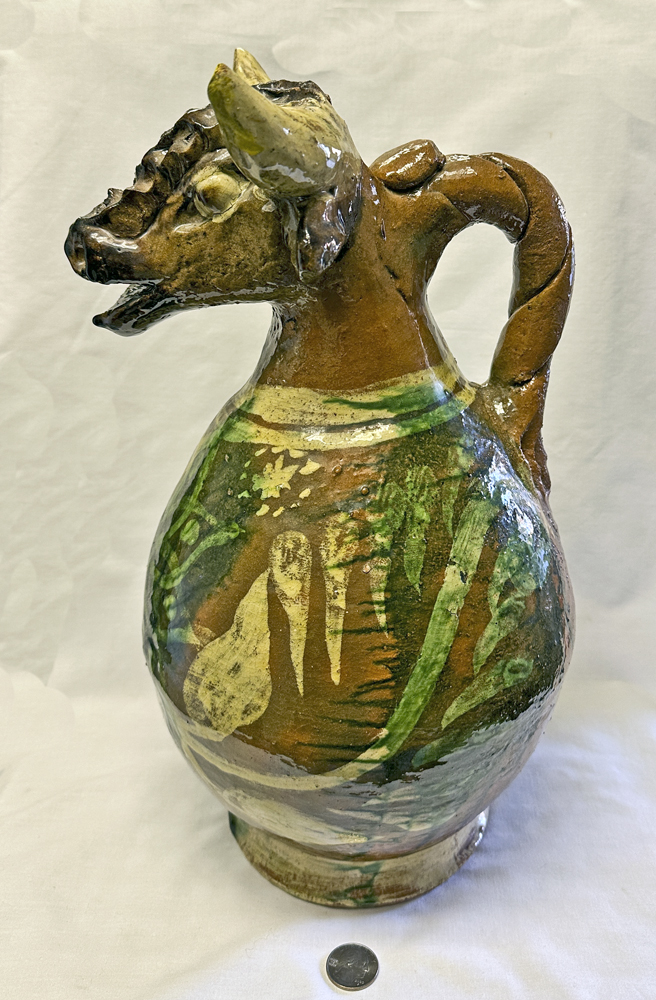
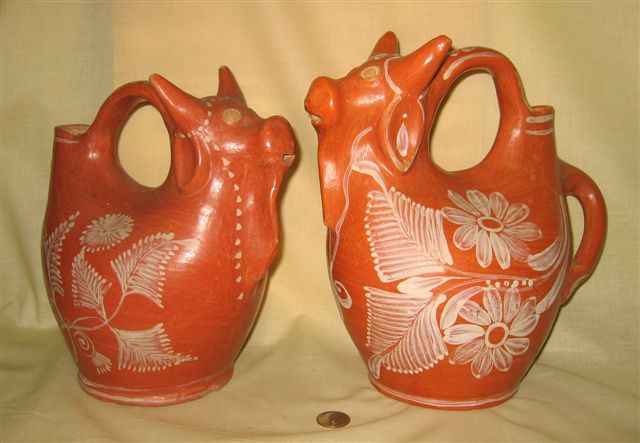
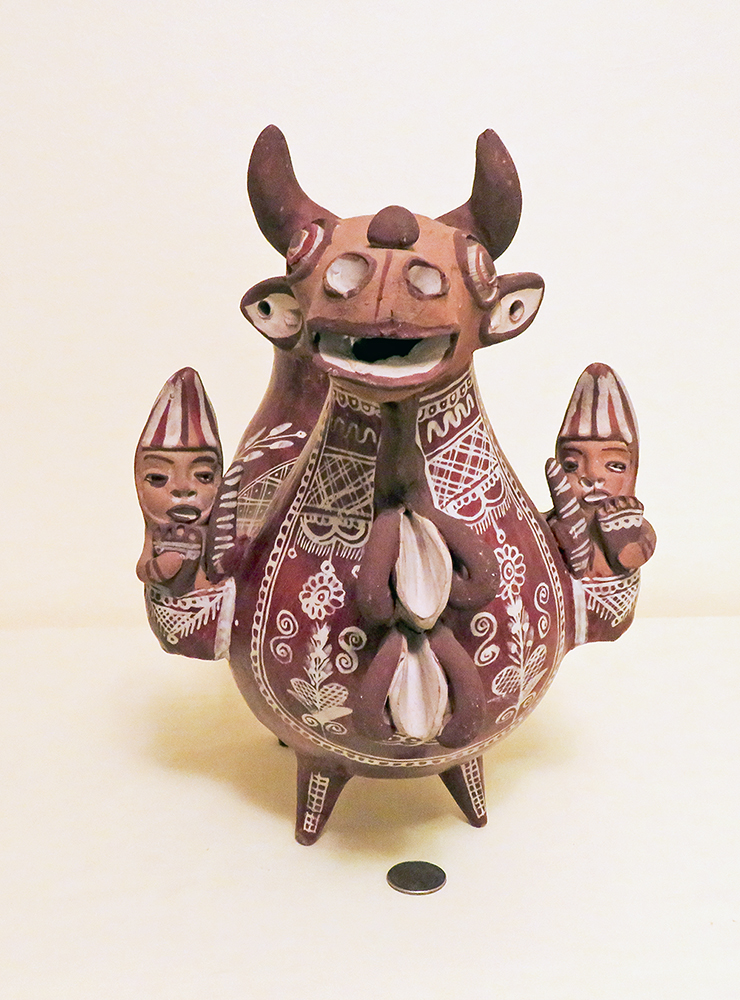
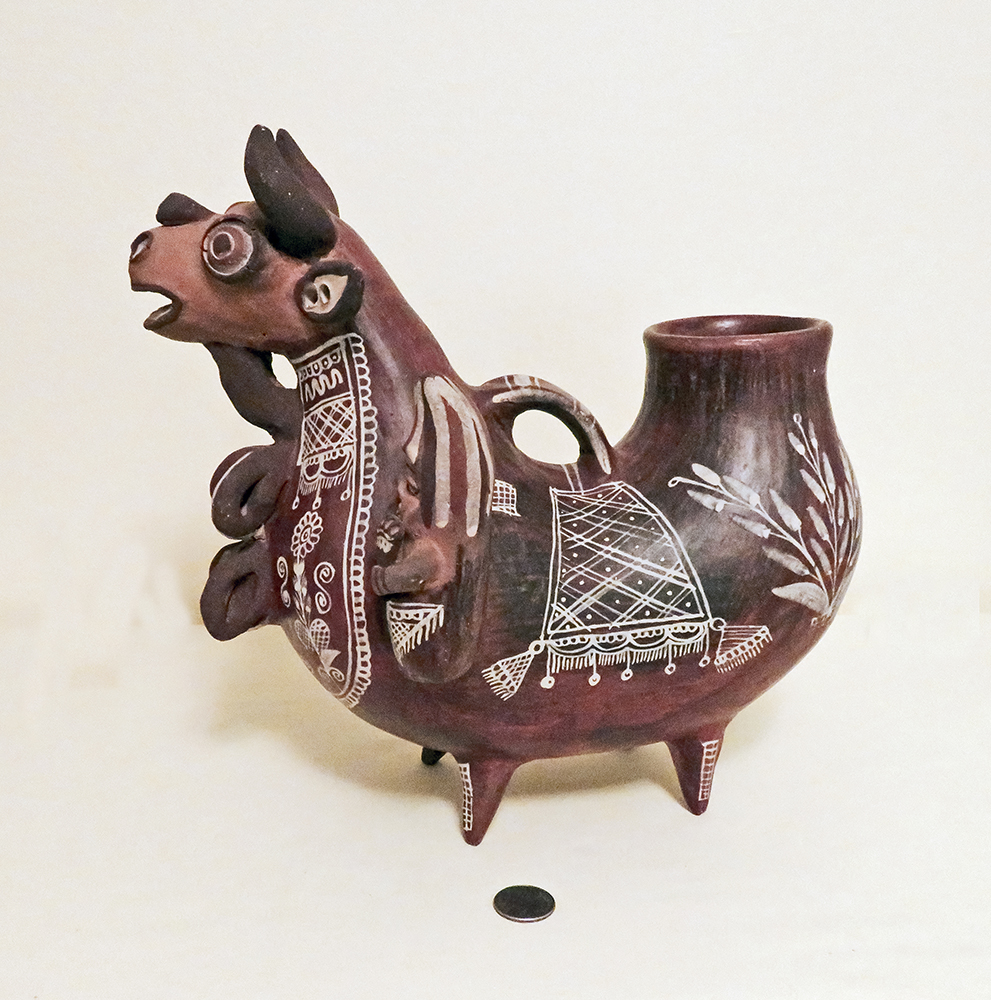
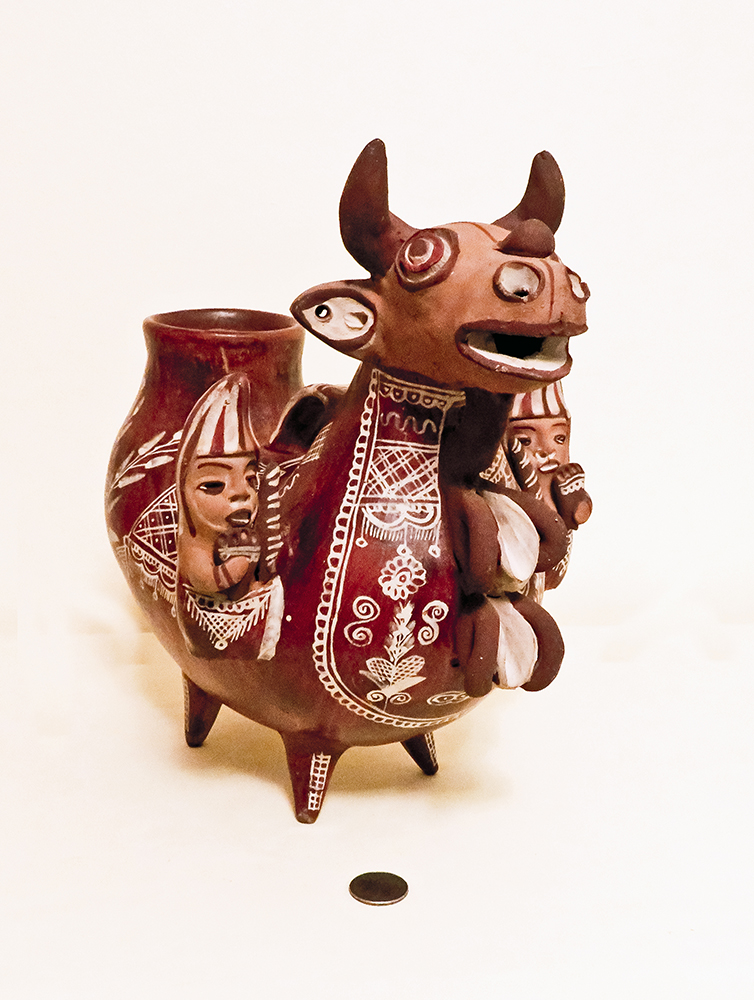
This extremely large and handsome bull with its own cups is also from Mexico. Its belly says "Acercate mas en en la boca te daros" which seems to translate as 'Come closer and in your mouth I will give you' which is a bit awkward but I get the gist.... |
>
|
|
>
|
|
|
|
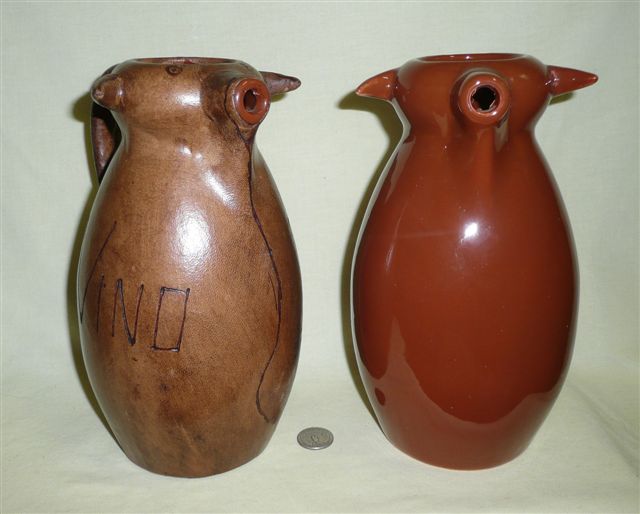
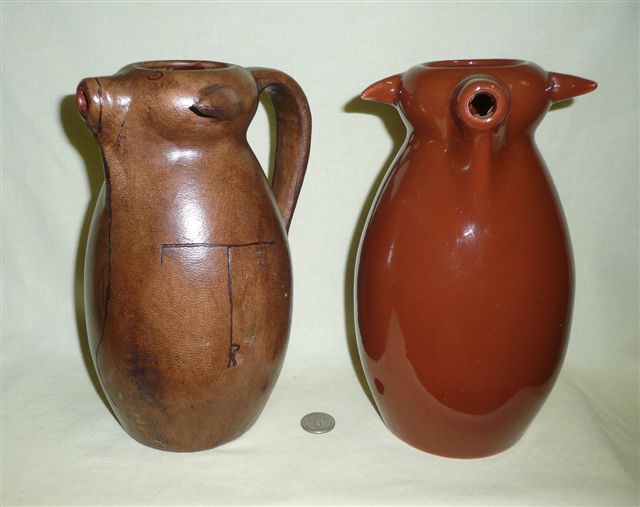
The plain brown bull pitcher here is unmarked. It’s companion, which has “VINO” embossed on its right side and a connected large T and small R on the left, is apparently the same ceramic pitcher, but beautifully wrapped in varnished goatskin parchment. The seller indicated that, although unmarked, it was most likely attributed to Aldo Tura, an Italian artist-craftsman-designer who began his furniture and decorative object business in the 1930’s (see www.tura.it). I’ve poked around a bit and found that Tura did indeed make quite a number of parchment-wrapped bar accessories as well as bars and other furniture, and some of the accessories seem to have been marked with a green label stuck to the bottom, which may have fallen off of this piece. If it is indeed a Tura then I got a heck of a bargain…and if not, at least I’ve now got a really classy goatskin-parchment wrapped vino jug. Update: Since I acquired the leather-wrapped bull I’ve seen several others on offer in various conditions and with different brands. One, in pretty tough shape, had a label that read “Artesania Raymon, Made in Spain, Ref 125”. I’ve not been able to find out anything about this company except that it’s in Valencia, and has made a variety of other leather-wrapped glass and pottery items. I think this attribution is more likely than Tura. |
|
|
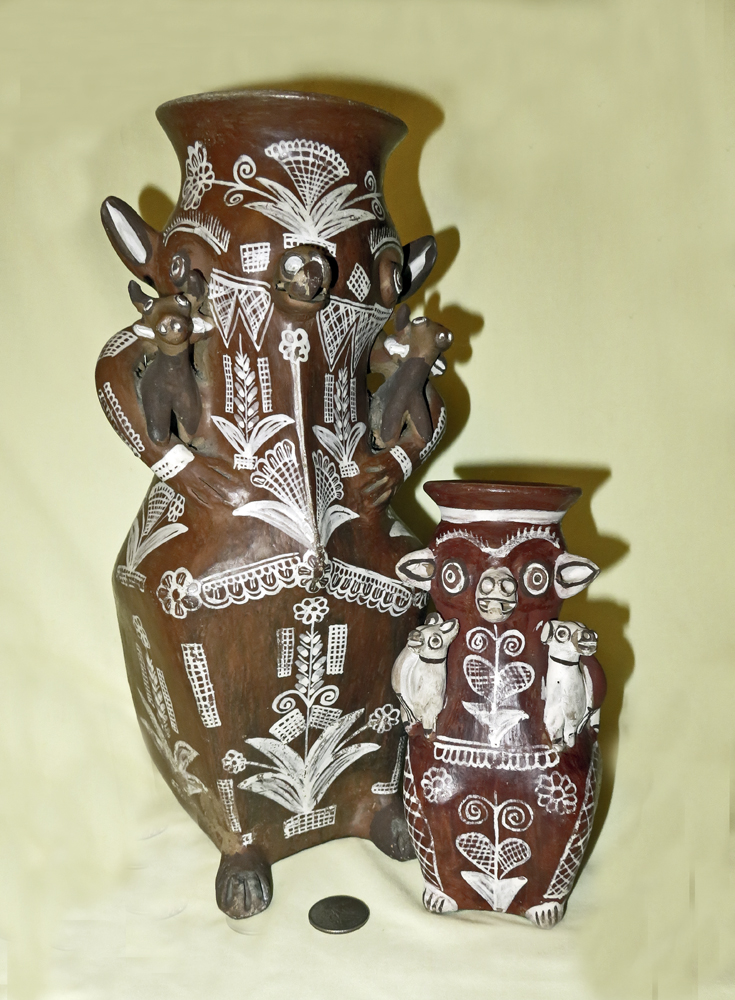 |
Instead of heads, these two rather strange cows (?) are carrying small cows in their arms. They are more like jugs than pitchers, but this seemed as good a spot as any for them. I didn't buy them as a pair, but they sure seem to be. |
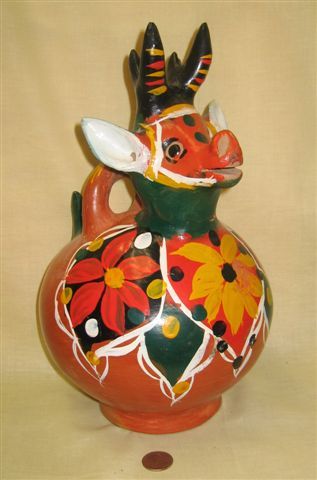 |
Cow? Bull? Devil? Heavens only knows, and I for sure should never have bought it but I wanted a closer look. It's here below the lovely Mexican and Peruvian jugs simply because it's nearly as large as them, albeit nowhere near as nice. |
|
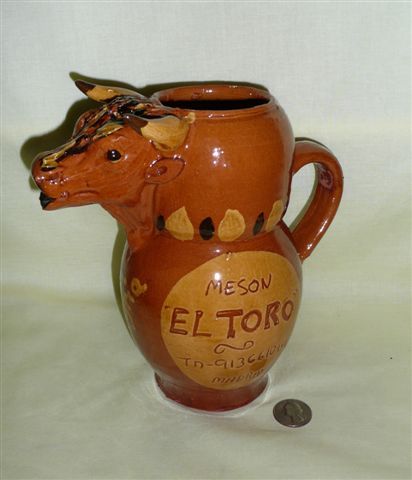
No need to guess what this one’s for, or where it’s from: “Sangria” is clearly inscribed on the front, and “El Toro, Madrid” on the side. |
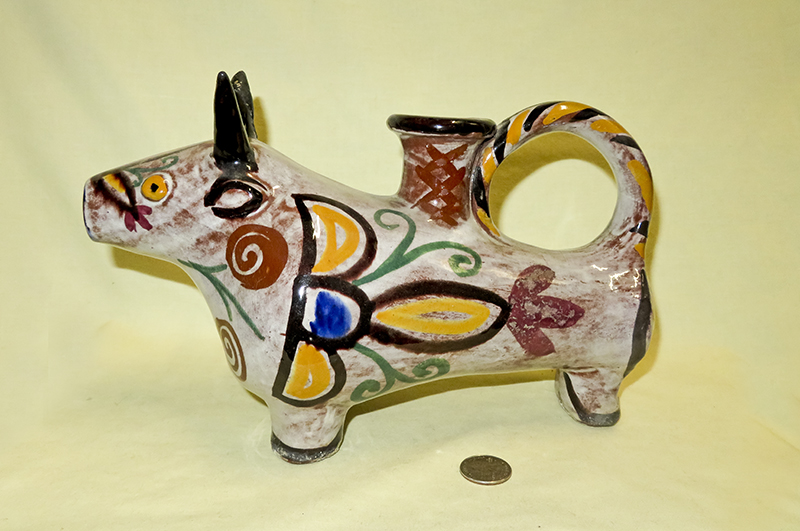 |
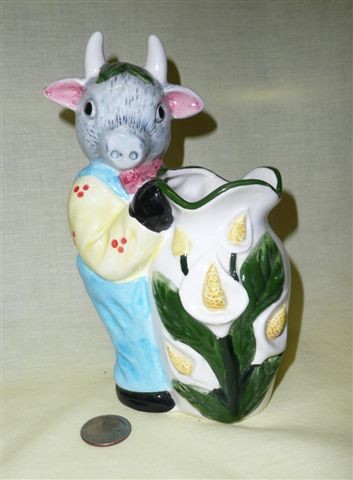
To close out this short sequence, here is a brightly colored one that I got from the UK. Some Brit must have taken a trip and brought back a souvenir. |
 |
This one is more than a bit odd for the collection, but we like to buy at least one cow creamer in every country we visit. A while back we went to Costa Rica for a couple weeks of birding, and this was the only cow we found, in a ‘porcellan’ shop in San Jose that specializes in peddling oriental gee-gaws to the Ticos. |
|
|
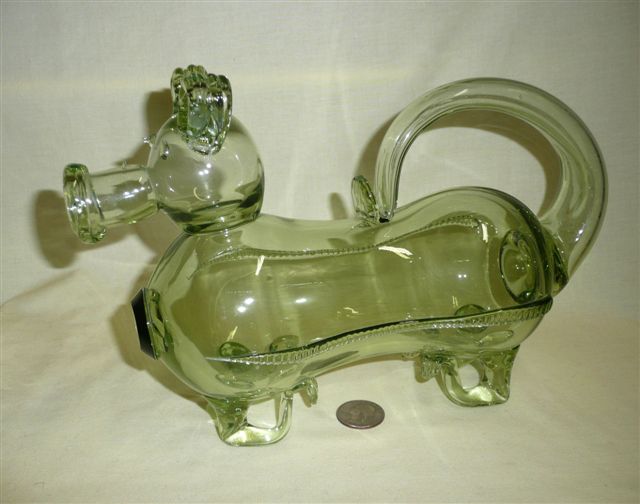 |
Speaking of odd, this is a blown glass liquid holder – the seller said either a dog or a cow, so naturally I assumed it was the latter although I do harbor some serious doubts. It probably came with a cork and metal stopper in the snout. The attribution is possibly to Orrefors Kosta Borda AB, a Swedish utility and art glass company that has a history dating back to 1742 (and since 2005 has been part of the New Wave Group), but more likely (from what I can find on the web) to John Erik Hugo Gehlin (1889-1953) a Swedish glass artist and designer at Gulla Skrufs glassworks which was in production from 1893 to 1995 and was once owned by Orrefors. One way or the other, it for sure seems to be Swedish. |
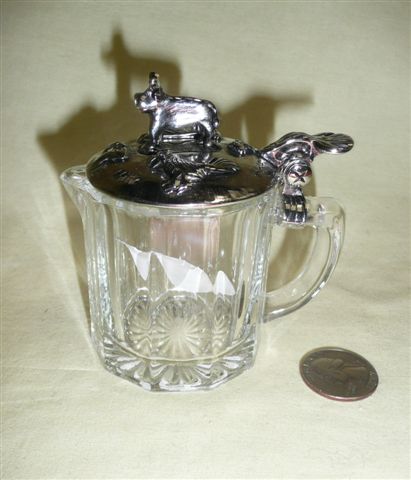 |
This little pressed glass creamer also violates my rules but it does have a nice metal cow (as well as four birds and “cream half milk half”) on the lid, and I justified buying it because it’s small and much more likely to see daily use than any of the others, if only because my wife likes it. |