Advertising and Souvenirs
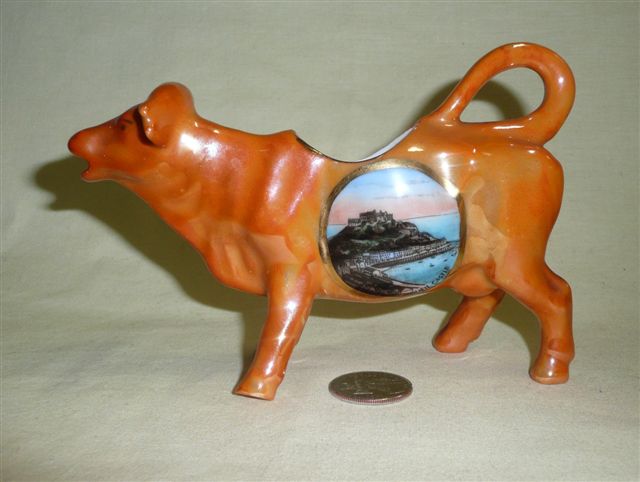
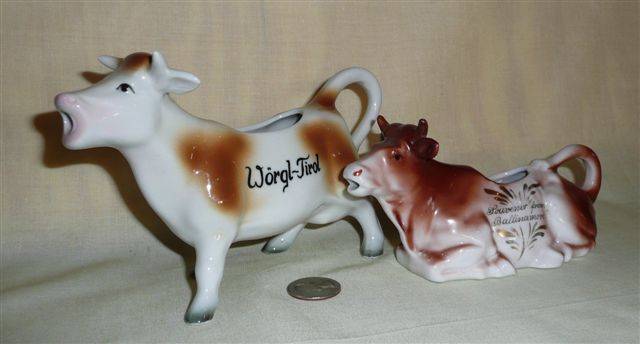
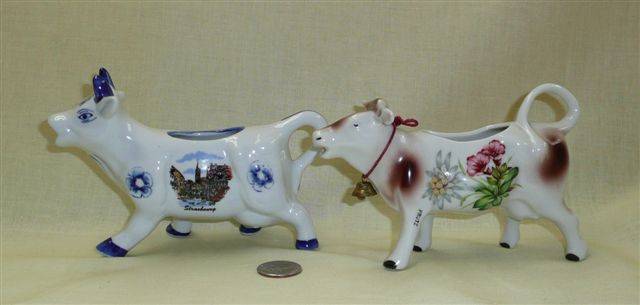
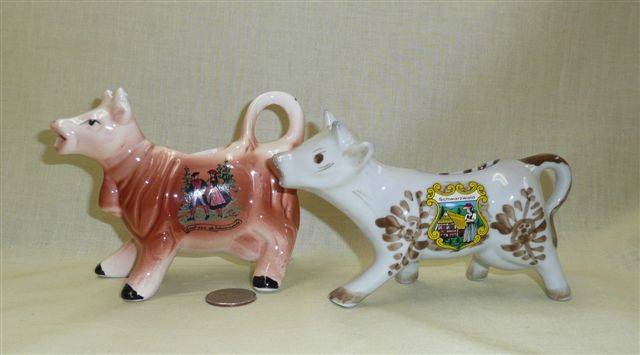
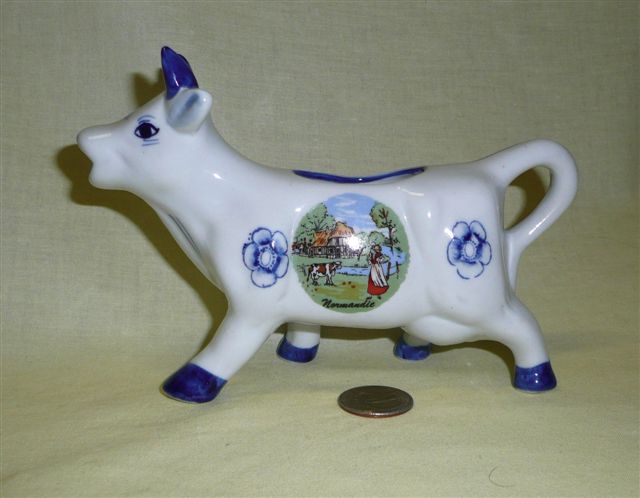
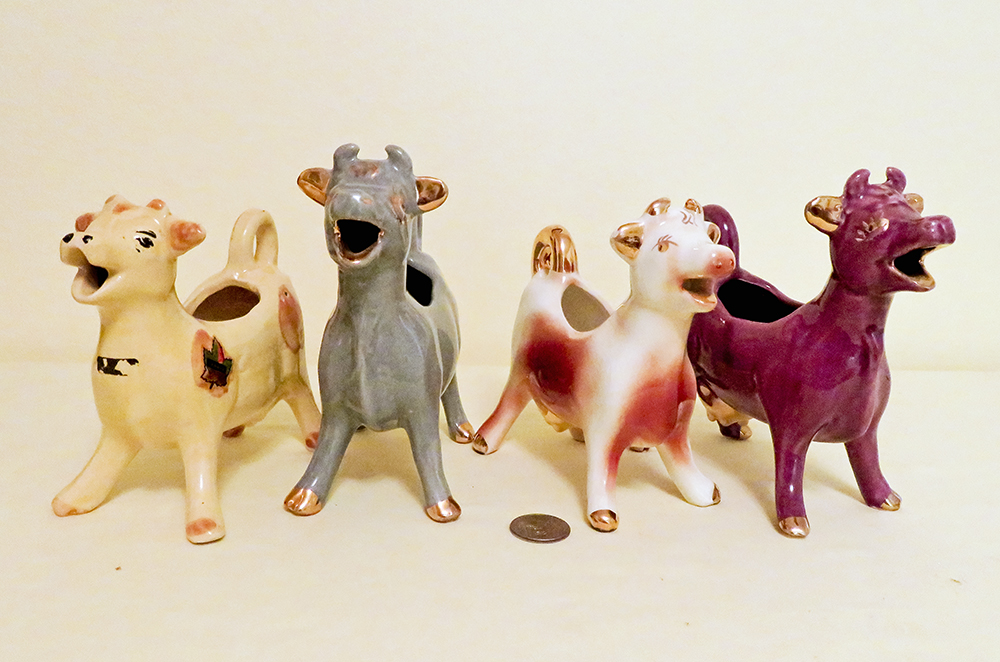
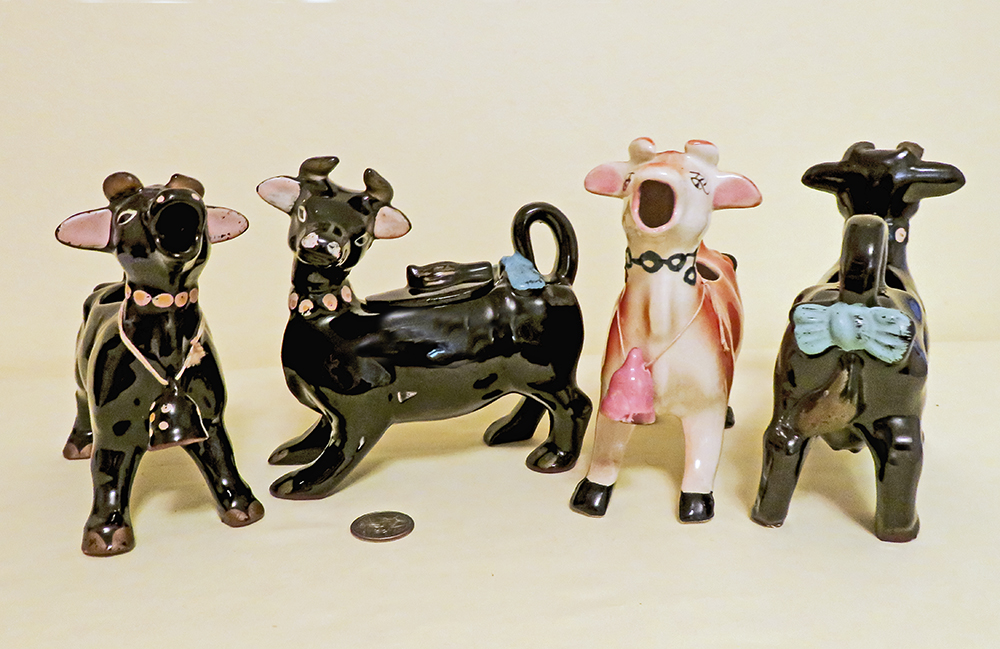
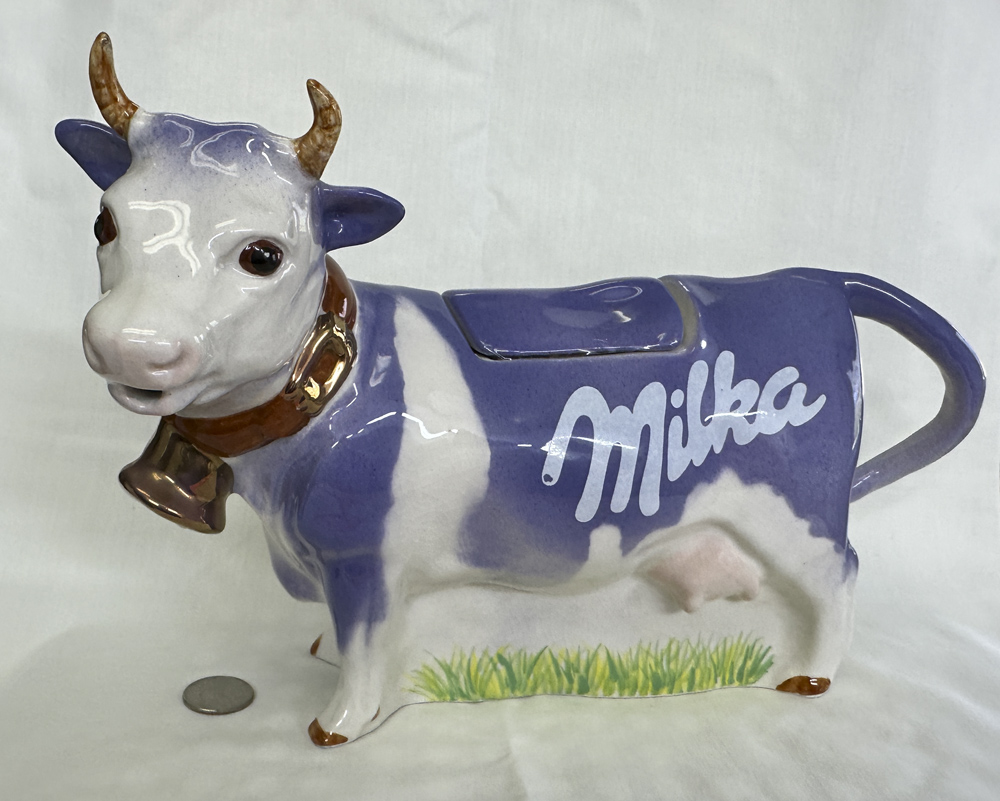
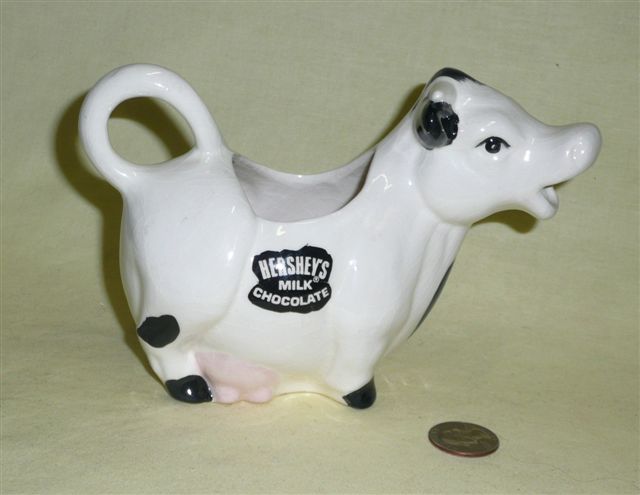
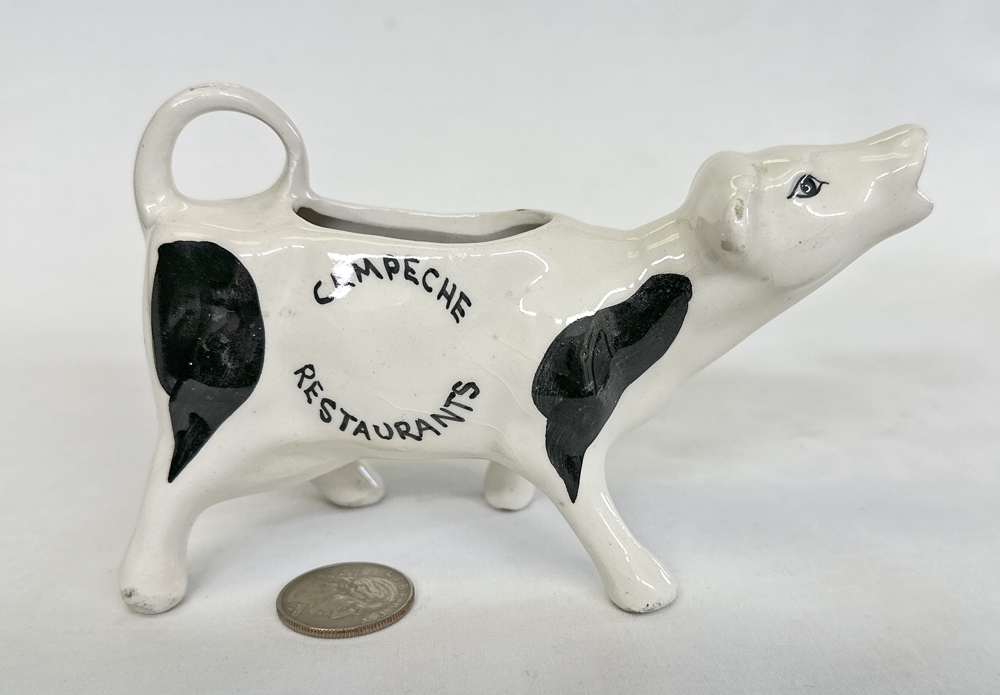
These two categories overlap quite a bit, so it made sense to me to display them together although there are some features that could be used to differentiate them. At one end of the spectrum there are cow creamers that represent a cow or milk product or place. The most famous of these (at least in the US) is Borden’s Elsie. Other examples include the many cow creamers from places like Jersey or Guernsey that are famous for their eponymous breeds. At the other end of the spectrum there are cow creamers that simply served as inexpensive remembrances of a place someone visited, e.g. Niagara Falls (No cows last time I visited – but they did have a variety of pigs. Tastes change I guess.). Then there are mixtures such as the plastic Whirley Moo-Cow creamers that were sold in the millions through restaurants and usually bore words or pictures, sometimes both, some with advertisements and some with sayings or place names. Another type of overlap is found in the rather lovely porcelain creamers (mostly German and French) that date from Victorian days through about the 1930s.While these were usually bought as keepsakes of a pleasant holiday they also served to advertise the beauties of various cities and resorts.
Let’s start this page with Elsie, who was created as a cartoon mascot to symbolize the quality of Borden’s
products in 1936. She was an immediate hit, and Borden and their follow-on companies have stuck with her.
Following their popular exhibit at the New York World’s Fair in 1939, where they had several live cows,
Borden decided to select one to satisfy children who wanted to know which one was the REAL Elsie. The
one they picked from their herd was a Jersey originally named “You’ll Do Lobelia”, and she became a
national favorite. Borden produced a number of creamers and pitchers of Elsie (along with many other
advertising products) - as well as of her husband Elmer (of glue fame), who in the head-only versions
accompanied her as a sugar bowl. While I have been unable to determine when Borden started making and
selling these creamers, I suspect it was soon after the World’s Fair, say the very early 1940s. As shown
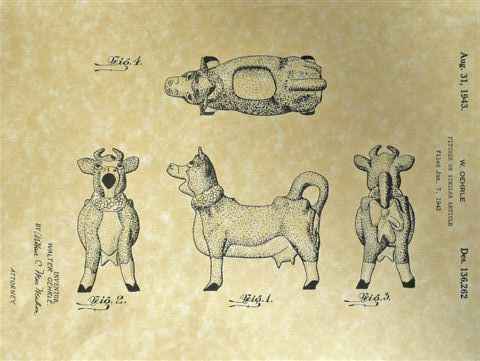
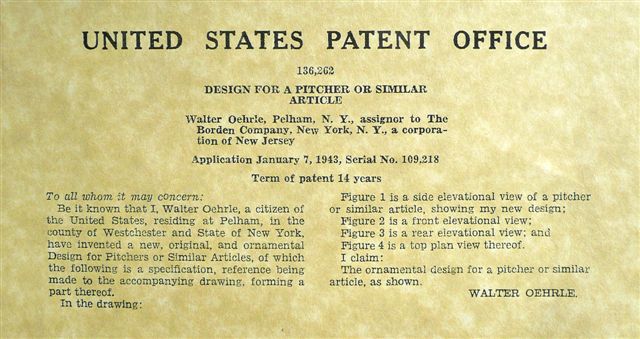
below, the ‘designer’ of the original full-body version applied for a patent in January 1943. That patent
didn’t seem to bother the imitators however, and ever since there have been innumerable ‘look-alikes’ or
knock-off Elsies, some but not all of which bear a striking resemblance to the ‘official’ versions.
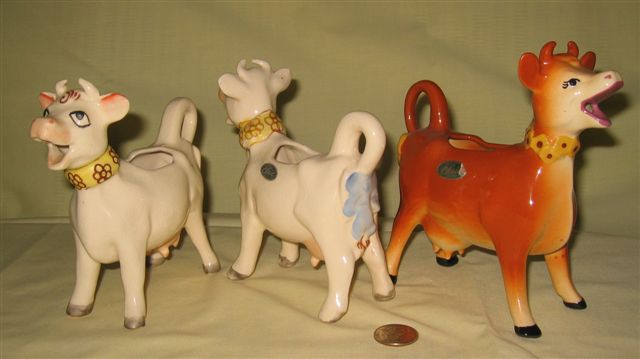 |
Here are two ‘official’ versions of Elsie (back as well as front of the white one to show off her pretty blue bow), bearing both a sticker with her name, and a Borden’s copyright stamp… |
|
|
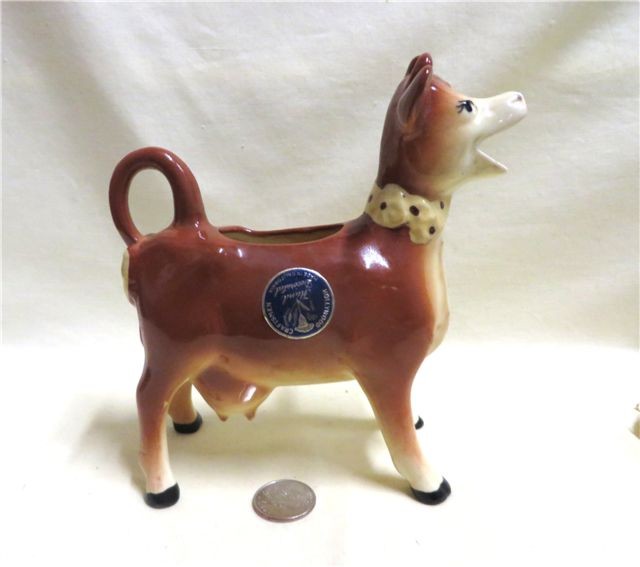
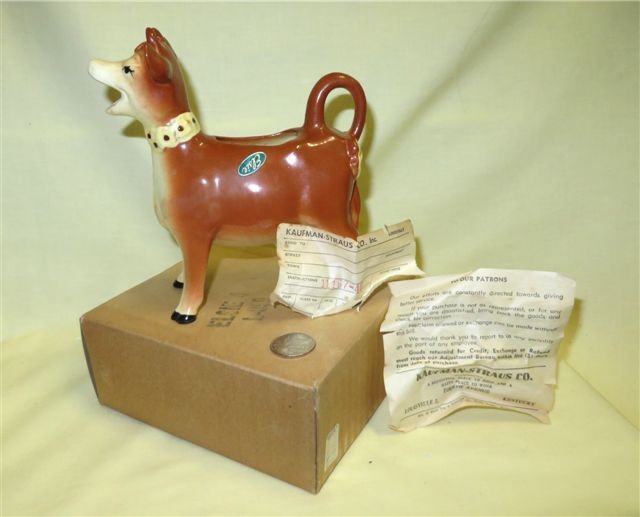
…and here’s what makes them “official” – a copy of the design patent issued to Walter Oehrle as assignor to Borden, in 1943…I can’t find much about Mr Oehrle (pronounced ‘Early’) on the web, except that he was a quite well known ‘cartoon’ artist, who in the 1920s and 30s produced images of bears for Union Pacific, as well as some paintings that were rendered into woodcuts, and then into cut glass, that hung in the Bear Pit Lounge and dining room of Yellowstone’s Old Faithful Inn. .. |
|
|
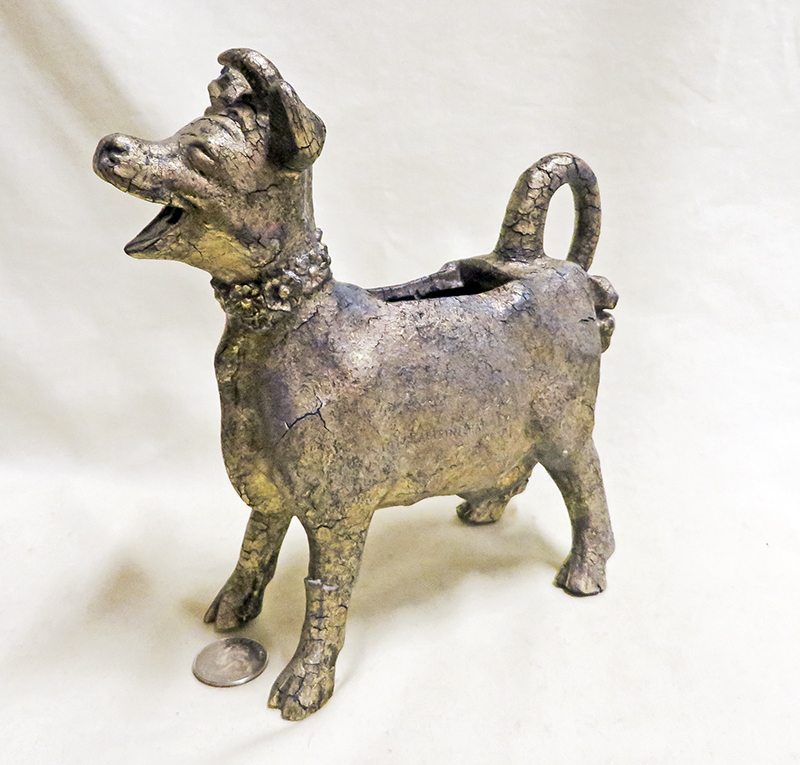 |
This pot-metal version of Elsie in the ‘official’ shape came from Borden’s exhibit at the “1947 Eastern State’s Exposition” in West Springfield, MA (the first after the end of WWII). I know that for a fact because it’s impressed into her left side, below a script “Howdy”, a line that’s indecipherable, and Elsie’s ‘signature’. This poor Elsie is in very sad shape – she’s badly pitted, cracked, and eroded, is missing part of her right horn, and on the way to me had three of her legs broken off. She was so badly damaged in shipping that the seller kindly refunded my purchase price, but before dispatching her to her final pasture I managed to patch her up just well enough to take this picture. I’d really like to acquire a better version of this cow but because of the very low quality of the post-war metal I expect that most of them, like this one, have fared poorly over the years. At the very least I’d sure like to learn what the illegible line of script on her side says – so if anyone out there has one that’s readable, please let me know. |
|
|
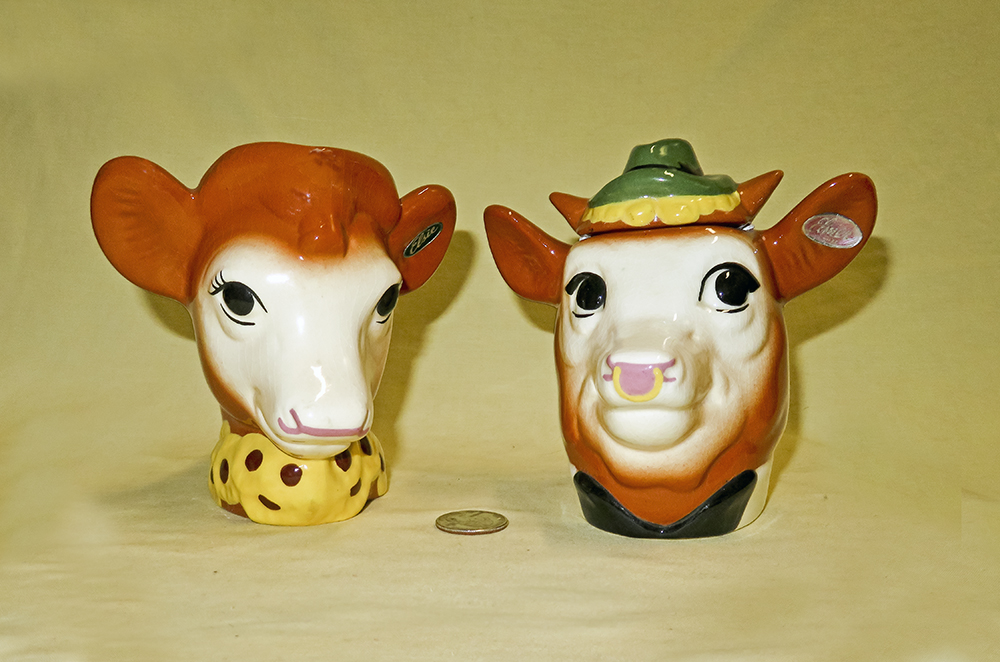 |
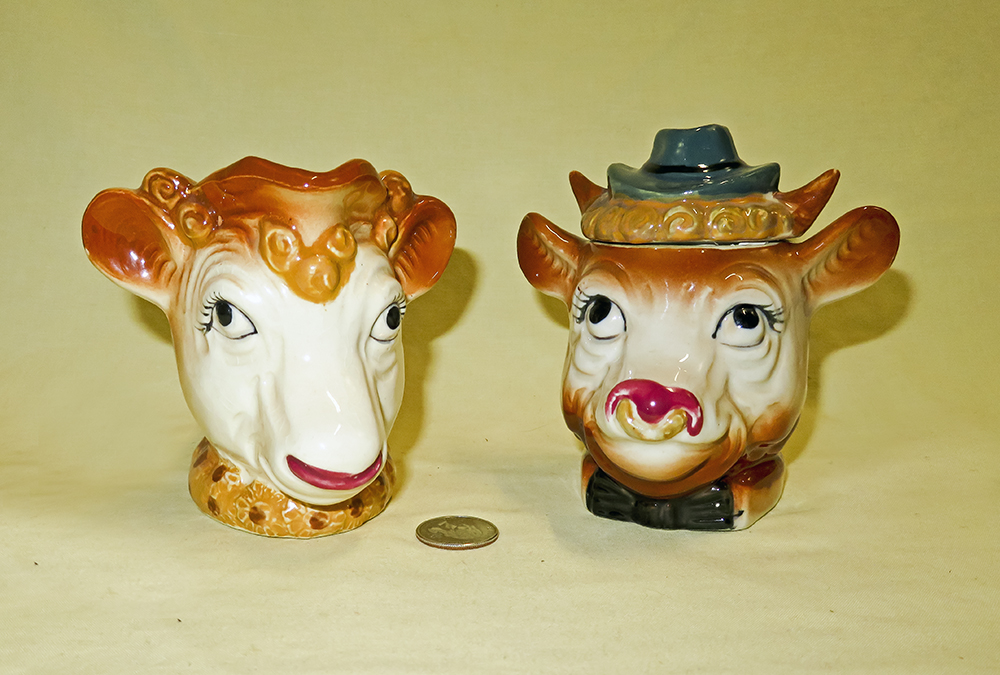
Here is Borden’s pitcher version of an Elsie head creamer, with Elmer as the sugar bowl. These two retain the original stickers in their ears. Elsie comes in a variety of colors and sizes, but this seems to be one of the 'classic' or 'official' versions. |
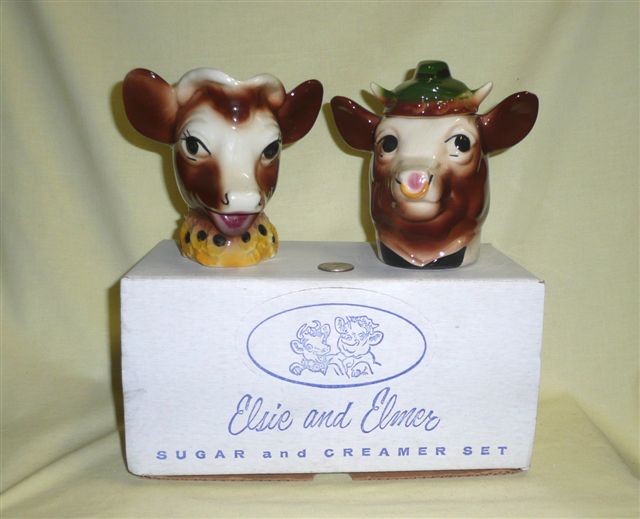 |
Here’s a mint set of what I assume to be a second ceramic ‘official’ version, in their original box. In this version Elsie has her mouth open, Elmer;s haT is a bit different, and they are somewhat darker. |
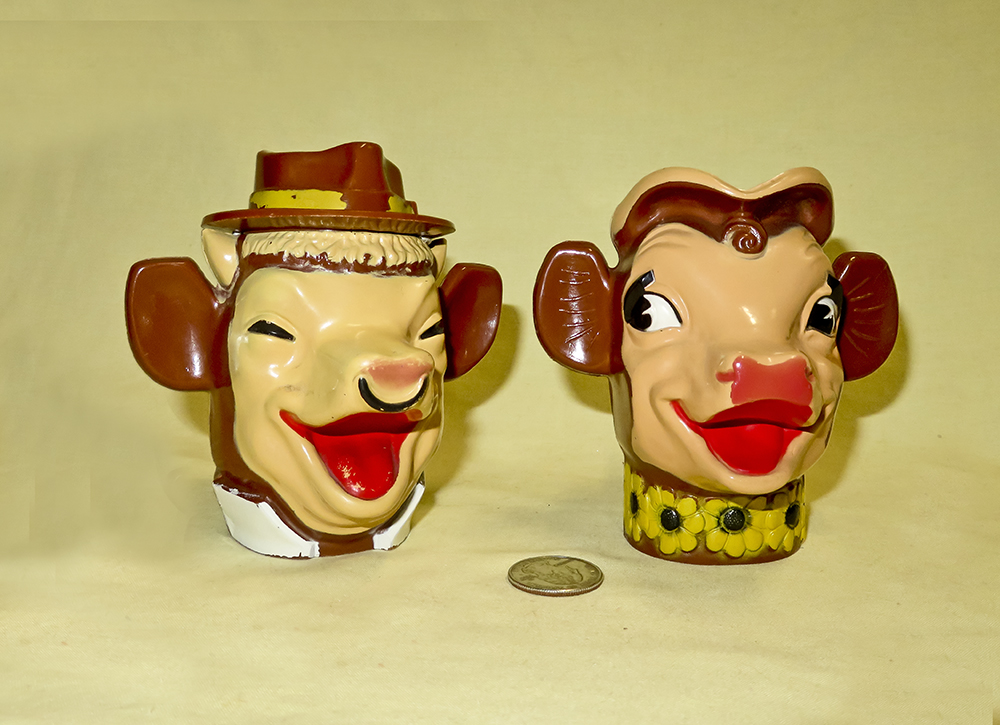 |
Borden's also made a plastic version of the Elsie and Elmer sugar and creamer set. This makes a lot of sense if you intend to allow your kids use it for their breakfast. |
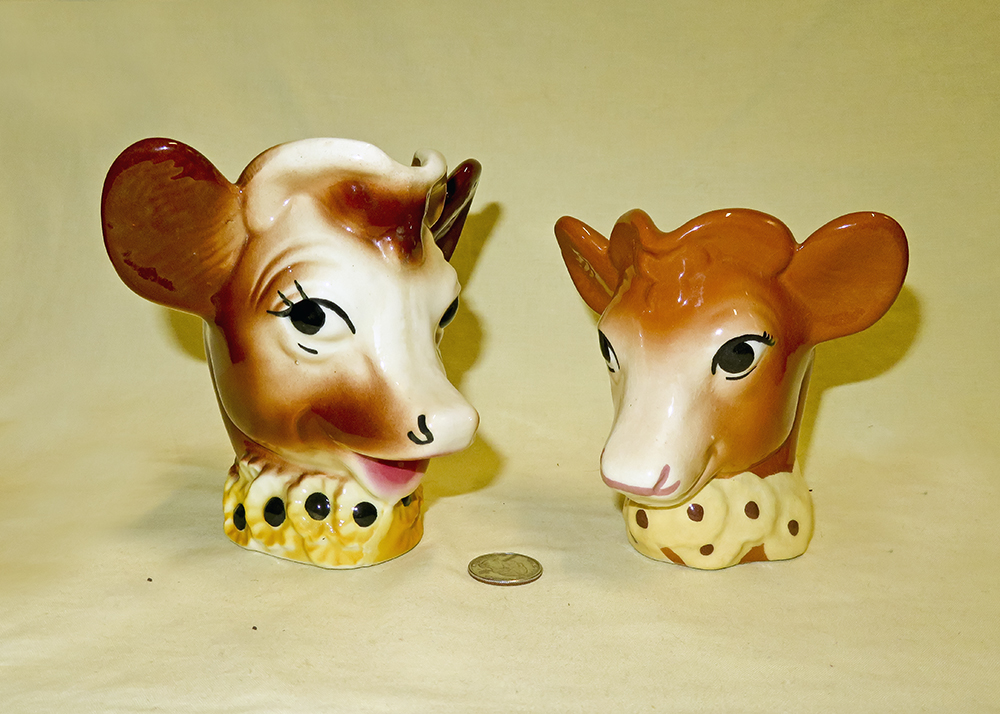 |
Here's an example of different sizes of Elsie - one smiling and one demure. |
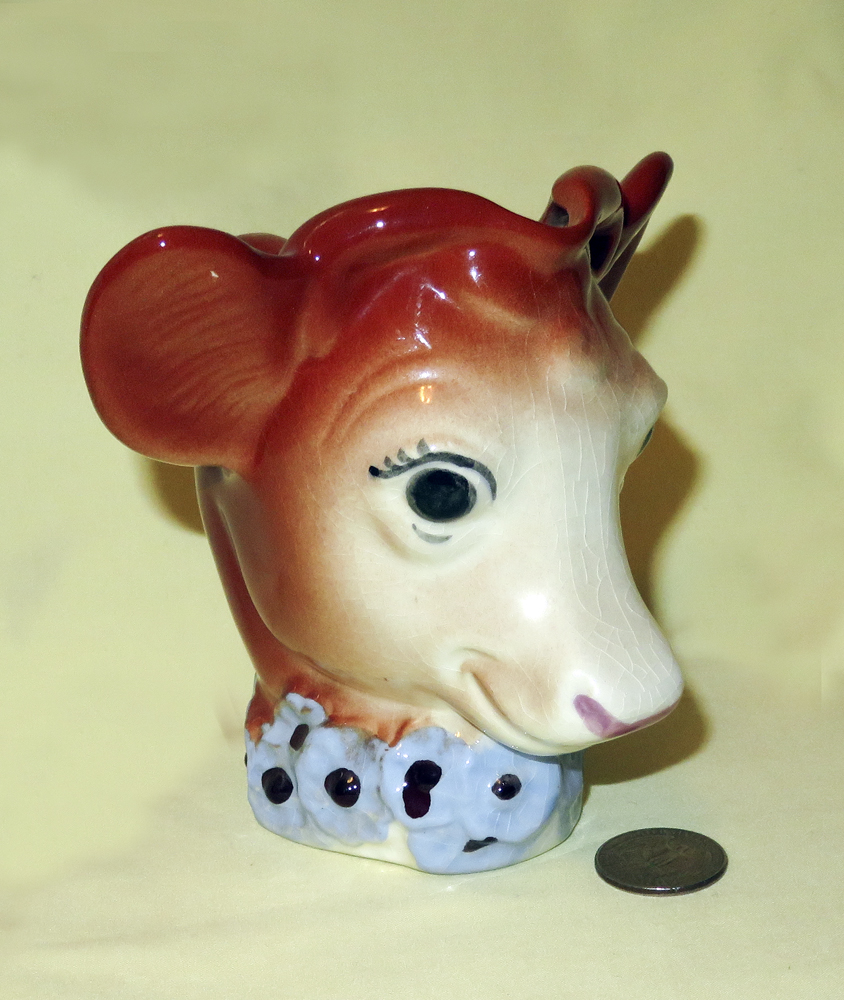 |
This is an interesting variant - blue flowers. Most all the ones I have seen (and there are a lot available) have the yellow flowers. |
|
|
|
|
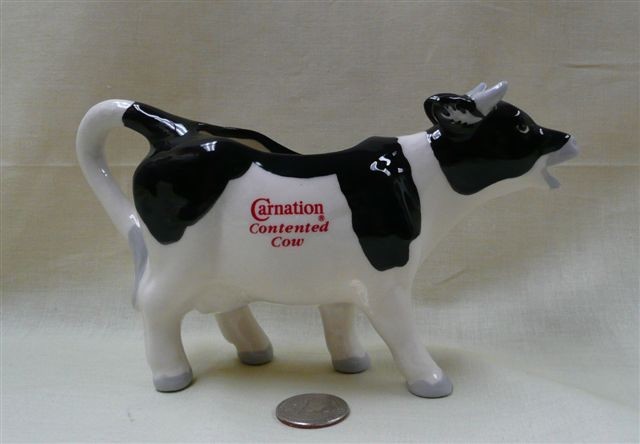 |
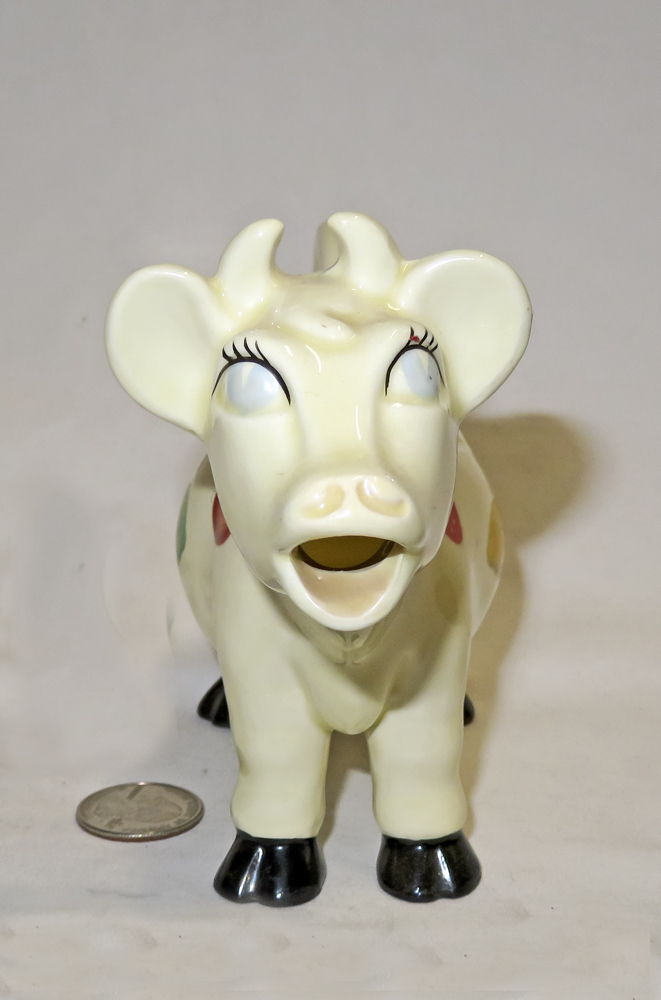
Back to the US - Carnation, which makes condensed milk, of course has to have its ‘contented cow'. This is actually a quite common mold - I have five versions, shown on page 2 of Modern Variations. |
|
|

|
|
|
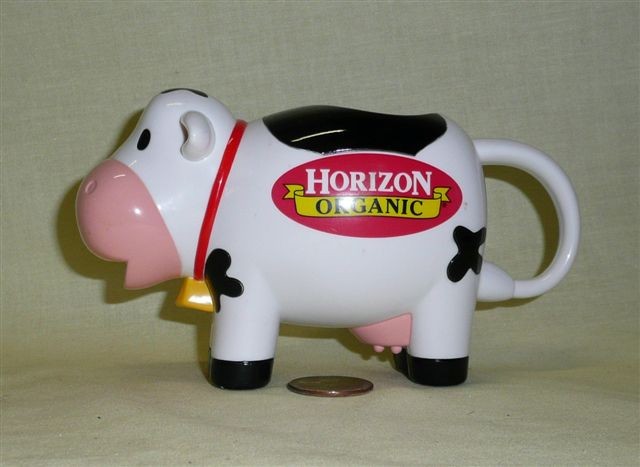
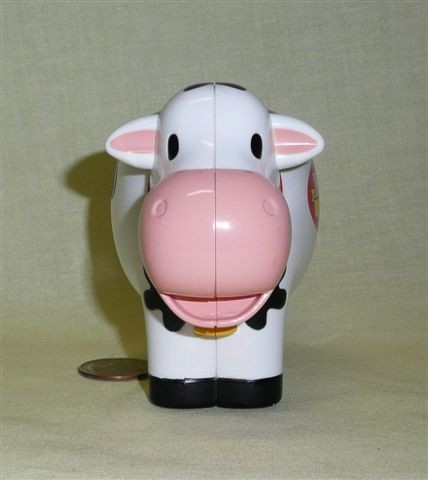
Cows are certainly a good advertisement for a dairy products company, albeit few of them seem to have actually used them. This delightful little made-in-China plastic guy pretty obviously comes from Horizon Organic, which I must admit I hadn’t heard of until I got this little beauty for the hefty sum of $.99. They’ve got a neat web page, full of games for kids and stories about their farms as well as products, and a history section that tells us that they “began in 1992 with a cooperative of small organic dairy farms in Wisconsin,” when “natural products industry veterans, Mark Retzloff and Paul Repetto, embarked on a search for organic milk in order to make organic dairy products available in the marketplace.” Given the growing interest in organic products, these days they “proudly source organic milk from over 500 family farms and cooperatives across the country, and that number is growing every day. We have contributed to converting hundreds or thousands of acres to organic farmland. We continue to help hundreds of farmers throughout the country transition to organic production to help provide more great tasting certified organic dairy foods to our consumers.” This little plastic ad must be mighty proud! And Mark and Paul must be doing very well. The ad for another of these creamers on eBay in late 2011 added that Horizon Organic is owned by Dean Foods, and its products distributed by White Wave Foods. |
|
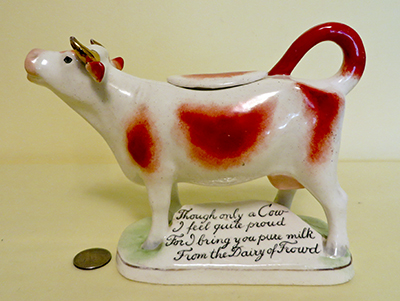 |
The base of this lovely cow reads “Though only a cow I feel quite proud for I bring you pure milk from the Dairy of Frowd”. A web search didn’t turn up any stories about a farm by this name, but I did manage to find a late 19c picture of dairy men in front of the Charles F. Frowd dairy shop at 36 Western Road, St Leonards-on-Sea, East Sussex, at http://www.1066online.co.uk/gallery/old-photos/36-western-road. Interestingly, this creamer isn’t British-made, but rather is stamped on the bottom for Royal Dux, a company in the town of Duchov in then Bohemia, now the Czech Republic. Their wares are apparently quite highly regarded and there are several articles on the web with information for Royal Dux collectors. |
|
|
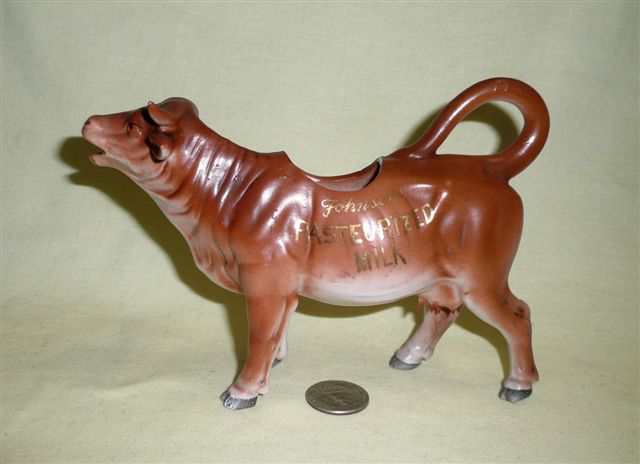 |
Here's another cow proudly advertizing milk, this time from the US: this beautiful classic German creamer proudly bears the gilded name of “Johnson’s Pasteurized Milk” While some form of purifying milk has been around for centuries, the ‘pasteurization’ process was developed by Louis Pasteur in 1864 and became commercialized around the late 19c and early 20c. The debate about the relative merits (and dangers) of raw and pasteurized milk rages on, but the US Public Health Service developed what’s now called the ‘Pasteurized Milk Ordnance” in 1924, as a basic standard for the states to adopt as a way of preventing milk borne disease. My guess therefore is that Mr Johnson chose to tout the cleanliness and healthiness of his product sometime after that, but well before WWII, which would match pretty well with the period in which cow creamers like this were being produced. |
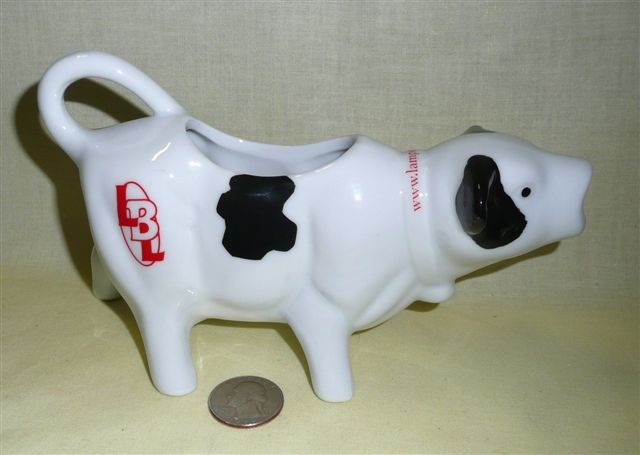 |
I find this to be an interesting modern variant, carrying both the logo (LBL) and web address of Lampire Biological Laboratories. Following the directions on the collar, we find that LBL “specializes in polyclonal and monoclonal antibody development, cell culture devices and services, and a wide variety of blood-derived products. Founded in 1977, the Pennsylvania based company offers an extensive line of secondary antibodies, purified IgGs, human and animal blood products, plus a comprehensive line of animal tissues and organs. The latest product releases include New Zealand sourced animal blood products, the gas-permeable LAMPIRE® Cell Culture Bag and exclusive antibodies to chemotherapeutic agents. Support services include peptide synthesis, antigen design, antibody purification, custom conjugation, and immunoassay development. In addition, Lampire has earned primary vendor status with biopharmaceutical, diagnostic, and medical device manufacturers worldwide.” Presumably the cow has offered its blood and parts for the company.
|
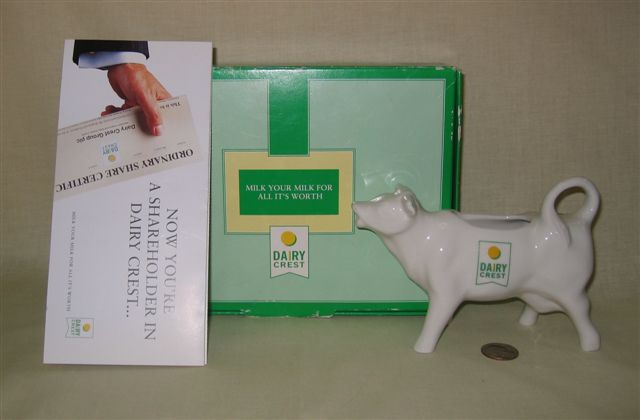 |
Here’s a British take on the cow as advertisement…with your stock in Dairy Crest comes this gift and the wish to “milk your money for all it’s worth”. |
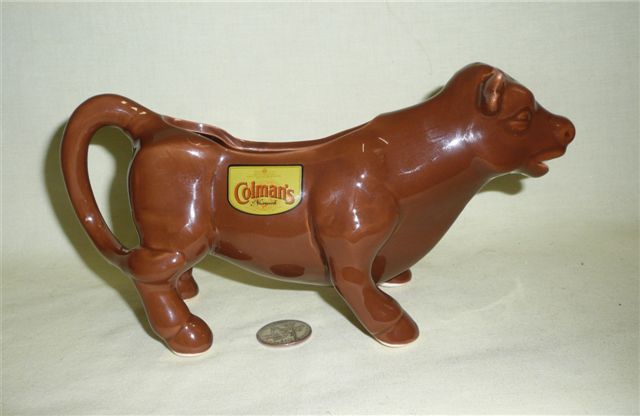
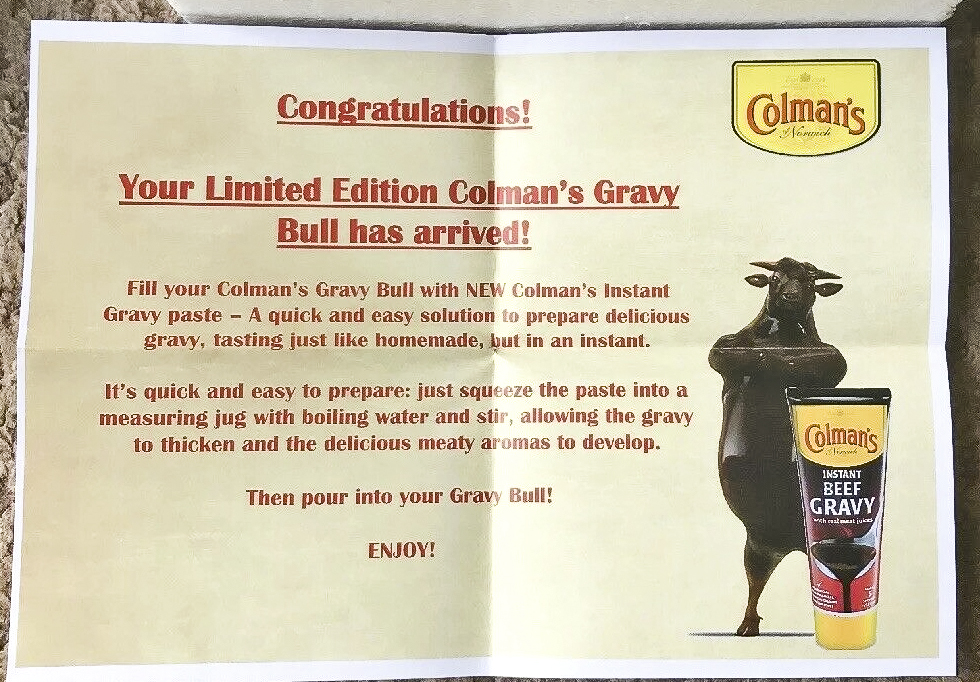
Another Brit: This bull has two stories to tell. First, it came to me from the Isle of Man. Although it wasn’t made there, it was the first one in my collection that arrived from that island. More about the Isle of Man down at the bottom of the page, accompanying a couple of souvenir creamers marked for it. Second and more relevant to this brown beast, this is the bull of Colman’s mustard, one of my favorites as well apparently of the Manx. The ‘Colman’s of Norwich’ web site tells its story: Jeremiah Colman , a flour miller, took over a mustard company based on the river Ytas, 4 miles south of Norwich, in 1814. His business prospered, and in 1903 the company bought its rival mustard manufacturer, Keen & Son. In 1995 Colman’s was bought by Unilever who wisely has retained the name and its symbols. The bull’s head was introduced in 1855 to symbolize tradition and quality…and I’m delighted to welcome this one to my collection, with ONE major exception: It is NOT a cow creamer. As the flyer attests, it is designed to purvey Colman's gravy. Oh well...it has two holes, could hold cream if you so wish, and was irresistable. |
|
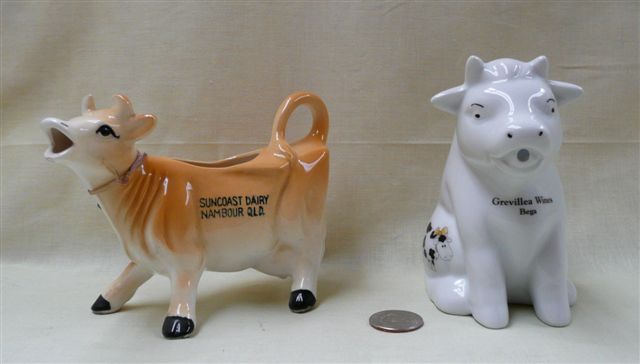 |
And here are a couple of Australian examples. The dairy one seems pretty straightforward, but the wine connection is less clear, at least to me. Perhaps the good folks from Grevillea Food and Wines of New South Wales will stumble across this web page and offer an explanation (and a bottle?). |
|
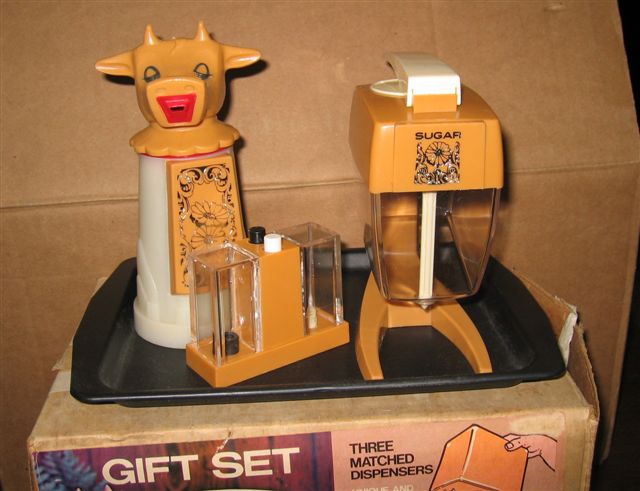
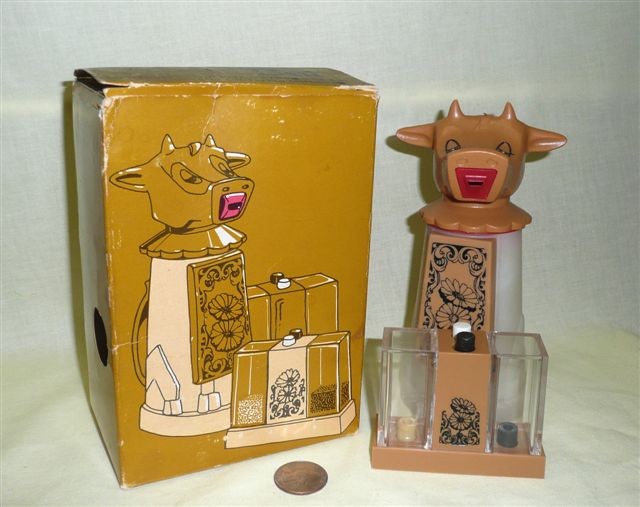
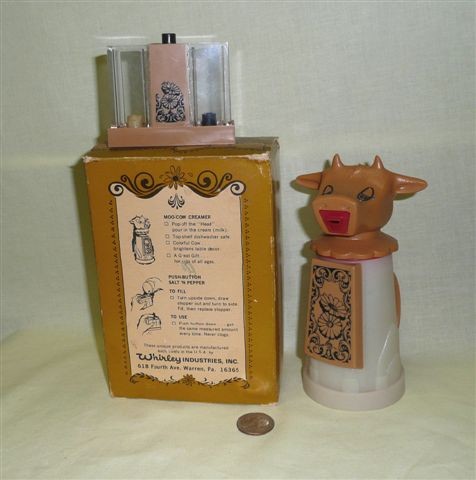
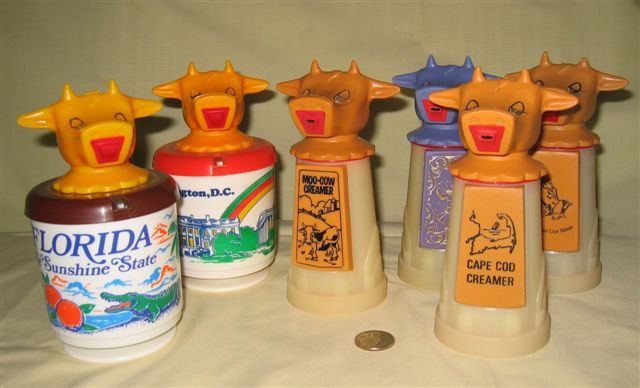
“Moo-Cow” creamers were all the rage in the 1970s. They are all marked on the bottom for Whirley Industries, Inc. of Warren PA. I’ve had some fun digging a bit into their history, with the help of one of their founders and some material that I was able to find on the web.. The company started when two young men who were classmates at Dartmouth College (Class of 1954), one from Warren and the other from New York City, got back together and decided to start a business in Warren in 1960. Their first endeavor was building and repairing Laundromats (‘Whirley Wash’). That went so well that they hired professional help for the repair work, moved into becoming distributors, and then decided to expand by selling coin operated car washes. Then in the late 1960s they heard about some molds for plastic salt and pepper shakers that hadn’t sold well and were available for sale near Boston. That got them started in the plastics business. After a fairly slow start a distributor came up with the idea of putting samples on restaurant tables at no cost to the owners, and customers started buying them. They became very popular and opened up new markets for the company. Then they got a call from another distributor friend who told them that the salt and pepper shakers were the best product he’d seen since a ceramic cow creamer that he had sold. By that time the ‘Whirley’ boys were seriously into the plastic molding business, so they turned to their chief engineer who designed the moo-cow creamer, based on a ceramic one that they thought came from England (I believe the ceramic creamer from which they took the idea was identical or at least similar to my own first cow creamer, and was actually made in the US). Following the successful pattern of the salt and pepper shakers, they marketed them in the 1970s through restaurants and gift shops, with the further embellishment of customized place or restaurant names and designs on the front panel. Most were brown, some yellow, some with white bottoms, and a few were purple. At the suggestion of a customer they added a straw hole in the back of the cow’s head. They manufactured and sold over 10 million of them, which not only made them a lot of money and firmly implanted them in the plastics business, but brought the name Whirley a lot of recognition. As you can see from these pictures they added a (less successful) syrup dispenser, and sold them as sets as well as through the restaurants. One of their historical notes states that when interstate highways displaced the state highways in the ‘80s the business of selling through restaurants deteriorated and they had to discontinue the cows and redesign their product line. Their next major idea was the original travel mug…and the success story went on from there. In 2004 they acquired a company called DrinkWorks! which had developed manufacturing facilities in China…and today as Whirley-DrinkWorks! they remain happily designing and delivering food and beverage products from their headquarters that remains in Warren, PA. And while they haven’t made moo-cow creamers for the last couple decades, these plastic cows remain one of the more readily available and popular items on eBay. |
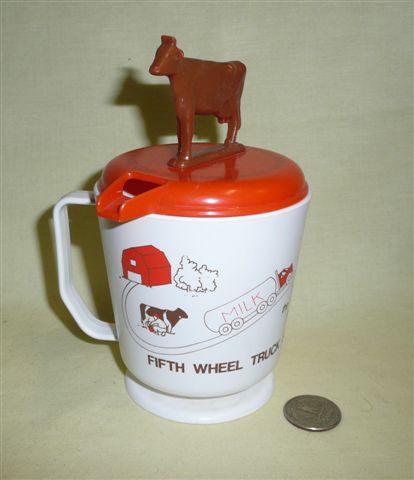
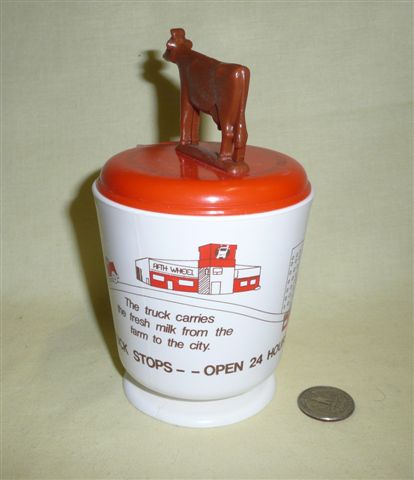
Here's a Canadian version of the same idea - from Fifth Wheel Truck Stops.
|
|
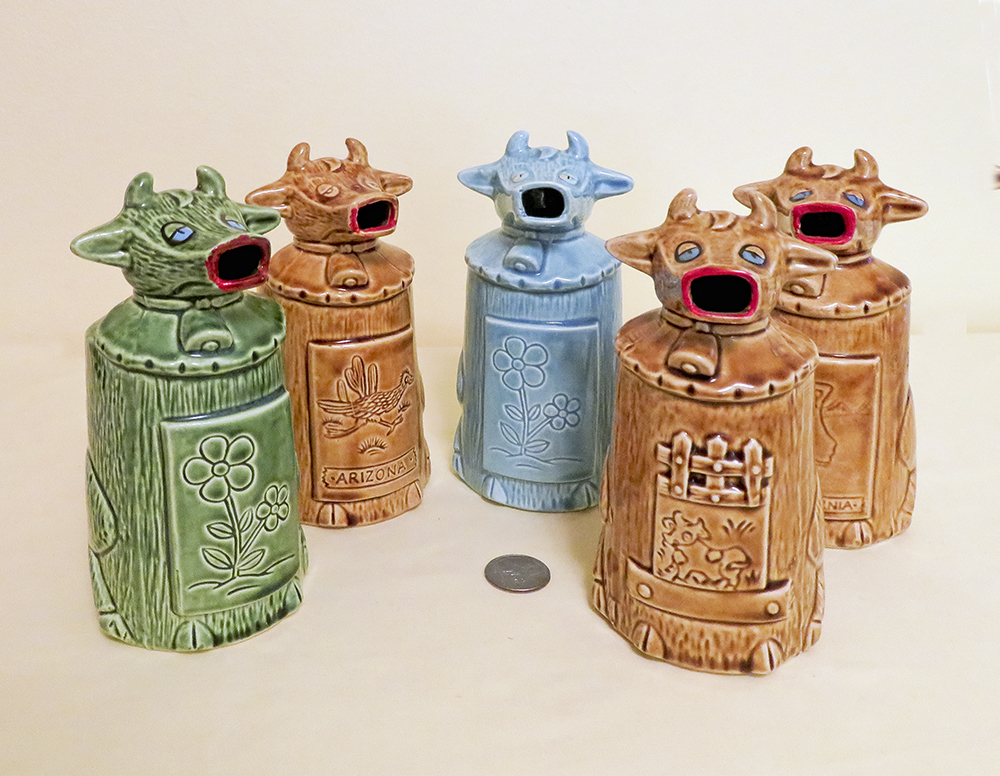 |
What worked in plastic also seemed to catch on in ceramics. These made-in-Japan versions come in a wide range of colors, some marked for many different states…perhaps all 50, who knows. |
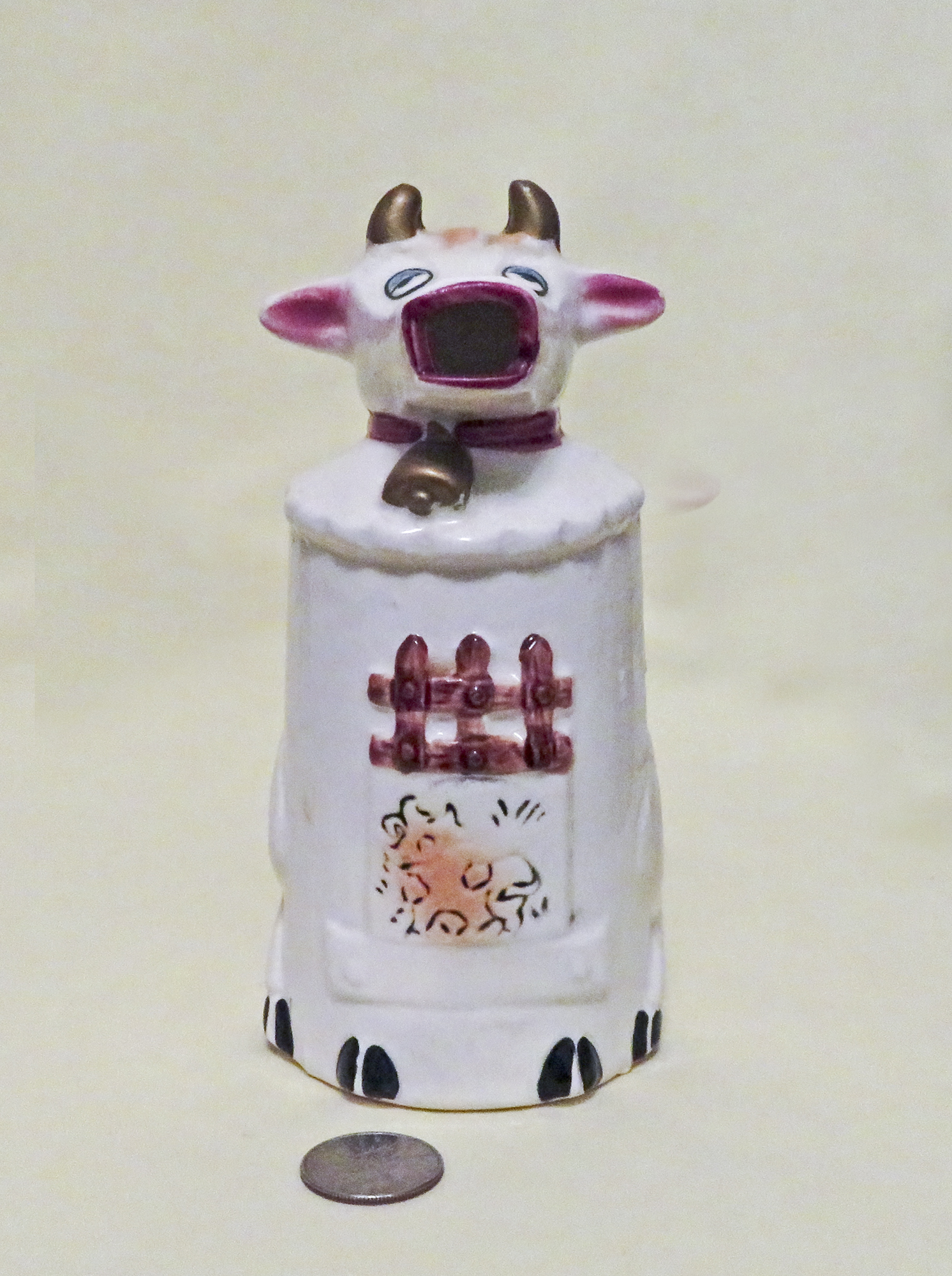 |
No I didn't need any more or these but then this white one turned up - only one colored like this I have seen so it joined the herd. |
|
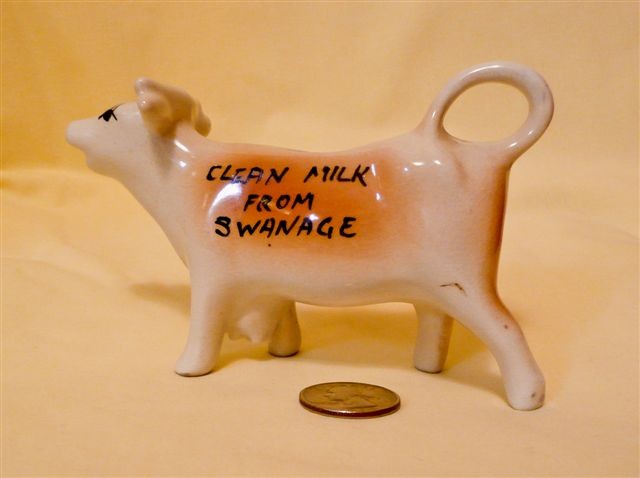
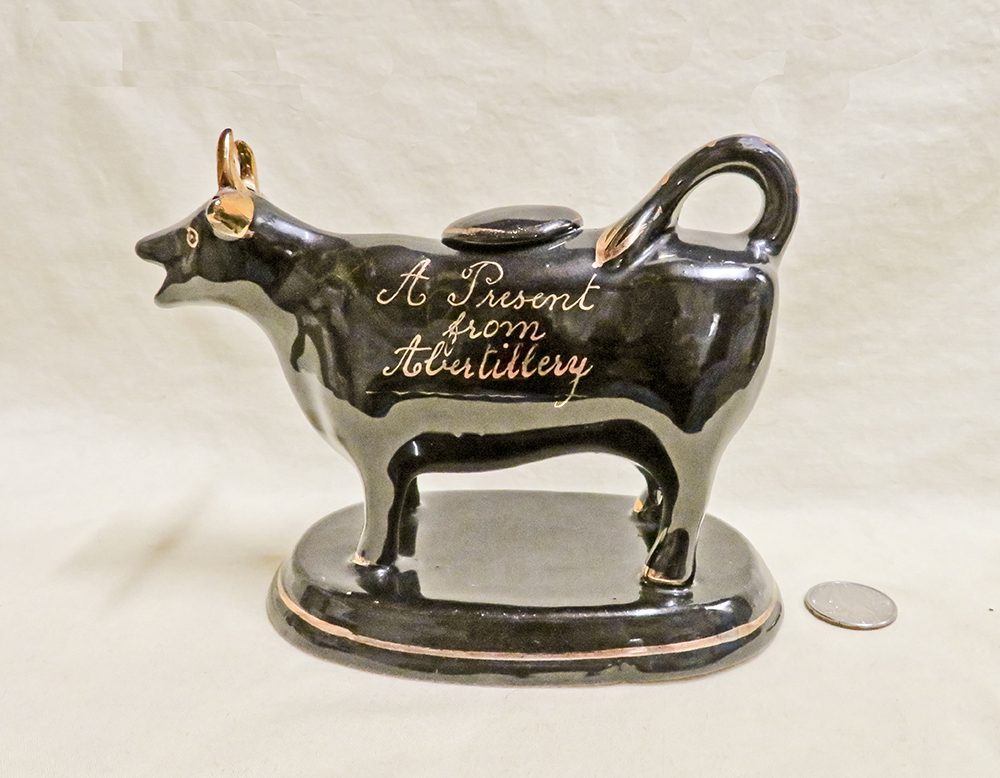
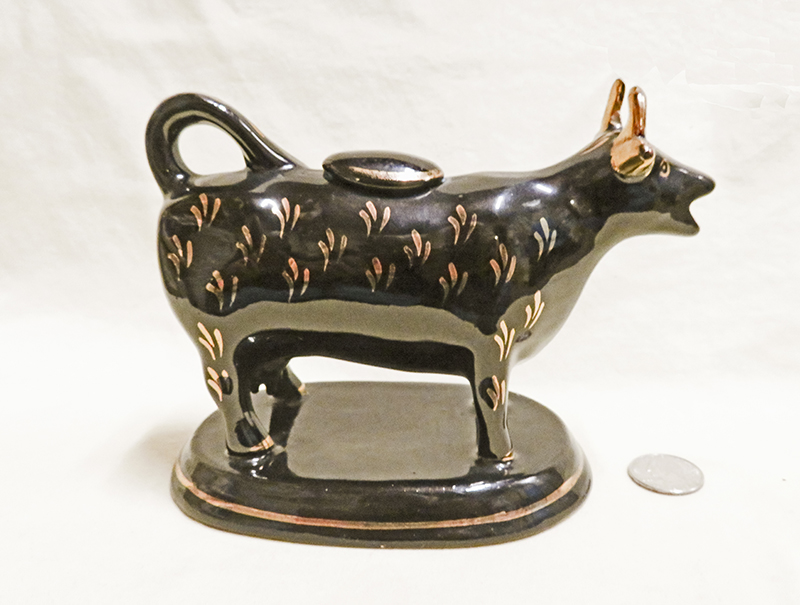
These creamers, and a question from one of my cow-respondents, led me to wondering when and why such souvenir cows became popular. One clue comes from the locations where they were purchased – e.g. in the case of this Jackfield cow, Abertillery is very near the Brecon Beacons National Park in Wales. A quick look at many of the other souvenir creamers, especially the Pre-WW I ones from Britain, indicates that they also hail from seaside or similar locations that became popular vacation spots in the Victorian era (1837-1901). A little googling quickly led me to some articles by Prof. John Walton of the University of Central Lancashire that traced the history and popularity of the ‘British Seaside Resort’…as well as to a July 2013 article in the Telegraph that discussed the propensity of the Brit’s to bring home a souvenir to remind them of the pleasures of their vacations. The burgeoning popularity of such vacations in the Victorian era can be attributed to a combination of the social changes of the time and the rapid expansions of the British rail system, starting in the 1840s, that enabled the middle and working classes to afford transportation to the resorts. The introduction of bank holidays in 1871 further increased the opportunities for summer vacations, and in turn the amenities of the seaside and other resorts expanded to help attract and expand the working class holiday market in places like Blackpool and Southend. Certainly cow creamers weren’t the only vacation souvenirs - candy, posters, post cards, and a wide range of china with crests or pictures of the resort were all very popular – but cow creamers were fashionable on their own in those days, so they naturally became part of the souvenir trade. And, as is evident from the examples on this page of my web site, the Germans were quick to take advantage of this market, especially before WW I but also in the between-war years in the 20s when, as discussed further below, their products bore the stamp ‘foreign’ to avoid the post-war British antipathy for German products. |
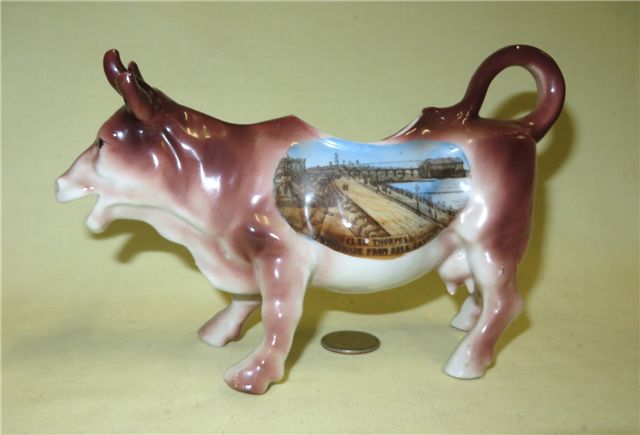 |
Here is a great testimony to the connections between British seaside holidays and souvenirs including popular cow creamers. This lovely German-made creamer is from a mold that I hadn’t seen before, and was at one time the prized souvenir of someone who visited the “Promenade from Ross Castle, Cleethorpes”. Cleethorpes is on the coast in North Lincolnshire, and the visitoruk.com site informs us that “Situated on Cleethorpes' promenade in the heart of the town, Ross Castle appears to be the ruins of an ancient castle but it is in fact a Victorian folly, built in 1863. As Cleethorpes was being developed as a holiday resort, following the arrival of the railways in the 19th-century, the Manchester, Sheffield and Lincoln Railway Company built a mile long promenade here to prevent continuing coastal erosion of the cliffs on which the town was sited. Above the promenade the rail company decided to build the mock ruin as a visitor attraction and it was named Ross Castle after the company's secretary Mr. Edward Ross.” |
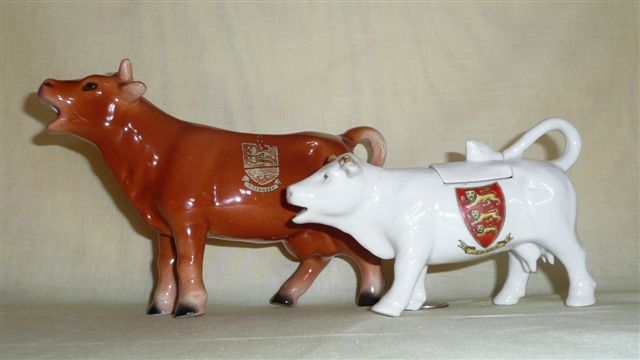 |
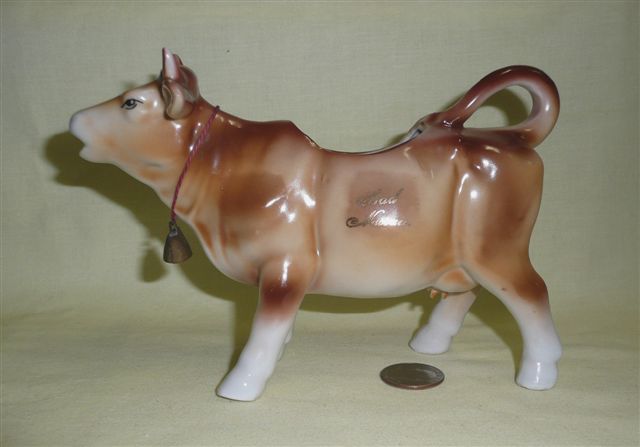
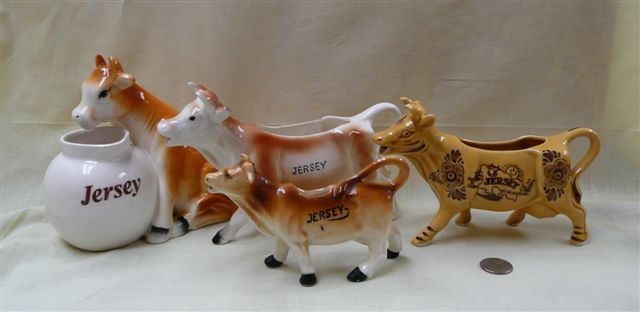
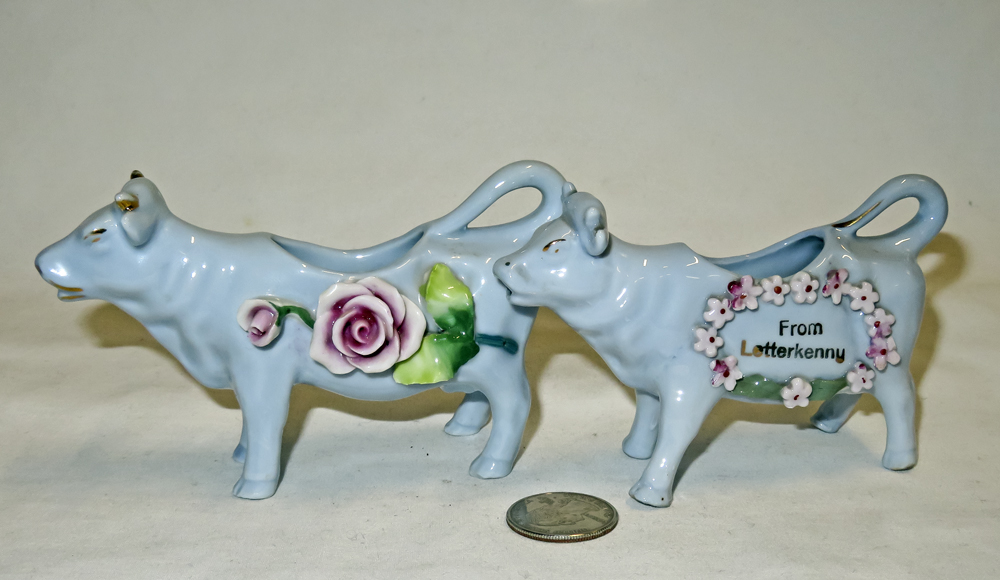
It’s only to be expected that the British Channel Islands, Jersey and Guernsey, famous for their cows, would also use them as popular souvenirs. Here are two bearing the islands’crests. (see Miniatures for some other cute examples from these two Islands) |


|
|
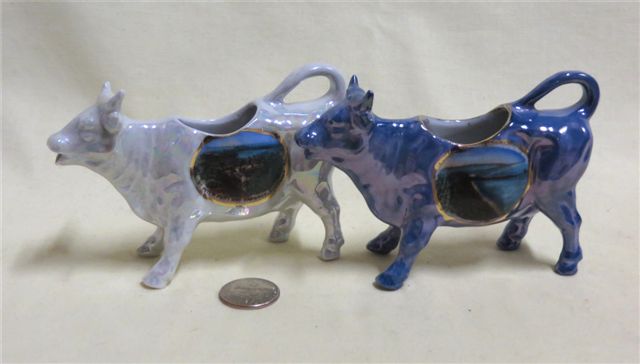 |
Here however are a couple more Guernsey examples, small German luster-glazed porcelain creamers bearing the Post WW I Foreign stamp and featuring transfer photos of the coast (blue cow) and St Peter Port and Harbor. |
|
|
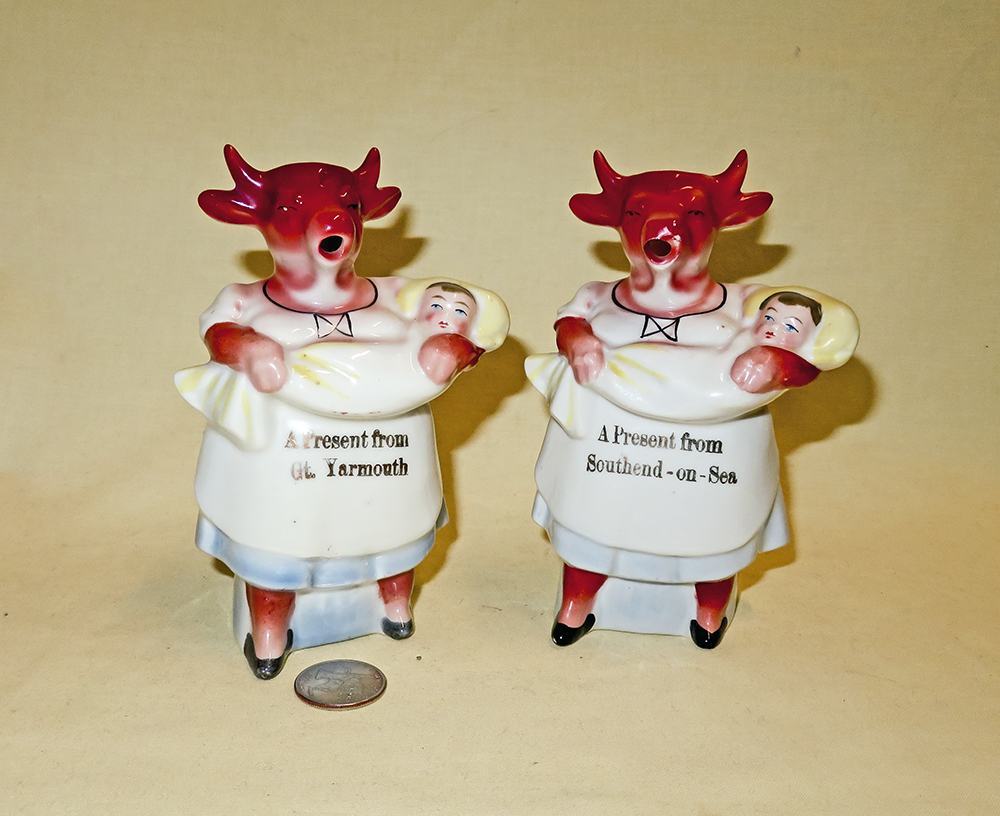 |
Here are another couple imported examples, cute nursemaids wearing Cornish dresses marked as presents from Great Yarmouth and Southend-on-Sea. Although unmarked (probably intentionally) these were made in Germany and likely from before WW1 (a knowledgable seller said they were Edwardian, circa 1910); there’s one like them stamped for Germany but without the souvenir imporints on page 3 of Modern Variations. I was delighted to get these – at £3.97 and for the GT Yarmouth one, less than a tenth of the price of the plain one, and £13.99 for the Southend version, they were a super bargain. Makes me feel almost sorry for the sellers, but that’s eBay. |
 |
I believe this one is also German. From Wikipedia and the website of Royal Forest of Dean we learn that Symonds Yat is a village in the Wye Valley and a popular tourist destination, straddling the River Wye in the English county of Herefordshire, close to the Gloucestershire border. The name Symonds Yat is derived from a 17th-century local sheriff called Robert Symonds and the regional dialect for 'gate' or 'pass'. The river Wye winds its way inn a deep wooded gorge around Symonds Yat Rock, one of the best known view points in the Wye Valley and The Royal Forest of Dean. Symonds Yat West is on the Herefordshire side of the river and Symonds Yat East is on the Gloucestershire side. The only connection between the two are two ancient hand ("pull") ferries by which the ferryman pulls people across the river using an overhead rope, for a small fee. The 5 mile connection by road is upstream over Huntsham bridge. When I bought this one, I thought is looked familiar and found one larger and one smaller that seem to be members of a family. Ther are shown in Modern Variations. |
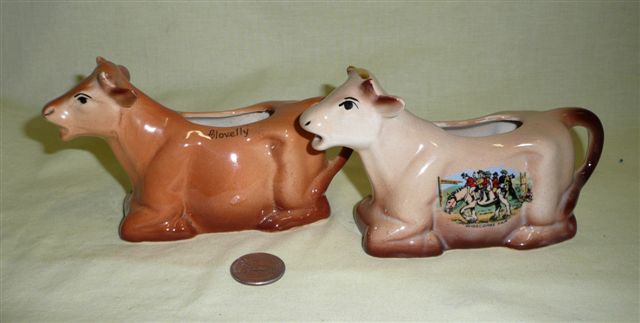 |
The Staffordshire factories are in the souvenir game as well of course. Here’s two that are obviously from the same mold, and presumably the same maker. The darker brown one is simply marked for Clovelly, which is on the coast of North Devon. I find from Hertiage Britain that “The picturesque, ancient, fishing village of Clovelly is uniquely special in that it has no cars and no individually owned houses. Its flower-strewn cottages "tumble like a waterfall" down a cleft in the 400' cliff along cobbled streets to the tiny working port and C14th quay.” It’ll be a ‘must’ for our next visit to the UK. Of course, the right time to visit Devon has to be the second Tuesday in September, which is when the Widecombe Fair – advertised on the light brown creamer – is held. The picture depicts Uncle Tom Cobley and his friends riding to the fair on on a grey mare … from an old Devon folk song which you can find at http://www.spreyton.org.uk/tom_cobley.htm. Wikipedia informs us that “The phrase ‘Uncle Tom Cobley and all’ is used in British English as a humorous or whimsical way of saying et al., often to express exasperation at the large number of people in a list”, since the song ends with Tom listing all his buddies. This creamer is marked, thankfully: for “H A Wain & Sons Ltd, Melba Ware, Stoke on Trent” whose factory in Longton, Stoke on Trent, opened in 1946. Thanks to them for leading me to this information. |
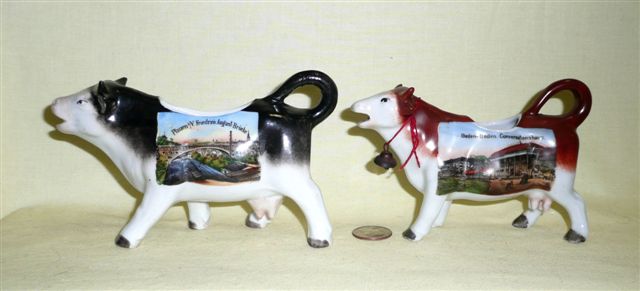 |
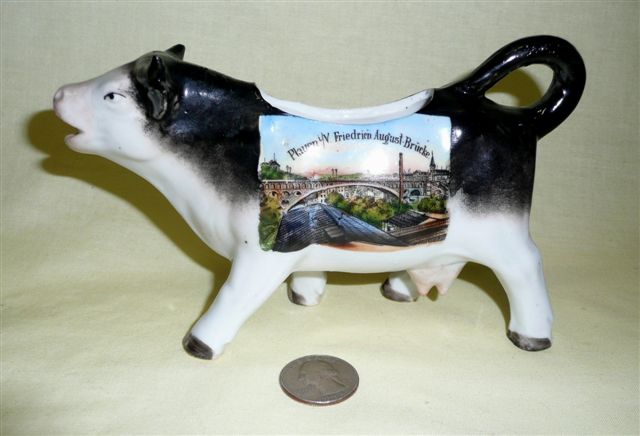
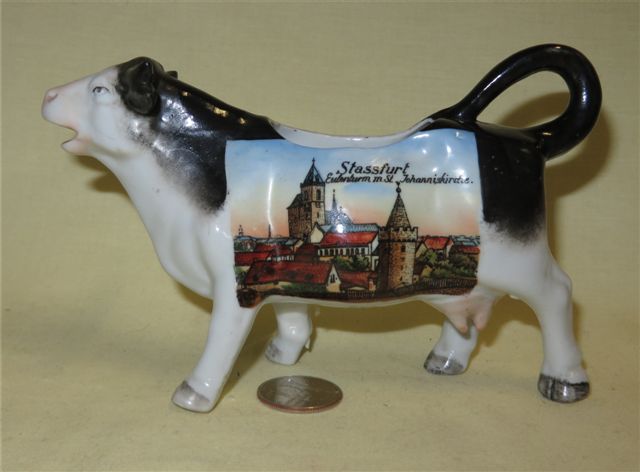
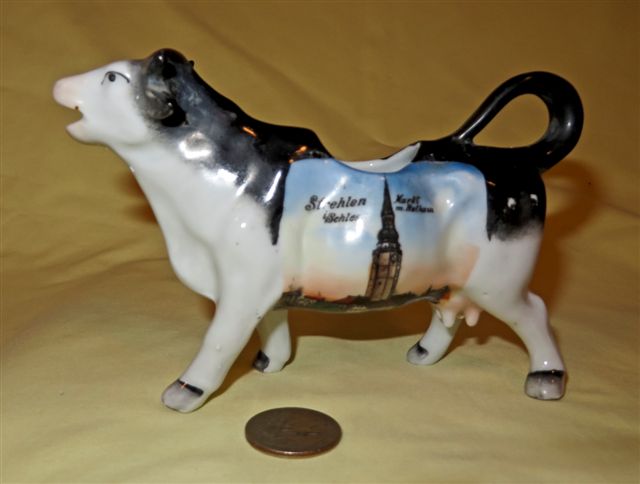
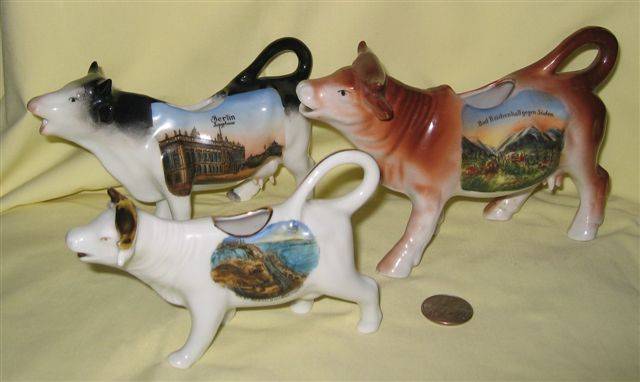
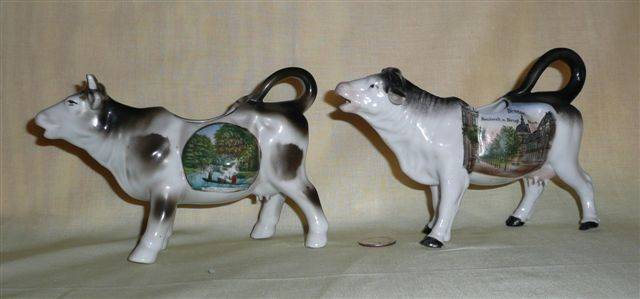
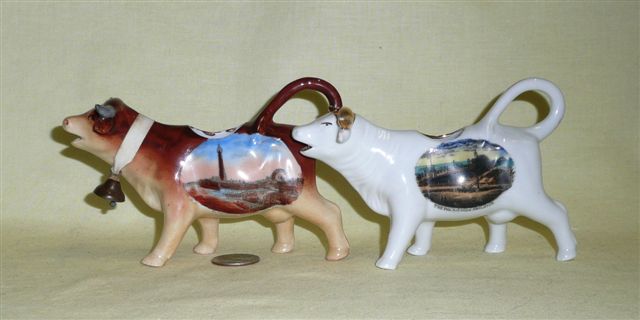
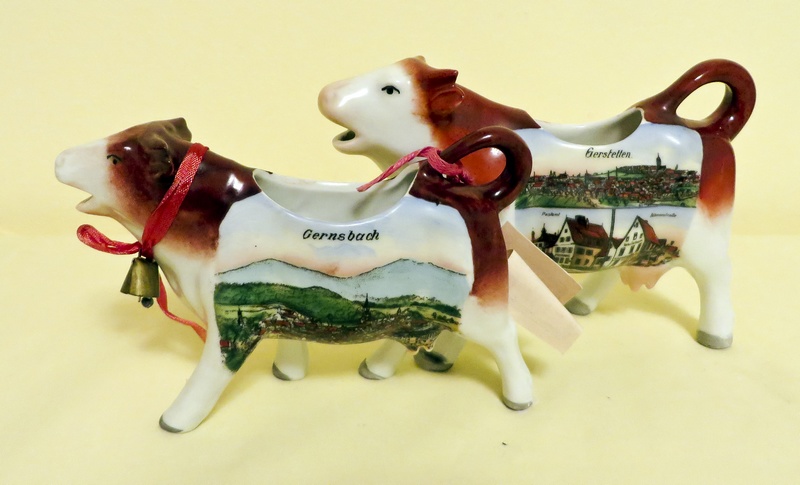
From the Victorian era (1837-1901) - when cow creamers were extremely popular – up until around up until sometime after WWI, probably into the early 1930s, German porcelain makers produced some very lovely souvenir cow creamers with quite detailed picture-transfers on their sides. This was a quite expensive process, I’m told, and as shown further down this page the more modern souvenir cows bear decals, paintings, writing, or some other less costly embellishment. These two cows serve as a good example of the lovely German ones that now form such a large herd in my collection – some purchased one at a time, and then an additional 35 or so acquired from the extensive collection of a Belgian gentleman. In addition to their quality, I like them because of the stories they have to tell about the places in England and on the continent that they memorialize. For example, here the black and white cow is from Plauen, a city in Saxony that was founded by Polabian Slavs in the 12thC. The picture depicts Friedensbrücke, the world’s largest stone arch bridge (Wikipedia has great write-ups about many German cities, and is the source for most of my brief descriptions). The brown cow is from Baden-Baden in the western foothills of the Black Forest, famous for its baths since Roman times. |
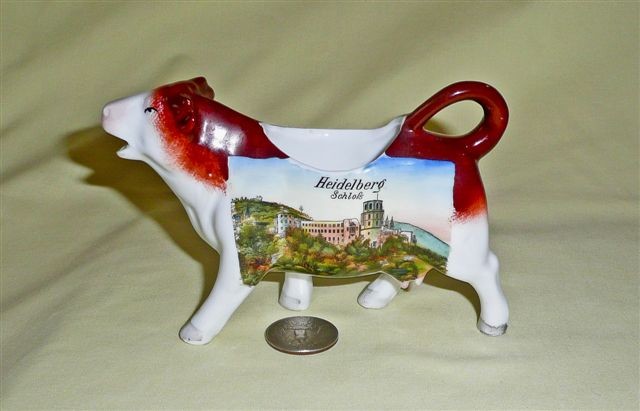 |
This seems to be a popular mold for these German transfer-picture cow creamers. This one showing the Heidelberg Schloss (Castle) has an unusually large and well done picture. The very nice write-up about this castle in Wikipedia notes that “The earliest castle structure was built before 1214 and later expanded into two castles circa 1294; however, in 1537, a lightning-bolt destroyed the upper castle. The present structures had been expanded by 1650, before damage by later wars and fires. In 1764, another lightning-bolt caused a fire which destroyed some rebuilt sections.” It has only been partially rebuilt since, yet it became a popular tourist attraction early in the 19c and especially after the railroad system reached Heidelberg in 1840. Count Graimberg who was instrumental in its preservation at the time popularized it with early pictures and souvenirs of which this cow – likely from the late 19c – is an example. |
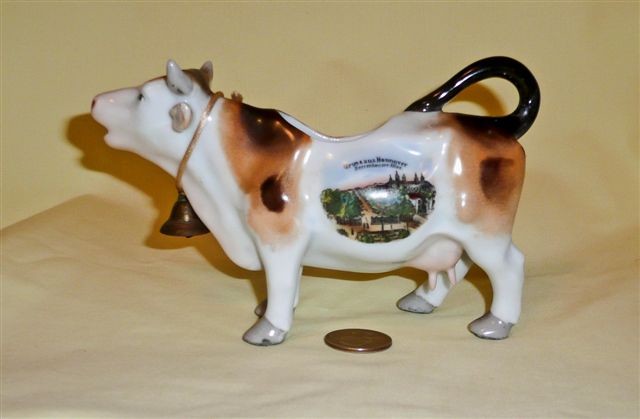
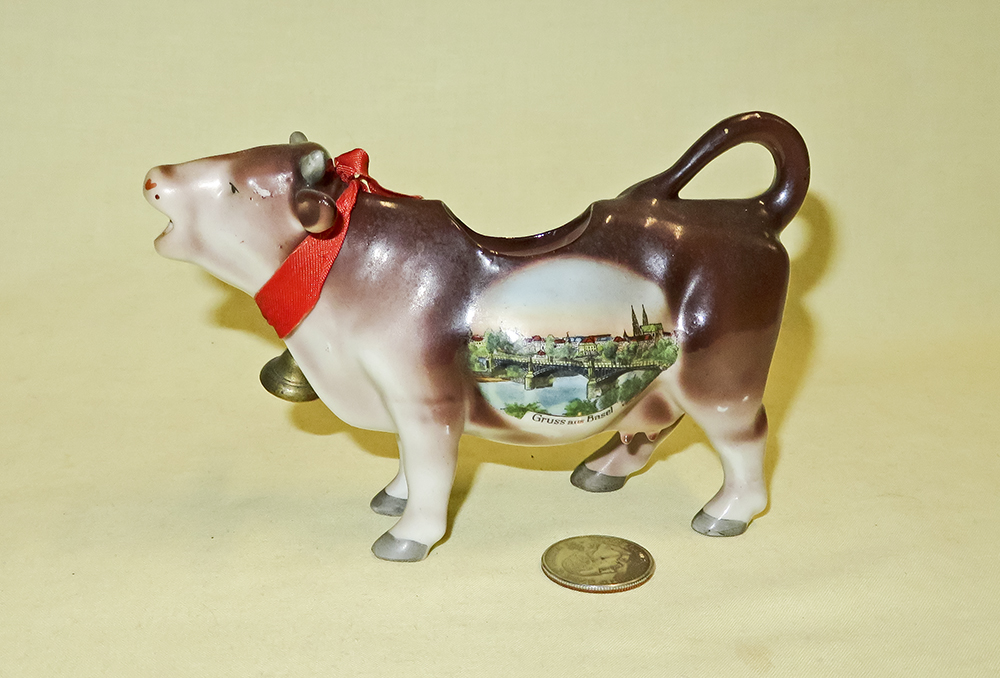
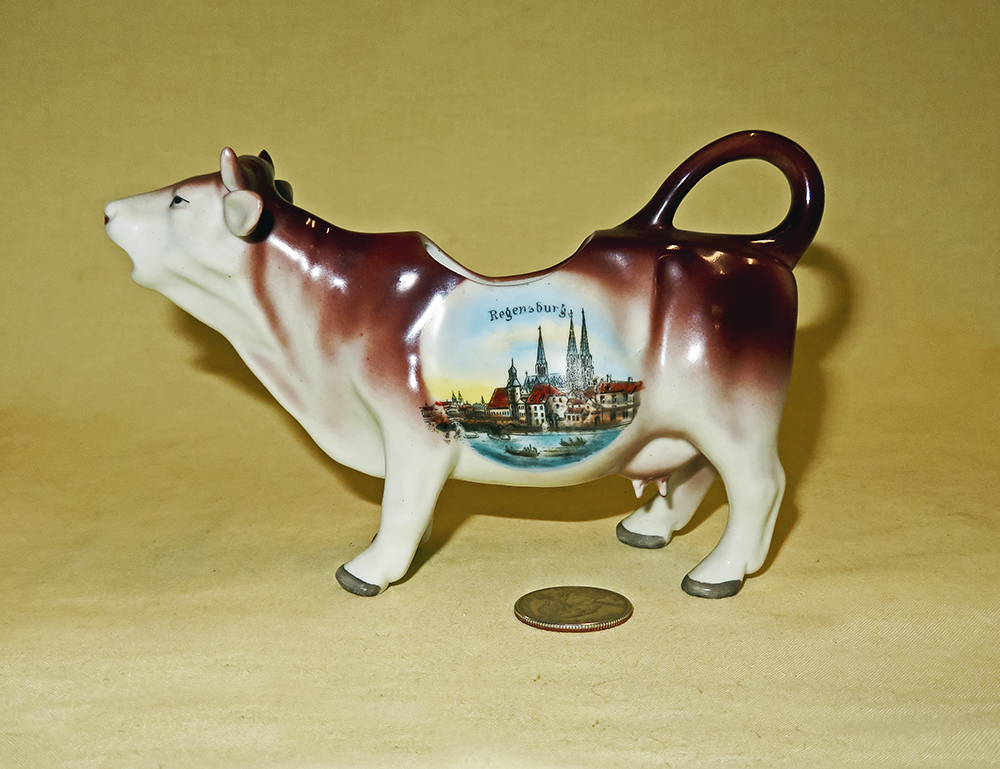
Here are three creamers from one of my favorite molds, which apparently also appealed to lots of others since it has appeared in many variants (I think I must have at least a dozen), both with and without the souvenir or advertising pictures. The lighter brown cow on the left depicts the main path or allee in the important European Baroque Royal Gardens of Herrenhausen, one of the most famous sights in Hanover (or Hannover) which is on the River Leive and is the capital and largest city of Germany’s Lower Saxony. The darker brown cow with the red ribbon in the center brings ‘Greetings from Basel’, on the Rhine River in northwestern Switzerland, near the borders of France and Germany and with suburbs in both of those countries. Basel is known today for its museums and university as well as its history of commerce and culture. On the right is Regensburg, located in SE Germany at the confluence of the Danube, Naab and Regen rivers. Its medieval center became a UNESCO world heritage site in 2014. Pictured is the city's cathedral, St Pater's Church. |
|
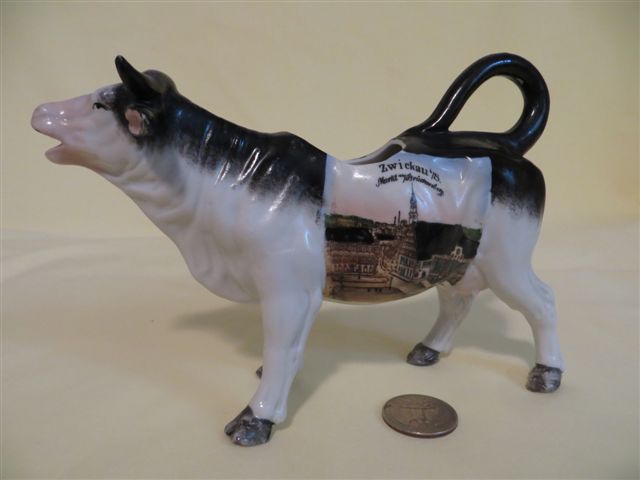
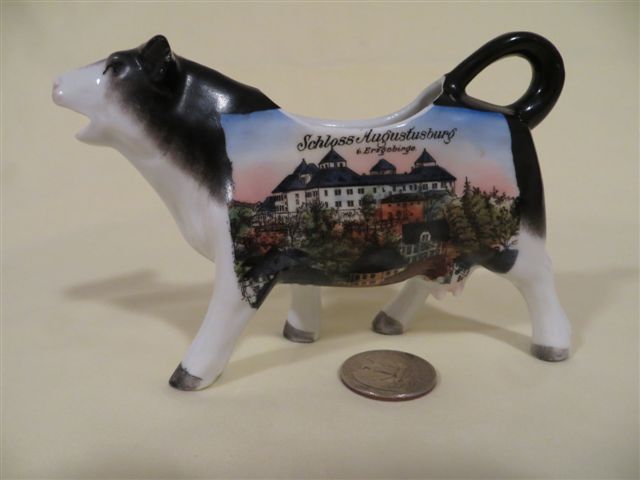
Three more lovely early German transfer souvenir cows. The brown one was made for “The Beach,Southend on Sea” in the UK. It becaume a popular tourist resort when the railways finally arrived in late 19c, and after Princess Caroline of Brunswick visited. It features the world's longest leisurte pier. Tourism has declined significantly since the 1960, as other venues have became more affordable. It's sort of out of place here because its two black partners come from quite close to each other in Saxony. One features Schloss Augustusburg in Erzgebirge which translates to Ore Mountains. These served as the border bnetween Saxony and Bohemia from the 12c to 20c, and now are along the divide between Germany and the Czech Republic. Zwickau is in a valley at the weatern foot of the Erzgebirge Mountains, and is the center of the Saxon auto industry. Its souvenir cow displays its main market. |
|
|
|
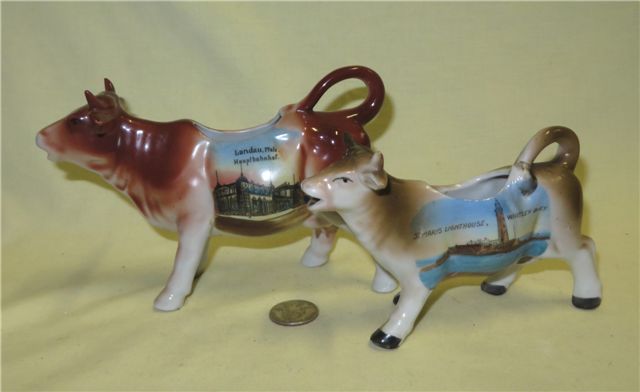
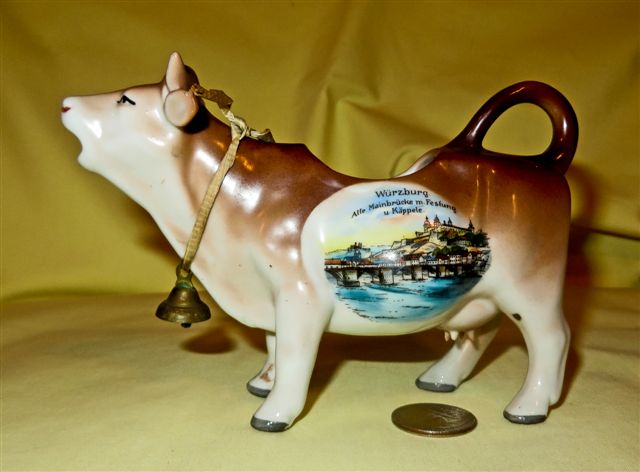
And still more, all German made with one a UK souvenir. Here’s what they teach us: In the shot of two, the larger hails from Landau in der Pfalz which is in the wine region of southern Rhineland-Palatine. This town was first settled in 1106, albeit the pictured Hauptbahnhof – railroad station – dates from considerably later. The little one depicts St Mary’s Lighthouse which (according to Wikipedia) “is on the tiny St Mary's (or Bait) Island, just north of Whitley Bay on the coast of North East England. The small rocky tidal island is linked to the mainland by a short concrete causeway which is submerged at high tide. The lighthouse and adjacent keepers' cottages were built in 1898 by the John Miller company of Tynemouth, using 645 blocks of stone and 750,000 bricks. It was built on the site of an 11th-century monastic chapel, whose monks maintained a lantern on the tower to warn passing ships of the danger of the rocks. The lamp was powered by paraffin, and was not electrified until 1977, St Mary's was by then the last Trinity House lighthouse lit by oil. The lighthouse was decommissioned in 1984.” The cow with the bell – one of my favorite molds and similar to one in the section above – comes from Wurzburg which is in Franconia, Northern Bavaria, on the Main River. Among notable aspects of its history were witch trials from 1626-1631, and a firebombing by the British in 1945. It has since seen lots of restoration. |
|
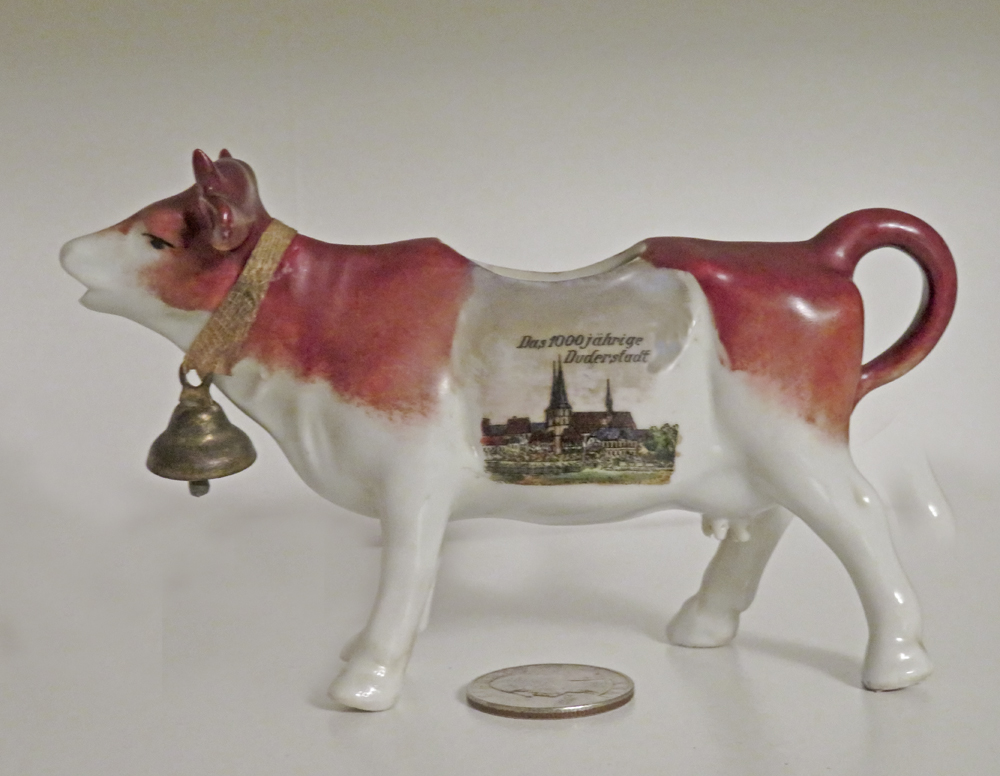 |
This lovely small German porcelain creamer with a nice brass bell and well modeled teats was made in 1929. How can I be certain? Well, the lettering literally translates to "The 1000 year old Dunderstadt", that is Dunderstadt's 1000th Anniversary. From Wikipedia we learn "It is the center and capital of the northern part of the Eichsfeld ("Untereichsfeld"). In earlier times it was the private wealth of the Roman Catholic archbishop of Mainz. The earliest documentary mention of Duderstadt was in 929 AD, and the city celebrates its anniversaries counting from that year. The city contains many historical buildings in the Half-timber style, most notably along the Market Street, which stretches from the St. Cyriakuskirche (Catholic, built 1250–1490), also called "Oberkirche" (upper church), down to the St. Servatiuskirche (Protestant, built 1370–1520), also called "Unterkirche" (nether church). Built in 1343, the Westerturm is one of at least eight gate towers and peels of the city's fortress wall, it burned down in 1424 and was rebuilt over the course of 12 years. The Westerturm has a very distinctive twisted roof. Though not the only tower in Germany with a twisted roof, its execution was particularly successful. There are a number of folk tales to explain the twist: one tale claims that an unoiled weather vane caused the wind to twist the roof. Another claims that when the devil was driving the men of Duderstadt to drink, the women drove him away, but not before he grabbed the tower and twisted it while passing over the wall, mak ing his escape." I believe the picture on the cow's side depicts both the towers of St. Cyriakuskirche, and the twisted roof of the Westerturm. Or at least I'd like to think so. |
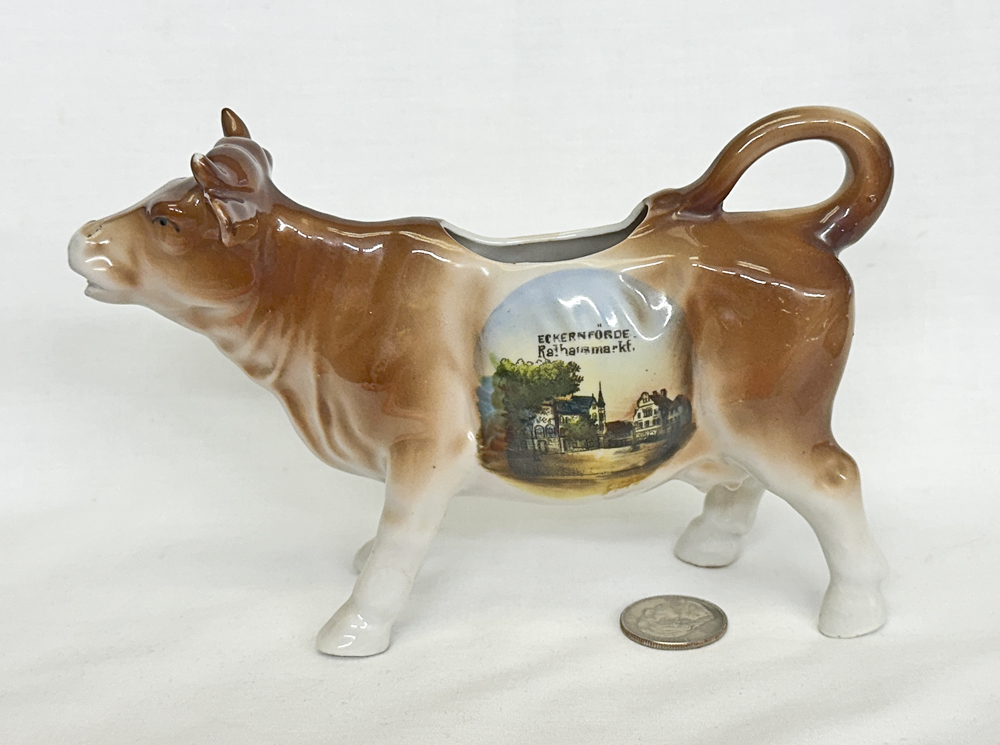 |
Much less pretentious is this beauty showing the town hall market in Eckenforde, located in the Kreis of Rendsburg-Eckernförde, Schleswig-Holstein, northern Germany. Situated on the coast of the Baltic Sea, approximately 30 km north-west of Kiel, it has a population of about 23,000 and is a popular tourist destination. |
 <
<
|
|
|
|
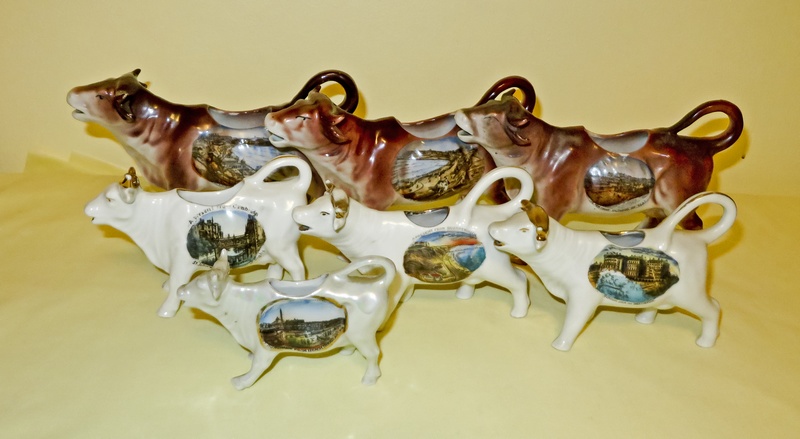 |
In this and the seven following sections are 35 German transfer-picture creamers I acquired from the extensive collection of a Belgian gentleman. The information about their pictures is largely derived from Wikipedia. Most of them are souvenirs from cities in Belgium and Germany, but these seven all are from the UK. From left to right, starting with the rear row (the brown cows), they picture “Scarborough – South Bay”; “The North Bay Scarboro” (yes, same town on the North Sea Coast of North Yorkshire, different spelling); and “The New Front – Southend-on-Sea”. The middle row, again left to right, brings us “A Present from Cambridge – St John’s College Bridge”; “A Present from Bournemouth – West Beach Bournemouth”; and “Rough Sea at Brighton”. I’ve been there in that kind of weather, and it’s not at all pleasant! And the little white cow in front advertises “West Promenade from Douglas to M…”, so presumably it is from Douglas, the largest city and capital of the Isle of Man. |

|
|
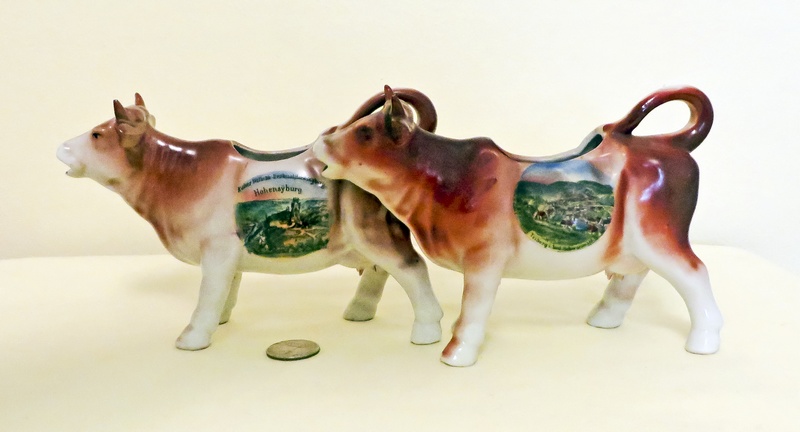
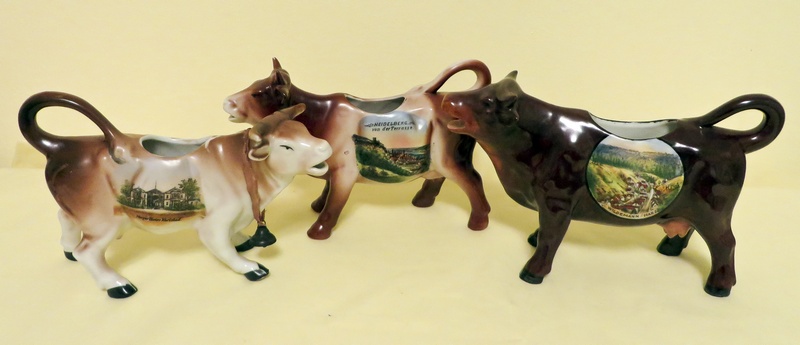
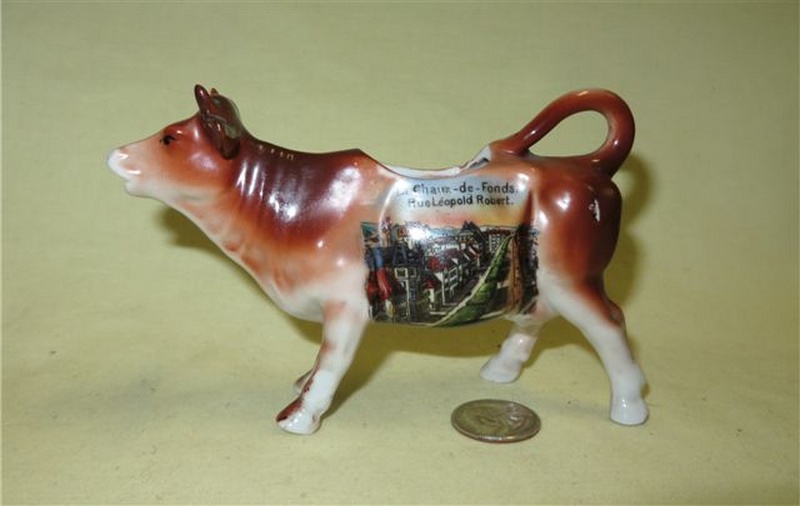
On the left is a souvenir cow picturing ”Kaiser Wilhelm – Denkmal, Hohensyburg”, or the memorial to Kaiser Wilhelm I in this town near the confluence of the Ruhr and Lenne. Next is one from “Triberg i.bad.Shwarzwald” which is in the Black Forest, and boasts a series of waterfalls on the Gutach River that are among the tallest in Germany. In the shot of three, on the left is a cow from “Mergertheim Karlsbad”, in Wurtemburg in the valley of the Tauber, site of a magnificent castle with archives of the Teutonic order, and residence of its Grand Master until its dissolution in 1809. In the middle we find “Heidelberg von der Terasse”, on the river Neckar in SW Germany, known for the Heidelberg Man. It escaped bombing in WWII because the allies wanted to us it as a garrison base. On the right is a cow from “Wildemann/Harz” in Lower Saxony, noted for its flora and fauna. |
|
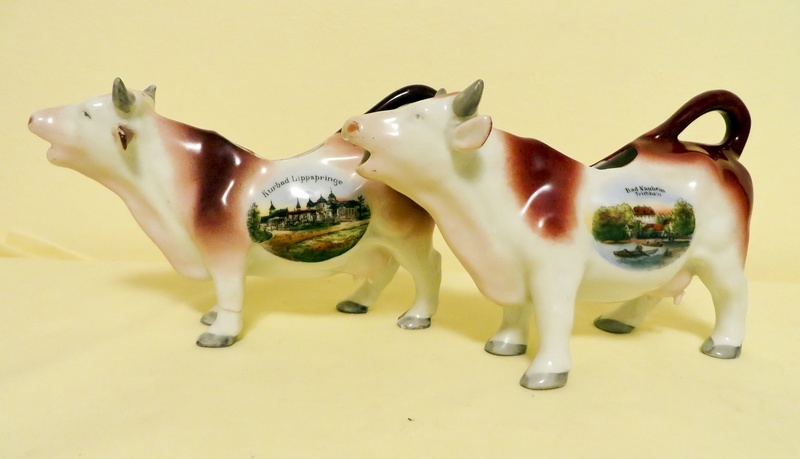

The two in the left picture are from one of my favorite molds. They have some flaws from shipping, but they are lovely nonetheless. On the left is a creamer from “Kur bad Lippspringe”, featuring a health spa in this town in North Rhine-Westphalia, Germany, which was a Templar stronghold in the 13th century. Its partner is from “Bad Nauheim, Tetchhaus”, a world-famous resort in the Hesse state of Germany, noted for its salt springs and ‘effervescent’ bath used to treat heart and nerve diseases. In the right hand photo we first find a souvenir of “Das National Denkmal, Auf Den Niederwald” which is also in the Hesse state. The monument was built in the 1870/80s to commemorate the unification of Germany; Kaiser Wilhelm I laid the first stone on September 16, 1871. To the right is a cow representing “Gruss Aus Altenburg” in Thuringia, Germany. |
|
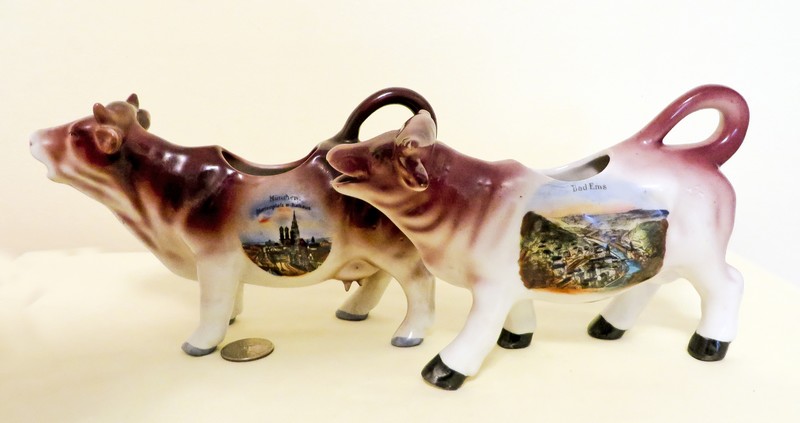
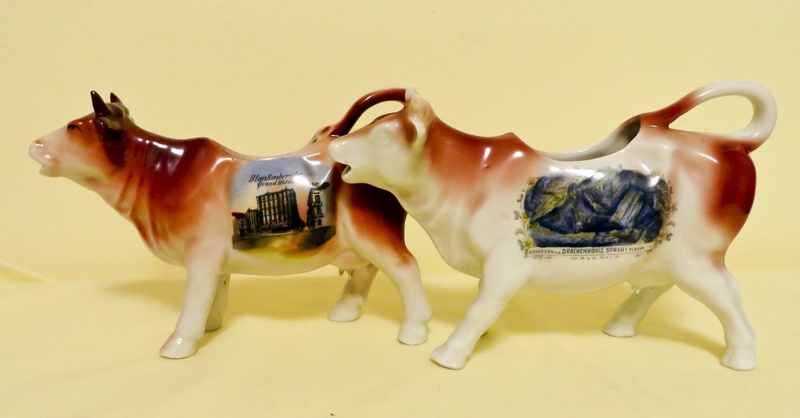
On the far left is a cow sporting “Marienplatz m. Rathaus, Munchen” or the city hall & St. Mary’s Square in Munich, the capital of Bavaria. To her right is “Bad Ems”, a bathing resort on the river Lahn in Rheinland Pfalz, Germany. On the far right a cow without distinct eyes displays “Andebken a.d. Drachenhohle B/Plauen l/v.c.” over “Walhalla”, basically a souvenir of the Dragenhole in Plauen, a town in the Free State of Saxony . Walhalla is a hall of fame honoring distinguished people in German history, above the Danube east of Regensburg in Bavaria. The fourth cow in this section is our first from Belgium, showing “Blankenberghe Grand Hotel” located in this North Sea coastal town that is noted for its long beach, promenade, pier, busy marina, and art nouveau architecture |
|
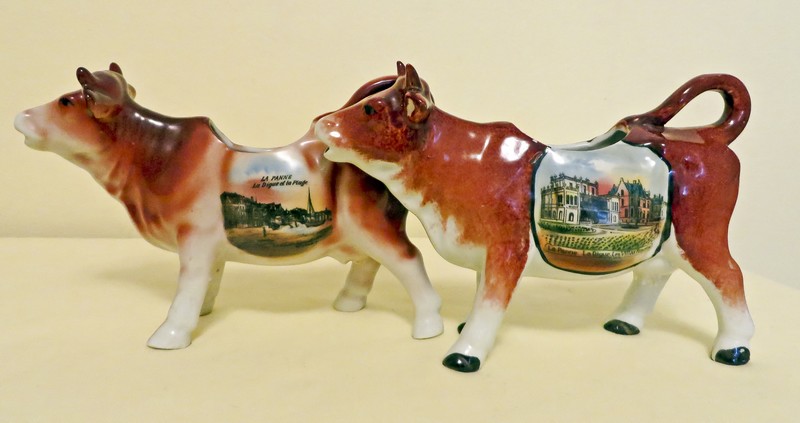
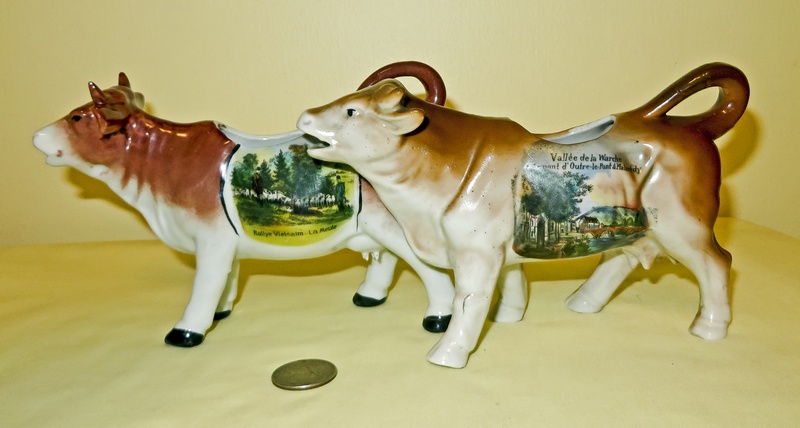
Here are four creamers from Belgian cities. The two nearly identical ones in the left photo are both from La Panne, on the North Sea coast of the Belgian province of West Flanders. The Belgian royal family lived here during WWI because it’s in the tiny fraction of the country that wasn’t conquered by the Germans. The cow on the left sports “La Digue, Les Villas Royales”, and its mate features “La Digue et la Plage”. Apparently the Dike is a prominent and popular feature. In the right photo, the cow with black hooves is a souvenir of “Rallye Vielsalm, La Meute” For those who are stuck with just English, it depicts ‘the pack’ at a fox hunt in Vielsalm, a Walloon municipality of Belgium in the province of Luxembourg. Its colleague advertises “Valee de la Warche, Le Pont de Outre - Le Pont a Malmedy” The Warche is a river in the eastern Belgian province of Liege, which flows through the village of Malmedy, site of a massacre of American POWs by Nazi SS troops during the Battle of the Bulge. |
|
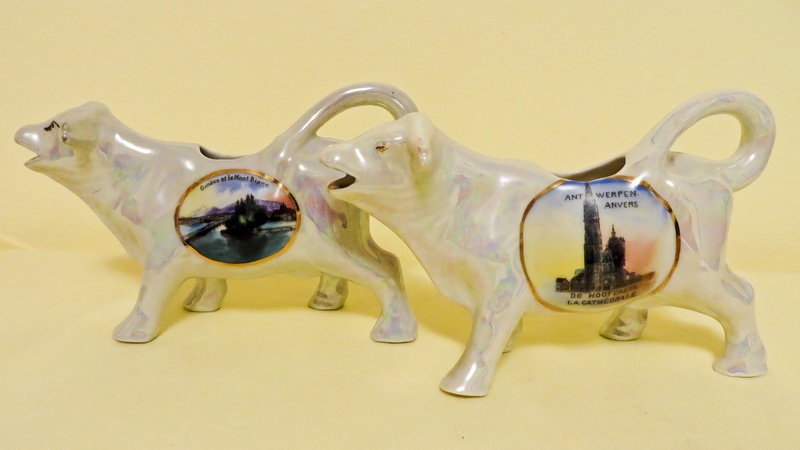
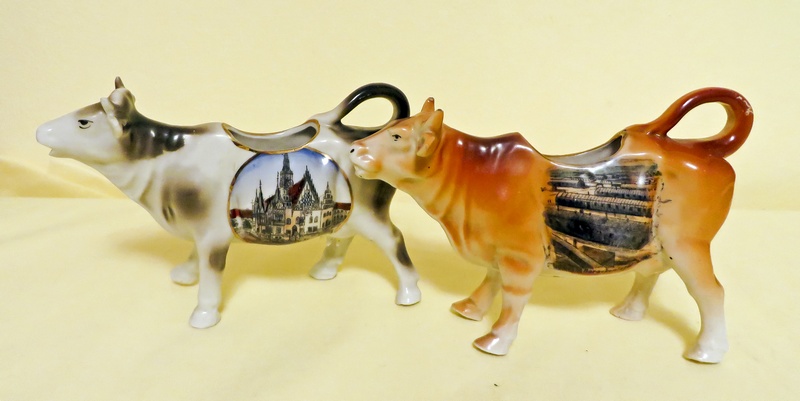
These four are from a variety of European locations. The little white one on the left with the picture of “Geneve et le Mont Blanc” is quite obviously from Switzerland. Her bilingual (Dutch/French) companion states “Antwerpen Anvers, De Hoofdkerk, La Cathedral” and comes from the capital of the Antwerp province of Flanders Belgium, the 2nd largest port in Europe. The grey and black cow displays the “Rathaus Breslau”, formerly in Lower Silesia of Germany and now known as Wroclaw, Poland. The reddish-brown cow bears “Barackenlager” beneath the picture of the barracks, and “Gruss von Fruppen-Ubungsplatz Elsenborn” on its belly, basically Greetings from the training camp in Elsenborn, Belgium. This town is noted for the Battle of Elsenborn Ridge in the Ardennes Forest, the only sector of American front lines in the Battle of the Bulge where the Germans failed to advance. |
|
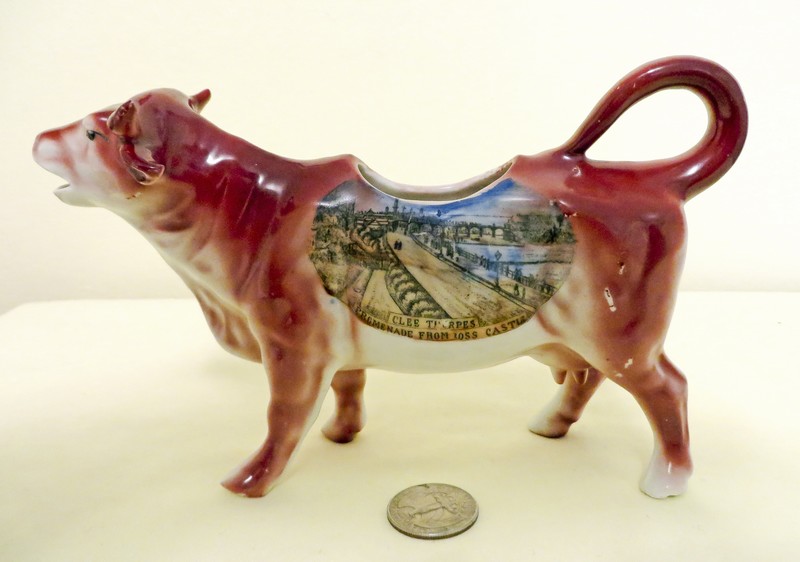
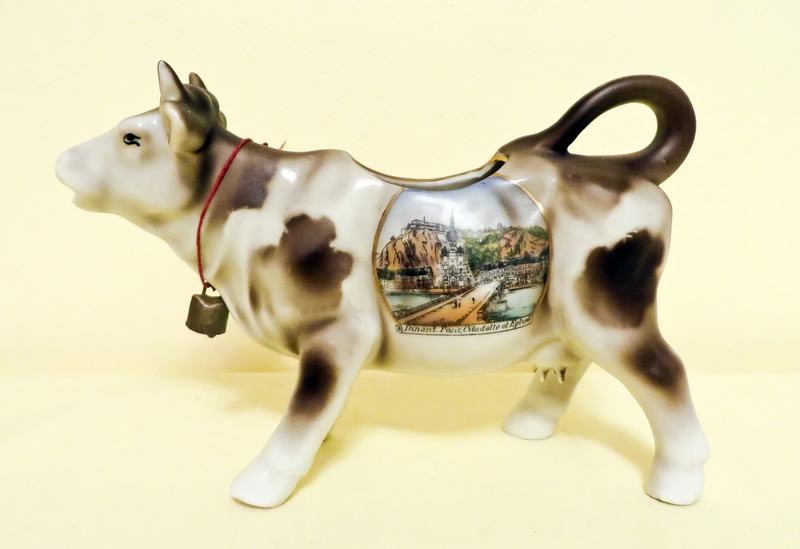
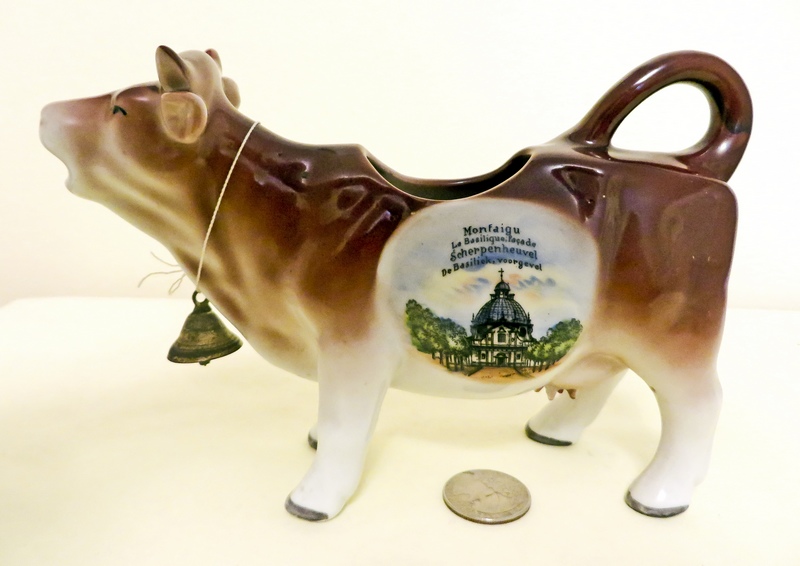
To complete the roster of the German cows from the Belgian collection, we start with one more from England, the second of my souvenirs from Cleethorpes showing the Promenade from Ross Castle, the mock ruin built in 1863 by the railway as a tourist attraction, and named after its then president. The little grey and black cow with the bell pictures “Dinant – Fort, Citadelle et Eglise”. Dinant is a Walloon city on the River Meuse in Belgium, and the 11c Citadel and Gothic 13c Collegiate Church of Notre Dame de Dimant are its major sights., And last but by no means least, another cow from one of my favorite molds, is from ”Montaigu, La Basilique Façade, Scherpenheuvel, de Basiliek, Voorgevel”. This ‘sharp hill’ is the most important Roman Catholic pilgrimage site in Belgium, located some 50 km east of Brussels. Wikipedia tells us that its origins date back to the pagan worship that still survived during the Middle-Ages around a holy oak on the hilltop, The cross-shaped tree was ‘Christianized’ with a statue of the Holy Mary. |
|
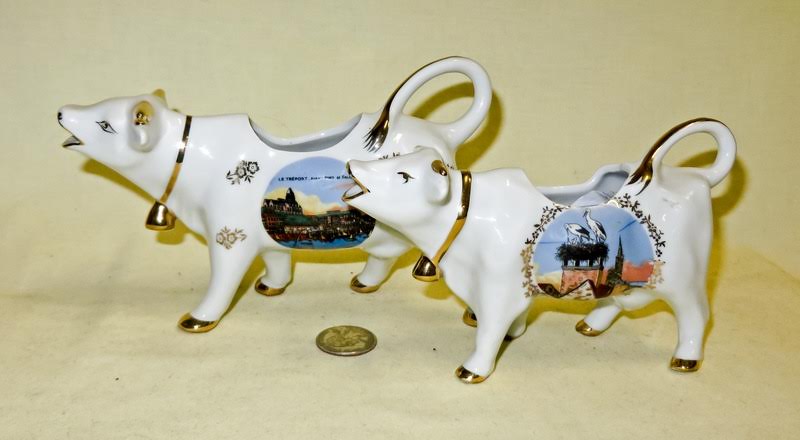
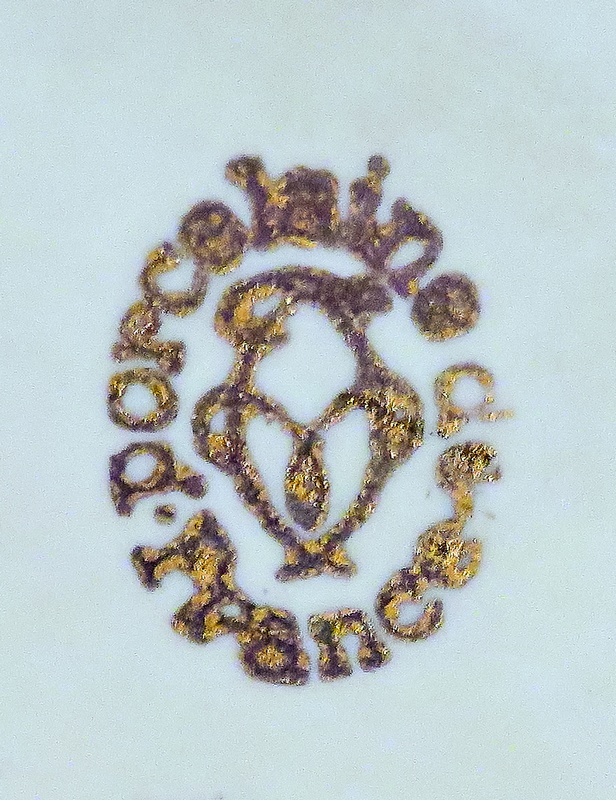
These beautifully crafted cows bear at least a family resemblance to the German crested transfer-picture creamers. In this case however, we know that they’re French from the ‘Porcelaine de France’ stamp (can’t identify the mark) on the hoof of the larger cow. It bears a picture of “Le Treport – avant port Eglise” I bought it on eBay from a group called Plucky Maidens of Portland, Oregon. Among other things they lead shopping tours to the flea markets of Paris. They said that this cow came from the Porte de Vanves ‘marche aux puces’ in the 14th arondissement (weekends only, and it can be reached on line 13 of the Paris Metro should you care to visit - it’s purportedly one of Paris’s best). Wikipedia informs us that Le Treport is “a small fishing port and light industrial town situated in the Pays de Caux, some 21 miles (34 km) northeast of Dieppe … The mouth of the Bresle river meets the English Channel here, in between the high (110 metres) chalk cliffs and the pebbly beach. Le Tréport is also a sea-side resort and home to a casino.” They also note that it was the location for the “2014 French police thriller Witnesses (Les Tremoins).” . The similar but smaller cow here has a black stamp on the belly with the same maker’s mark as well as “Made in France”, and its picture is of nesting storks. It was also an eBay purchase, but without the pleasure of an interesting story since it came from the un-exotic city of Houston TX. My wife and I haven’t seen nesting storks in France, but we have spent quite some time watching them in places like Hungary, Estonia, and Uzbekistan. |
|
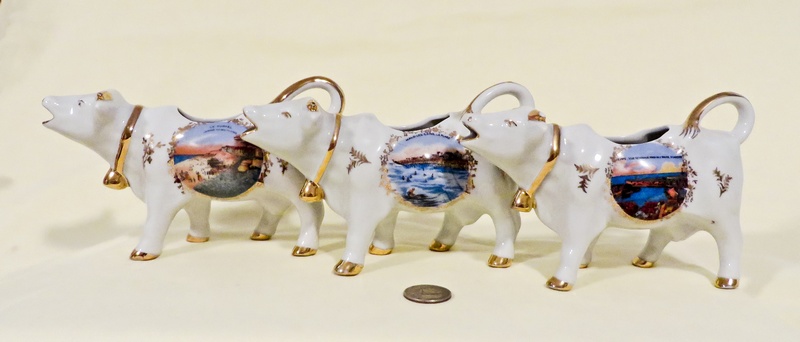
These three similar cows, as well as the two below and the mustard, salt & pepper boat, all came
to me via the ‘catawiki.com’ auction site from the extensive collection of the Belgian gentleman from
whom I also got a large herd of German transfer creamers. |
|
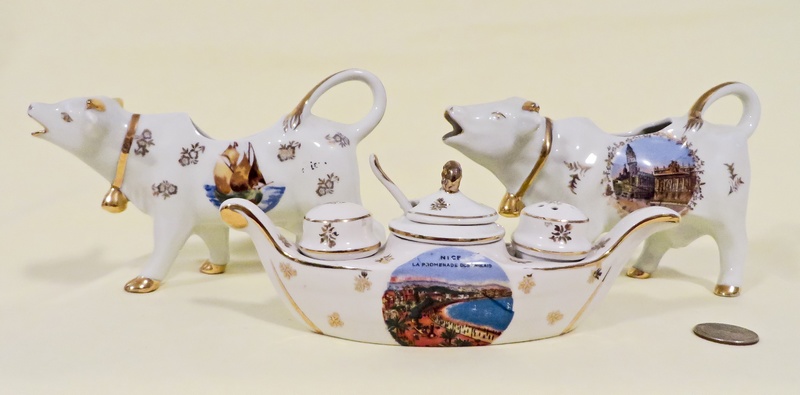
The cow on the left simply bears a picture of a sailboat. The one on the right has “Lille – la bourse et le theatre”. Lille is in French Flanders, on the Deûle River, near the border with Belgium. Wikipedia states that “the legend of "Lydéric and Phinaert" puts the foundation of the city of Lille at 640. Lille's Dutch name is Rijsel, which comes from ter ijsel (at the island). The French name has the same meaning and comes from l'île (the island).” The cute little mustard, salt & pepper boat – which came with the cows – features “Nice – La Promenade des Anglais”. Our Wikipedia source explains that “Starting in the second half of the 18th century, the English aristocracy took to spending the winter in Nice, enjoying the panorama along the coast. In 1820, when a particularly harsh winter up north brought an influx of beggars to Nice, some of the English proposed a useful project for them: the construction of a walkway (chemin de promenade) along the sea. It was paid for by the Rev. Lewis Way. The city of Nice, intrigued by the prospect of a pleasant promenade, greatly increased the scope of the work. The Promenade was first called the Camin deis Anglés (the English Way) by the Niçois in their native dialect Nissart. After the annexation of Nice by France in 1860 it was rechristened La Promenade des Anglais.” |
|
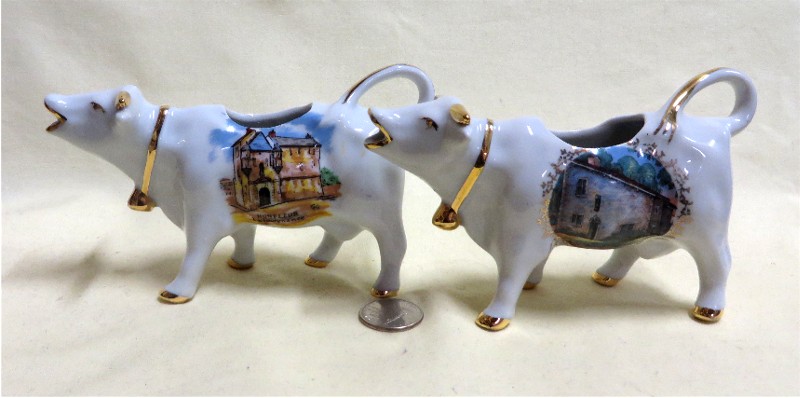
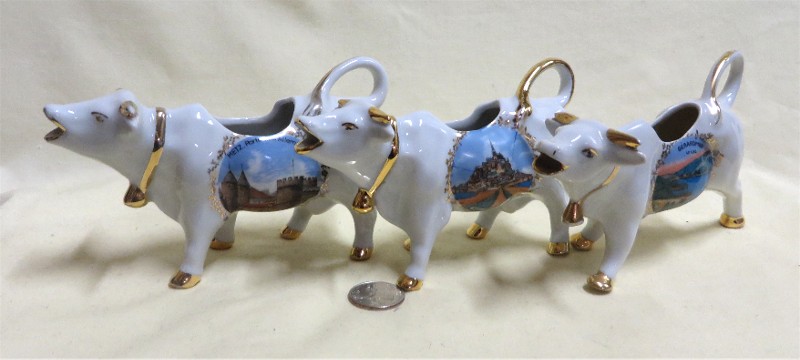
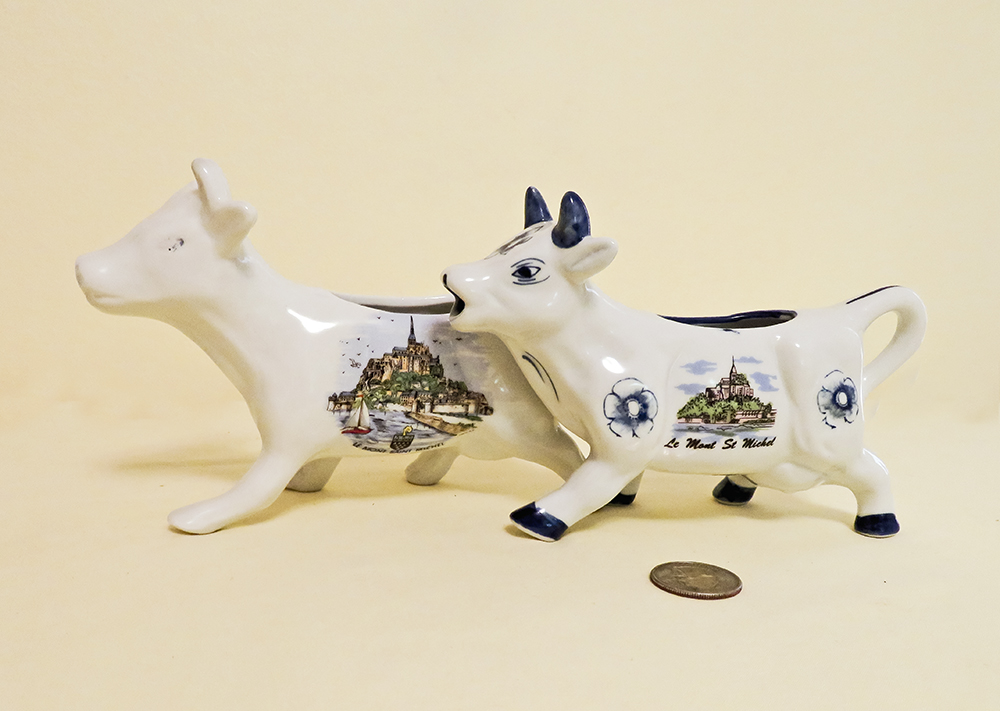
These five are from the second batch of French porcelain cow creamers that I got from a Belgian gentleman’s collection via the Catawiki auction site. From left to right they represent cities as follows, information courtesy of Wikipedia: Honfleur is in northwestern France, across from Le Havre on the southern bank of the Seine estuary. This cow displays the 18c Lieutenancy building which is at the entrance to the old harbour, initially home to the Lieutenant of the king, later the commerce tribunal, then the local governor. Next is a cow from Domrémy in northeastern France, now called Domrémy-la-pucelle in honor of the Virgin of Orleans, Joan of Arc, whose birthplace home is pictured. This cow (I assume it’s a heifer) must be very proud to be so honored. In the second picture, on the left is a cow from the old city of Metz which is in northeast France near the junction with Germany and Luxembourg. It has variously been “a Celtic oppidum, an important Gallo-Roman city, the Merovingian capital of the Austrasia kingdom, the birthplace of the Carolingian dynasty, a cradle of the Gregorian chant, and one of the oldest republics in Europe. The city has been steeped in Romance culture, but has been strongly influenced by Germanic culture due to its location and history.” Pictured is the fortified city gate ‘Door of the Germans’ which formerly served as a bridge over the river Seille. The next cow bears the UNESCO World Heritage commune of Mont Ste Michelle, located just off the coast of Normandy. My wife and I have been among its 3 million plus visitors per year. Last in this group is a cow honoring the lake at Gererdmer, now a ski resort in northeast France near the German border. |
|
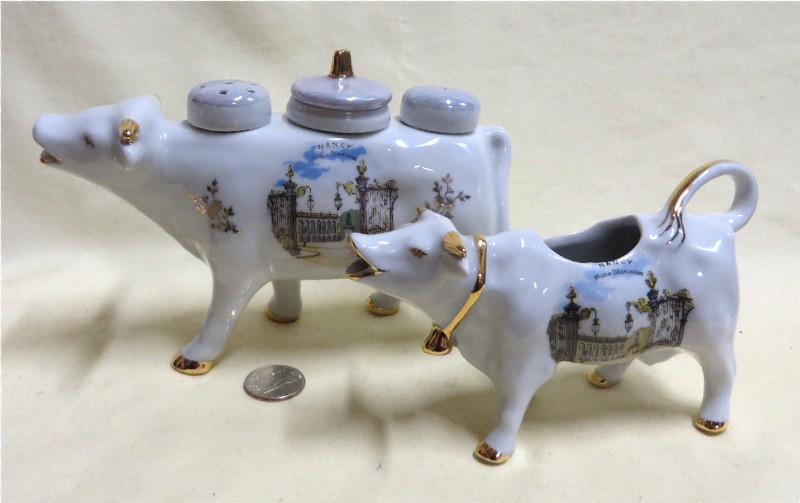 |
My first batch of these French creamers came with a boat-shaped holder for salt, pepper and mustard. In this group the condiments are housed on the back of a large cow, which with its creamer companion hails from Nancy in northeast France, formerly the capital of the Duchy of Lorraine. Pictured on both cows is Place Stanislaus, built in the mid 18c by Stanislaus I of Poland to connect the medieval old town with the ‘new town’ built by Charles III in the 17c. These days it’s a World Heritage Site. |
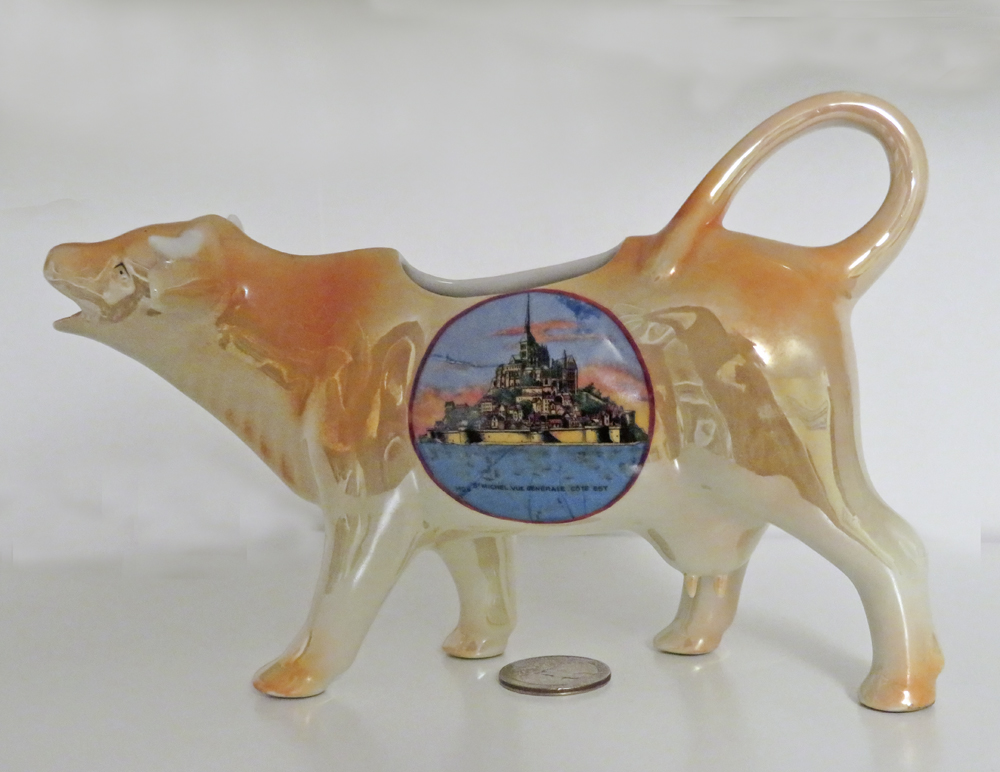
This orange lustre cow bear" the picture of a 'general view' of th east side of Mt St Michel. It has the 'Porcalaine dre France" stanp like the white ones above - the only one of theirs of a differwnt color and mold in my colelction. | |
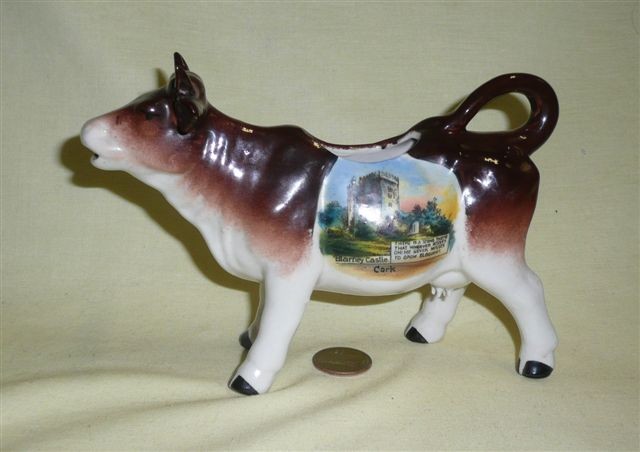 |
Here’s another Made in Germany (indeed, it has a red stamp on it’s butt that says as much) beauty, that comes from the shop of M.A. Ryan of Blackthorne House, Cork Ireland (so says a stamp on its belly) and features Blarney Castle. Built in the 1400s by the great Irish Chieftain Cormac MacCarthy, the castle is world famous for its Stone of Eloquence…proudly proclaimed on this little cow’s transfer print as “There is a stone there that whoever kisses Oh! He never misses to grow eloquent”. My wife visited but thankfully failed to kiss the stone, since the advertised ‘eloquence’ often turns out to simply be verbose blather. |
|
|
Naturally enough, there had to be a Jersey cow (in case you can’t tell from the coloration it says so on the right flank in gold) made in this very popular but expensive photo-transfer fashion. Here the picture is of the castle of Mont Orgueil, constructed (per the Wikipedia article) following the division of the Duchy of Normandy in 1204, and defending the harbor of Gorey on the east side of the island. The castle lost its warfighting utility after gunpowder came into regular use, since there is a nearby somewhat higher hill from which it could be easily bombarded. It was then used as a prison until the end of the 17c, then became run down until it was fixed up for garrison accommodation and other military and ceremonial uses. It became a museum in the 20c. |
|
|
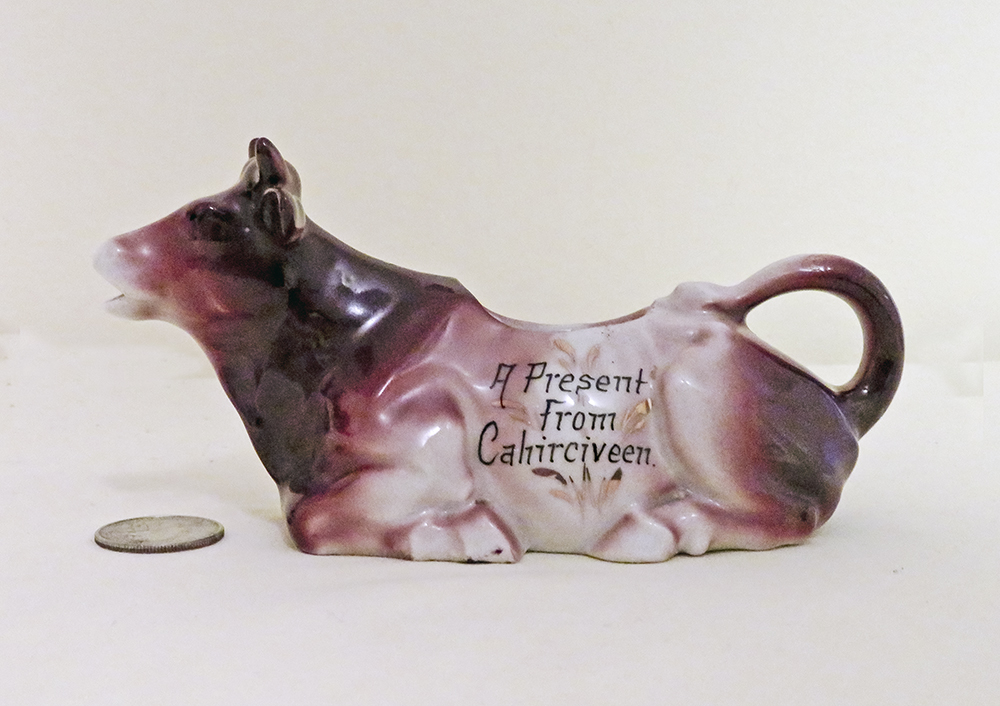
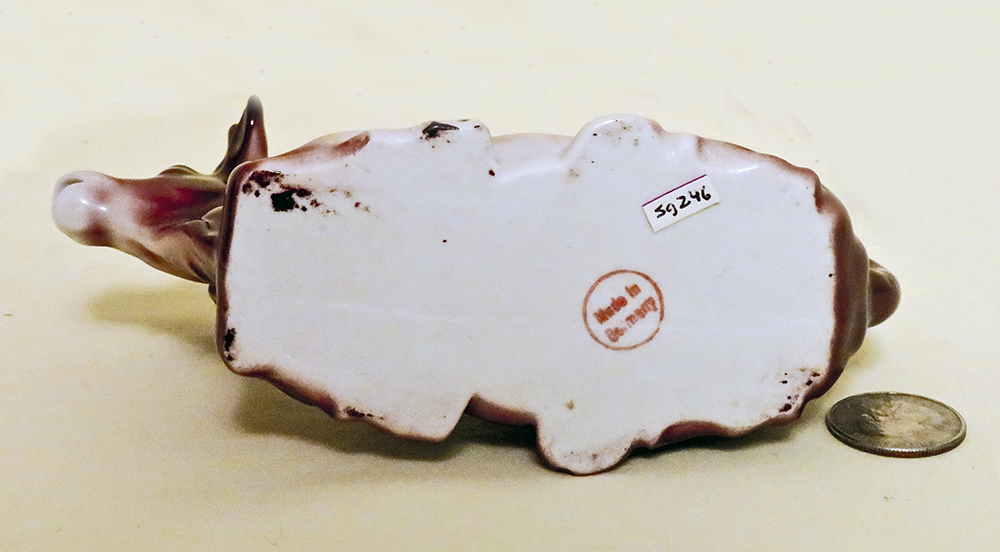
Ireland apparently also got in the act – although this pre-WWI souvenir features script as opposed to a transfer print. From Wikipedia we learn that “Cahersiveen[7][8] (Irish: Cathair Saidhbhín, meaning "Little Sadhbh's stone ringfort")—alternate spellings Cahirsiveen, Cahirciveen or Caherciveen—is a town in County Kerry, Ireland. It is located on the River Ferta and is the principal town of the Iveragh Peninsula. Cahersiveen is near Valentia Island and is connected to the Irish road network by the N70 road. It has a population of 1,294 (CSO 2006). The Catholic church in the town is the only one in Ireland named after a lay person, Daniel O'Connell. It is situated on the slopes of Bentee.[8] It also contains a decommissioned Royal Irish Constabulary barracks, now a heritage centre. Cahersiveen was where the first shots of the Fenian Rising were fired in 1867.”. From the local County Kerry tourist site we learn further that it hosts Caltric music festival in August, and is close to “Ballycarberry Castle, two ring forts, and Valentia Island”. Sounds like it would still be a fun place to visit. You might note that a bit further down this page, in the section with a bunch of pictures of souvenir cows, there’s a very similar one, from Ballinamor Ireland…from post WWI according to the ‘Foreign Made” stamp on its bottom. |
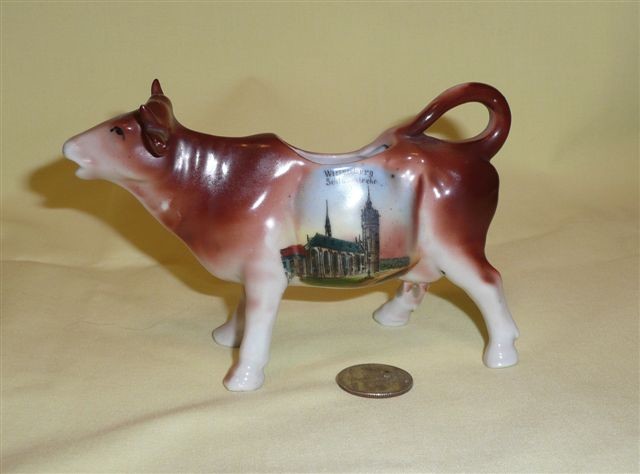
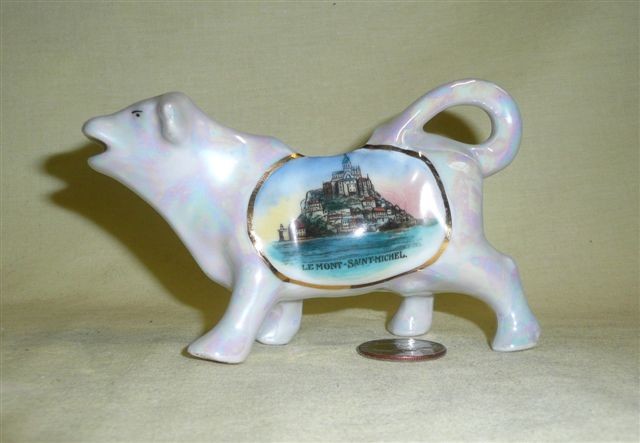
|
|
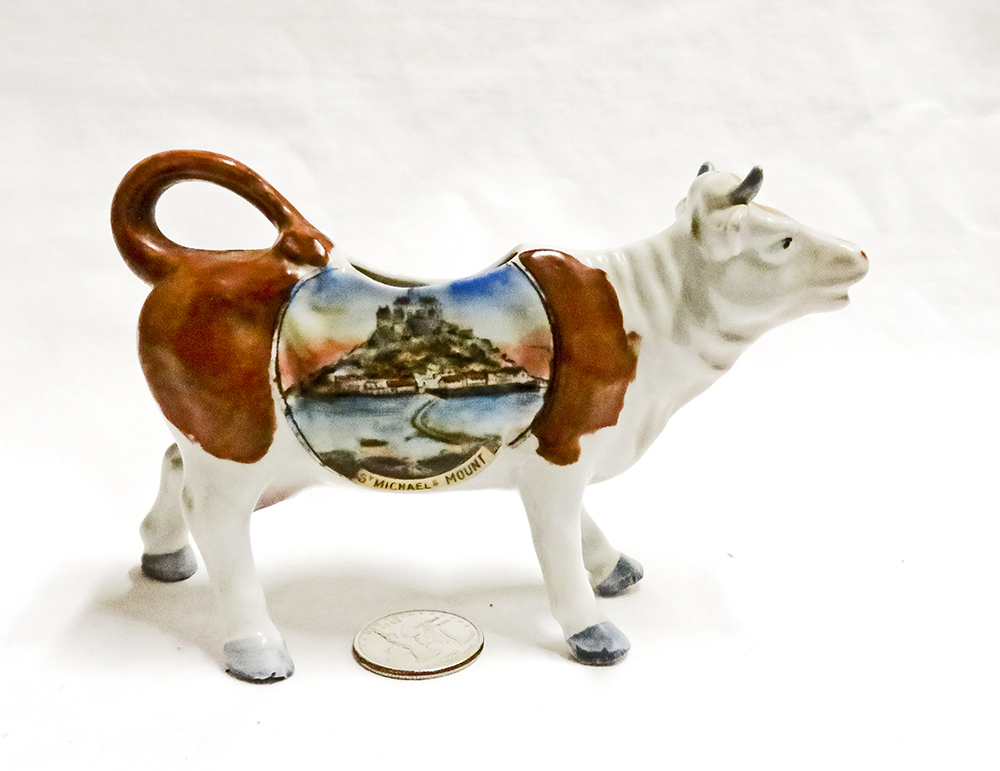 |
While most of the many souvbenir cow creamers from Mont St Michel use the French name of this popular site this porcelain, poresumably German-made one, was pretty obviously designed to appeal to visitors from the UK, since it advertises "St. Michaael's Mount". Whatever name is used, however, doesn't explain the popularity of cows as souvenirs from a place where none are to be found...at least, not grazing on opwen land. |
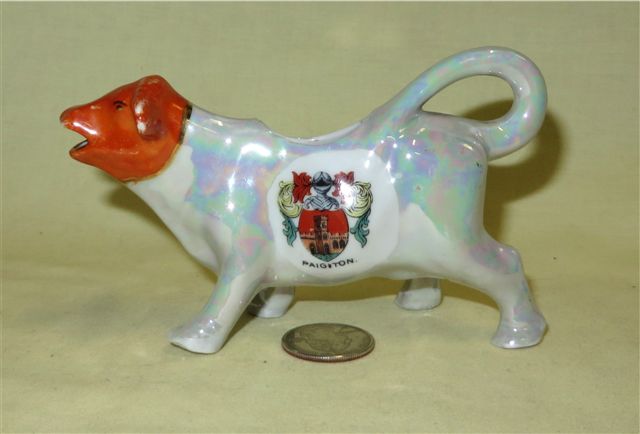 |
Here is another little luster cow, similar mold to the one above, but with a bright orange head above a thin gold stripe, and a crest inside a white area on its left flank for “Paignton”. I didn’t notice it at first but there is a faint red “foreign’ stamp on the bottom or its (yes it’s androgynous) right hind hoof, implying German descent. Wikipedia informs us that “Paignton ... is a seaside town on the coast of Tor Bay in Devon, England. Together with Torquay and Brixham it forms the unitary authority of Torbay which was created in 1998. The Torbay area is a holiday destination known as the English Riviera. Paignton's population in the United Kingdom Census of 2011 was 49,021. It has origins as a Celtic settlement and was first mentioned in 1086. It grew as a small fishing village and a new harbour was built in 1847. A railway line was opened to passengers in 1859 creating links to Torquay and London.” So as discussed elesewhere, this creamer would appear to be a ‘summer souvenir’ for the working class folks who flocked to the seaside early in the 20c and then again between the wars. It’s a lovely little cow. |
|
|
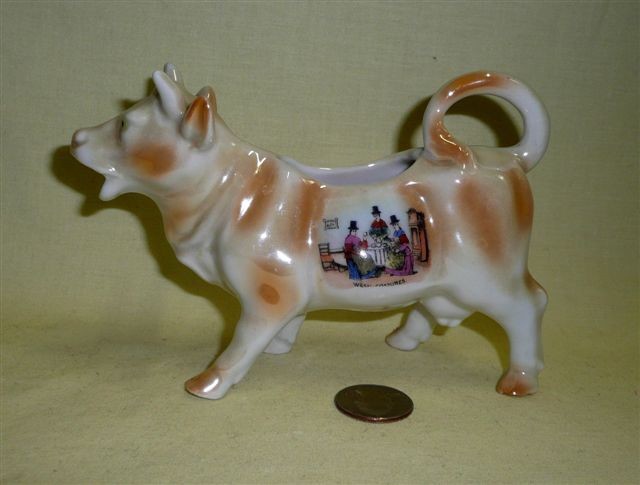
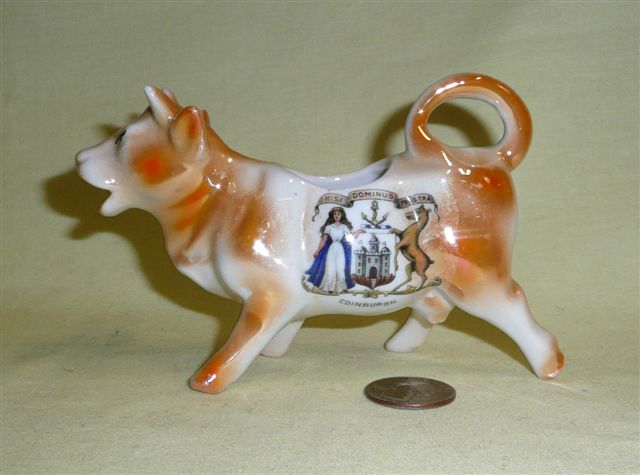
Here are two versions of an interesting variant – both German made after WWI, as evidenced by the
“foreign” stamp. As noted elsewhere, this was used during the post-war period when the Brits were
very keen on acquiring crested or otherwise marked souvenir china, but were reluctant to buy anything
recognizably German. The creamer with the picture of 3 ladies reads “Welsh Costumes”, and has “RHSL”
on the other side; I have no idea what that may mean. The other creamer bears the coat of arms of
Edinburgh…thus here we have a cow that seems to have been popular in both Wales and Scotland. For
those of you with an interest in the arcane, here’s a description of the coat of arms:
|
 |
|
 |
|
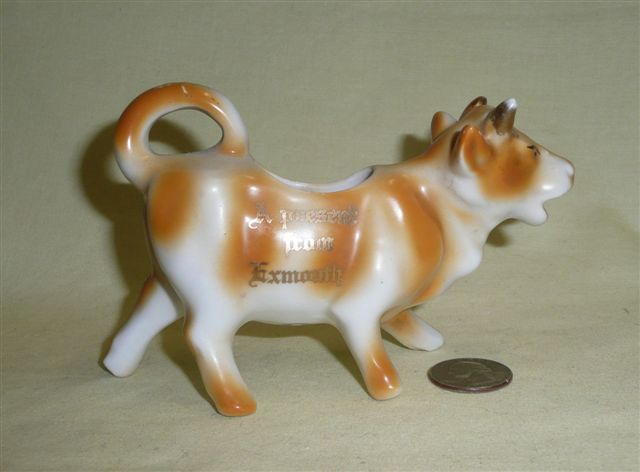
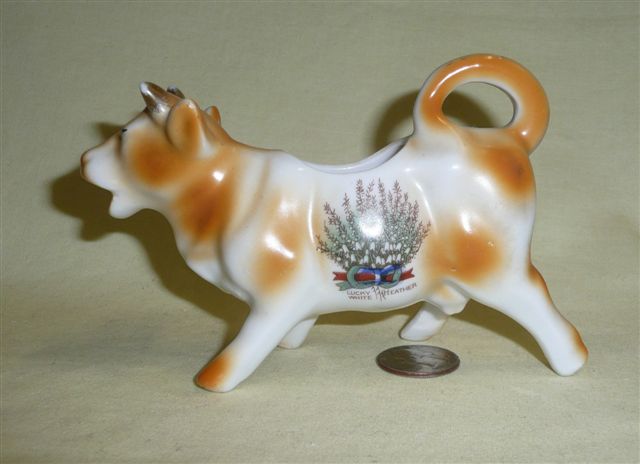
This is another British souvenir cow from a similar mold, again bearing the Foreign stamp to disguise its German origin – from Exmouth in this case. It has a sprig of ‘lucky white heather’ on its left side – a very popular crest on souvenir items. I have found several explanations of why white heather is considered lucky. For example, we learn from http://www.treesforlife.org.uk/forest/mythfolk/heather.html: that “The idea that white heather is lucky was popularised by the Victorians and their love of Scottish traditions. In 1884 Queen Victoria herself wrote about her servant Mr Brown, who "espied a piece of white heather, and jumped off to pick it. No Highlander would pass by it without picking it, for it was considered to bring good luck." White heather's luck may have been attributed to it because of its scarcity, in the same way that four-leaf clovers brought other Celts luck. Other interpretations include the more romantic notion that white heather grows over the final resting places of faeries, or the idea that in a country of many ancient battles, white heather grew on patches of ground where no blood had been shed. Indeed white heather's luck appears originally to have been associated mainly with battles; in 1544 Clan Ranald attributed a victory to the fact they had worn white heather in their bonnets, and Cluny of Clan MacPherson attributed his escape after Culloden to the fact that searchers had overlooked him whilst he slept on a patch of white heather.” On an even more romantic note, I found a couple sites, including Yahoo answers, that tell the following tale: “Long, long ago in Scotland, the famous Celtic bard, Ossian, had a daughter called Malvina. She was beautiful and sweet natured. She won the heart of Oscar, a handsome warrior. They became betrothed, but Oscar left in search of fame and fortune. Malvina pined for him and sought solace by telling her father how much she loved her brave warrior, Oscar. On a beautiful autumn day, the two were sitting on a Highland hillside when a ragged messenger staggered towards them. He brought the terrible news that Oscar had been killed in a mighty battle. The messenger held out a spray of purple heather to Malvina - a last gift from Oscar - and told her that he had died whispering her name and pledging his love. In her grief, Malvina ran over the hillside, weeping bitterly. Where her tears fell, the purple heather turned pure white. When she saw this, she said "May this white heather forever bring good fortune to all those who find it". And so, in Scotland, to this very day, white heather continues to be a token of good luck.” This is much, much more than you wanted to know, I’m sure…but isn’t it interesting the tales that cows have to tell? |
|
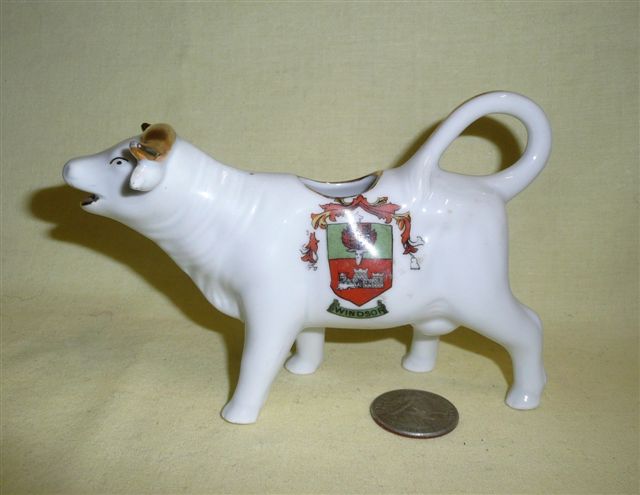 |
This creamer – from the same mold as the two above from Bournemouth and Brighton, also bears (as do they) the ‘foreign’ stamp. I find it sort of ironic that although the British public may have been reluctant to purchase items that were obviously made in Germany, the peddlers were by no means shy about using German imports as souvenirs for some of their most beloved places…here, Windsor. |
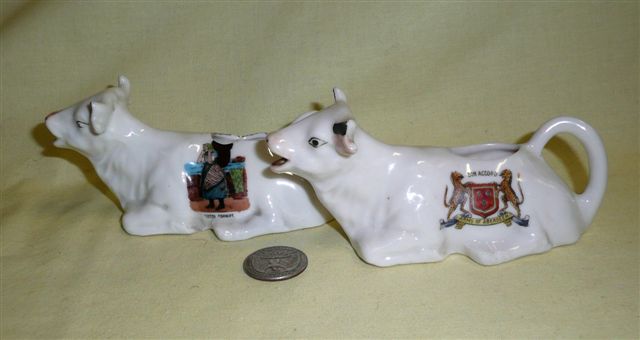 |
These two are identical but for the shape of the hole on top, and only the one on the left – with the picture of a “Scottish fishwife” - is stamped, for Gemma. From www.villagenet.co.uk/collectors/crestedchina.html we learn that “Collecting heraldic porcelain miniatures, or crested china as it is now popularly known, became a national craze in the late Victorian and Edwardian eras. During the period of its production, around 1880 to1930, it is thought that around 90% of all homes contained some pieces. Indeed, no holiday or seaside outing was complete without the purchase of some piece of souvenir porcelain. The introduction of Bank holidays in 1871, paid holidays for workers and improved wages, combined with improved travel facilities such as trains, paddlesteamers and charabancs, boosted the sales of souvenirs considerably.” Apparently the first pottery firm to come up with the ‘crest’ idea was W.H. Goss of Stoke-on-Trent, and they initiated a national craze. Cheaper products from Germany, Austria etc soon flooded the market, pushing out the more costly British china. |
 Here are examples of British and ‘foreign’ crested ware as mentioned above. The Jersey cow is
marked “Grosvenor Ware”, and the City of York creamer is stamped with the crown & shield of
Gemma . They tell an interesting (to me) story. From The Potteries web site we learn that Grosvenor
Ware is a trade name for crested china made by Sampson Hancock & Sons, earthenware manufacturers
at Tunstall 1857-70, then at other works in Stoke and then Hanley. “The company was founded by
Sampson Hancock, a prominent Wesleyan, in 1857 and was renamed S. Hancock & Sons (Potters) Ltd.
in 1935. It closed in 1937, having been put into receivership on 23rd March. It was a relatively
small enterprise, employing around 150 people. Sampson Hancock died on 9th May 1900 and was succeeded
in the business by his sons, Jabez, Harry and Arthur. The company produced tablewares and
fancies for the popular market - its main income being from semi-porcelain and earthenware
tablewares, toilet wares, vases and vitreous hotel wares. Many of the products, including ironstone
china, were for export markets. After WW1 the company increased its production of ornamental and
decorative wares. These included children's wares and doll's heads. Boxed teasets for children were
being produced by 1917 featuring popular nursery rhymes and pictures of children. The company also
produced a range of crested wares, these being marked with the trade name The 'Duchess'
China or The 'Corona' China and Grosvenor Ware. These may have been produced
in quantity to see the company through the war years when skilled labour was unavailable.Pieces
included animals, small decorative dishes and Great War commemoratives, or had English or Welsh
crests. Crested ware appears to have been made until the 1920s.” I had trouble learning anything
about Gemma until I came across another collector’s very interesting and informative website, for
match strikers of all things! (http://www.matchstrikergallery.pwp.blueyonder.co.uk/index.html)
There I learned that Gemma crested ware comes from “Victoria” Schmidt & Co. “This Czechoslovakian
porcelain factory was founded by Lazarus and Rosenfeld in 1883. They then sold the business to
Franz Schmidt in 1885. It lost it's independence in 1945 when it merged with two other firms,
Altrohlau Porcelain and EPIAG to become a part of Starorolský Porcelán. Then in 1958 it became part
of Karlovarský Porcelán Stará . Since around 1970 the factory has been used as a training
facility. Outside of it's home territory it is most well known for the Gemma crested ware range,
although a variety of other wares were also produced. The Crown and Shield mark … was used between
1918 and 1945.” In addition to the history of these two companies, what makes this interesting is
that although both creamers seem to be from identical or very similar molds, the Czech-made creamer
is much more detailed and of higher quality (if indeed cheaper) than the Brtitish one. It may well
be that the Jersey cow dates from the ‘war years’ (WW I that is) as discussed above. |
|
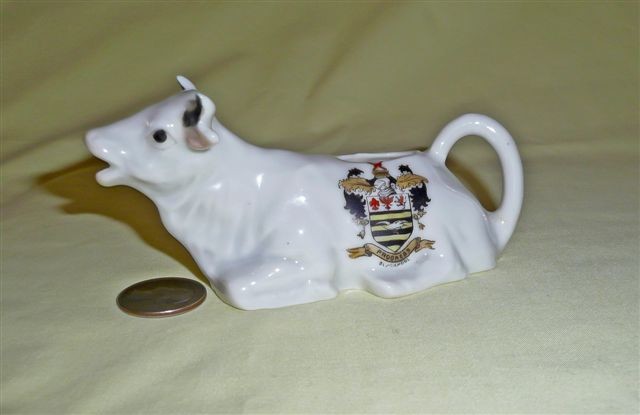 |
Here’s another Gemma beauty, this time bearing the crest of Blackpool. These remain very popular in the UK, and thus bring quite a nice price. |
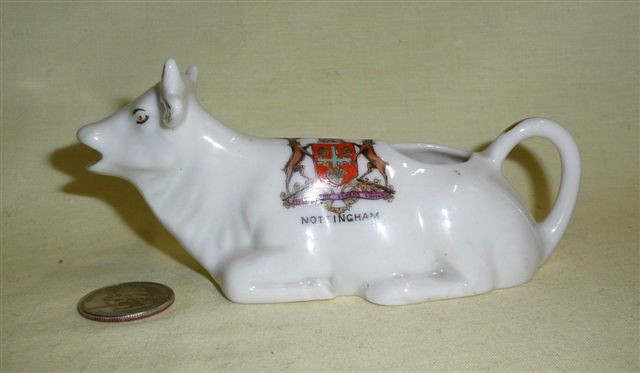 |
This seemingly identical creamer bears the crest of Nottingham as well as a mark that reads “Shelly China, 317, Model of Early Staffordshire Cow Cream Jug”. So apparently there were several potteries with copies of this mold. From Wikipedia we learn that “Shelley Potteries, situated in Staffordshire, was earlier known as Wileman & Co. which had also traded as The Foley Potteries. The first Shelley to join the company was Joseph Ball Shelley in 1862 and in 1896 his son Percy Shelley became the sole proprietor, after which it remained a Shelley family business until 1966 when it was taken over by Allied English Potteries. Its china and earthenware products were many and varied although the major output was table ware. …Shelley is probably best known for its fine bone china “Art Deco” ware of the inter-war years and post-war fashionable tea ware.” There are Shelly collectors’ clubs in both the UK and US. Howver to me, the most intriguing point here is the indication that there was a much earlier version of this ‘jug’ – so now I have to keep looking! |
 |
Just when I think I have more than enough examples of one style or maker, along comes one I just can’t pass up. So, here’s yet one more Gemma creamer, this time not from the UK at all but rather advertising “Umgungunhlovu, Pietmartinzburg”. As you can imagine this sent me to the atlas, then to Wikipedia where I learned that “Pietermaritzburg is the capital and second largest city in the province of KwaZulu-Natal, South Africa. It was founded in 1838, and is currently governed by the Msunduzi Local Municipality. Its "purist" Zulu name is umGungundlovu, and this is the name used for the district municipality.” I can’t explain why the cow has an ‘h’ instead of a ‘d’, but it does… Now, while the folks down there do indeed have cows, I have a strong suspicion that this souvenir was designed to catch the eye of a British tourist (or expat? Or Canadian, since it came to me from there). Whatever…as I’ve mentioned elsewhere, one of the fun aspects of my collection is that you can’t help but learn new things from cows. |
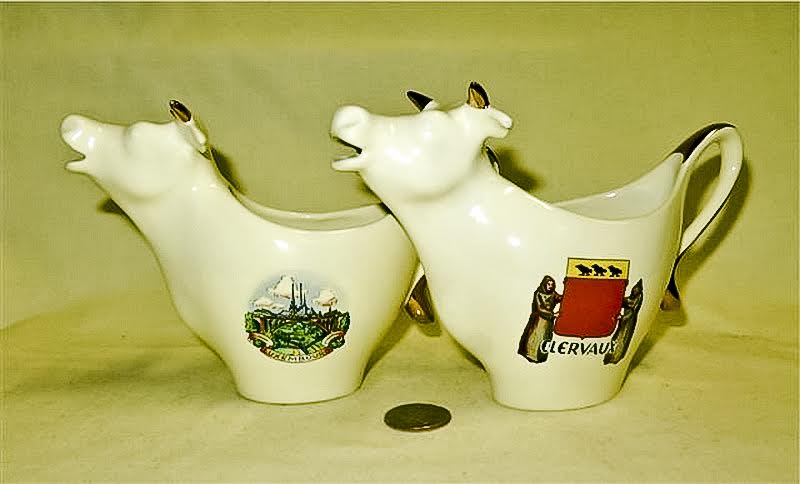
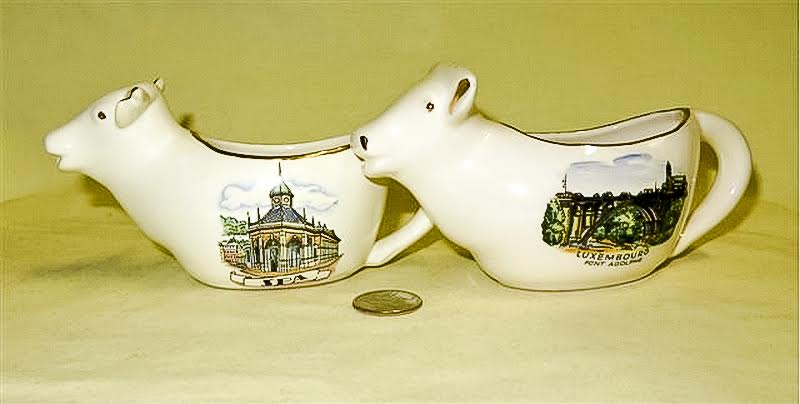
While most of the early souvenir creamers were from German or English potteries, other factories took advantage of their popularity. Here are four from Luxembourg, which I acquired from the large and lovely collection of a Belgian gentleman. He had more examples, but I decided that these four would be adequate for me.. The larger ones with their heads raised are both bottom-marked for “Villeroy & Boch” (as well as “Made in Luxembourg”) which per its web site has had a proud tradition of “elegance, innovative design and exceptional quality” since 1748. These two aren’t quite that old, but like others of this genre are likely late 19c or very early 20c. One bears a transfer picture of their home town, and the other displays the shield of Clervaux, a town and commune in northern Luxembourg. I assume that the monks bearing the shield are from the nearby Abbey of St Maurice & St Maur. Villeroy &Boch have fashioned a more modern cow creamer (in Modern Variations), but as of this posting none are shown on their web site. Of the two more recumbent cows, one has a picture of Pont Adolphe in Luxembourg and the other simply “SPA” which I am quite sure in this case refers to the name of the town in Belgium from which the generic term for a curative mineral spring was derived. The former bears a circular stamp with inside wording that reads “Made in Luxembourg” around “A.L.” while the SPA cow is unmarked but obviously from the same mold. There is a more modern cow of theirs, along with more information about V&B (now villeroyboch-group) near the bottom of the Favortie Brands page. |
|

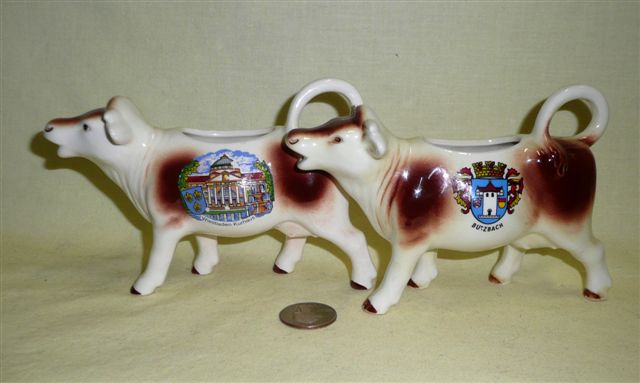
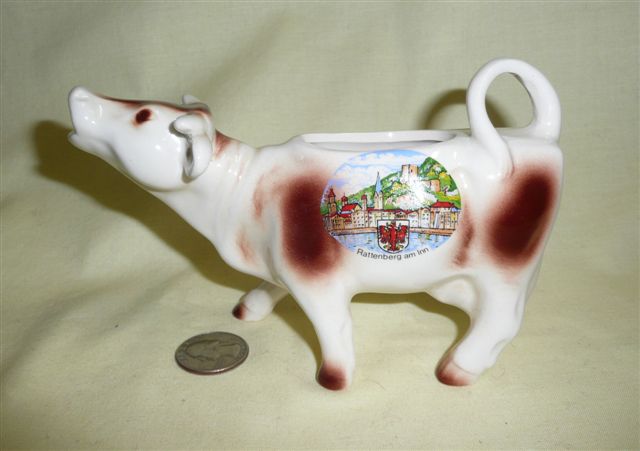
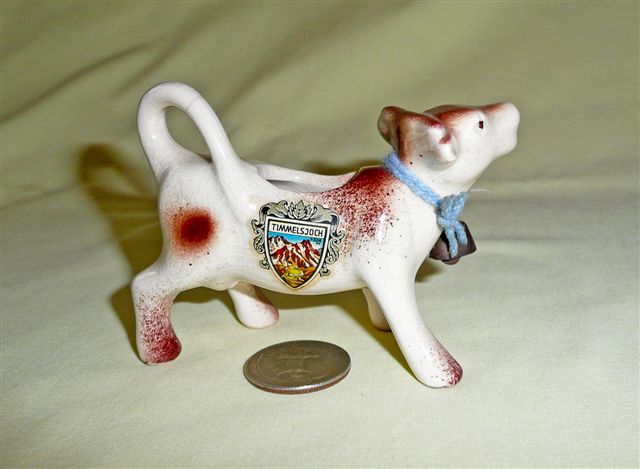
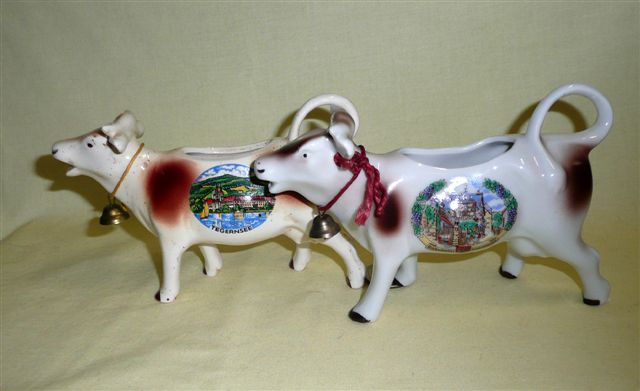 The more modern (here post-WWII) creamers remained popular as souvenirs but the pictures and crests are quite a bit less refined, and much cheaper to produce than those with the earlier transfer process. These six are all from the same mold – and all, I believe, are manufactured by Goebel, although only the ones from Cham and Tegernsee (both have bells) are marked for them…with the TMK-3 small stylized V-bee, used from 1960-1972. The other four are simply marked in blue (as are the Cham and Tegernsee cows) “Made in W. Germany”. Part of the fun of these is learning a bit about the towns they depict, largely via Wikipedia: Hartberg is a small town in Styria, Austria; it was first referred to as a ‘civitas’ in 1286, but settlements there date back to 3c BC, and presumably the tower visible on the hill is one of the remnants of that early fortification. Monks founded a church in the Bavarian forest near Cham (pronounced Kam) in the 8c, and the town itself has borne this name since late 10c. Wiesbaden is an old spa town on the north bank of the Rhine in Saxony, continuously occupied since the Romans build a fort there in 6AD. The creamer’s picture depicts the neo-classical spa-house, built at the request of Kaiser Wilhelm from 1904-07. Butzbach is in Hesse, Germany, and housed many US Army troops until they pulled out after the end of the Cold War. Tegernsee is a spa town in Bavaria, about 50 miles south of Munich, on the lake of the same name. Its Benedictine abbey was founded in 746, and secularized in 1803 at which time it became the summer home of the Bavarian royal family, the Wittlsbachs. |
|
|
|
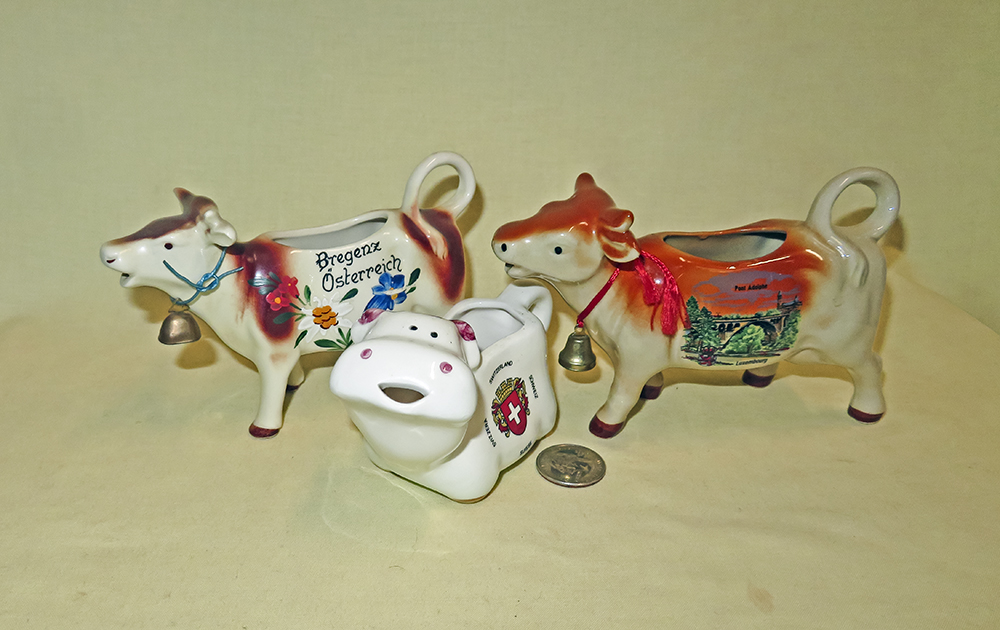 |
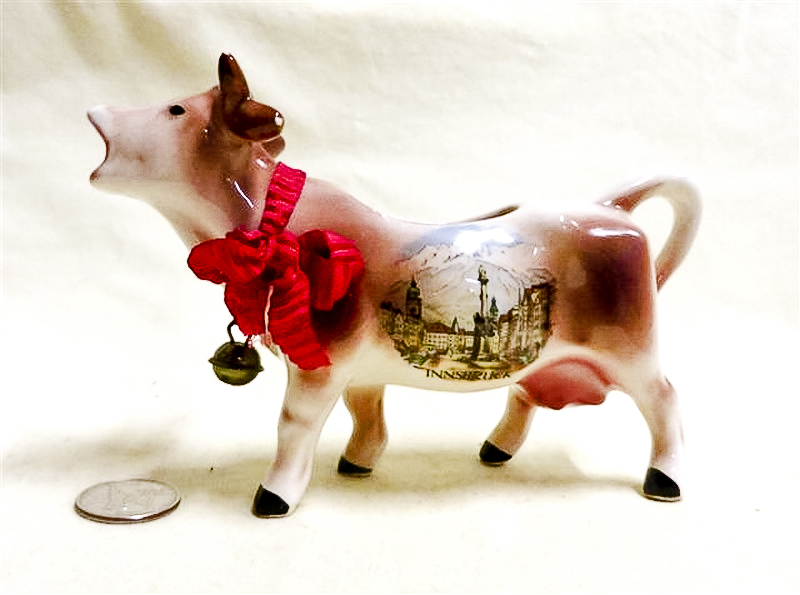
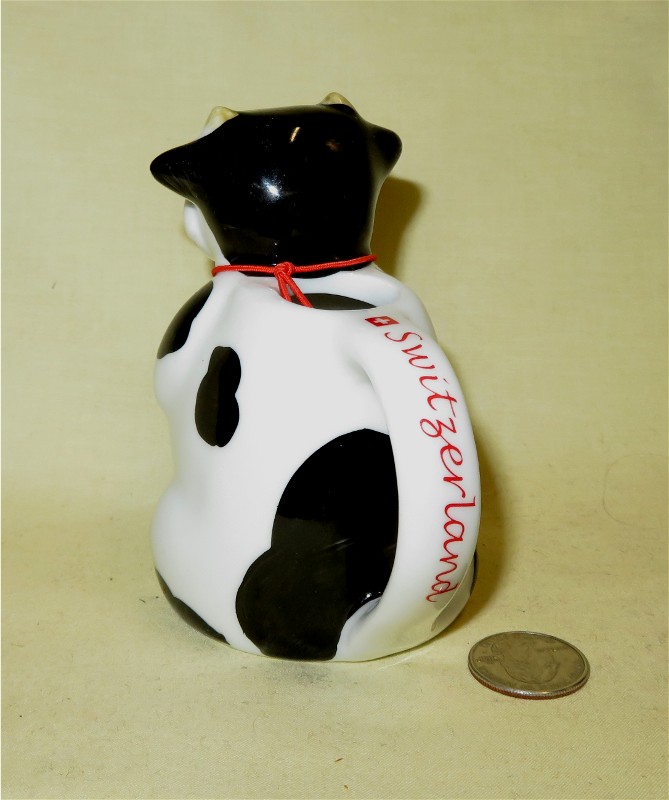
Here are souvenirs from Austria, Luxembourg and Switzerland. The “Bergenz Osterreich” creamer with hand painted flowers over the glaze is a small v-bee Goebel. It celebrates the capital city of Voralberg, the western most state of Austria, famous for its music and dance festivals. The little Luxebmourg cow has a decal for Pont Adolphe, the famous double decker arch bridge built between 19090-03 and named for Grand Duke Adolphe who reigned from 1890-1905. I particularly like the little Swiss guy, who names its country in four langruages. Like many Swiss souvenirs I expect it was made in Japan, since I have others like it that bear that imprint. |
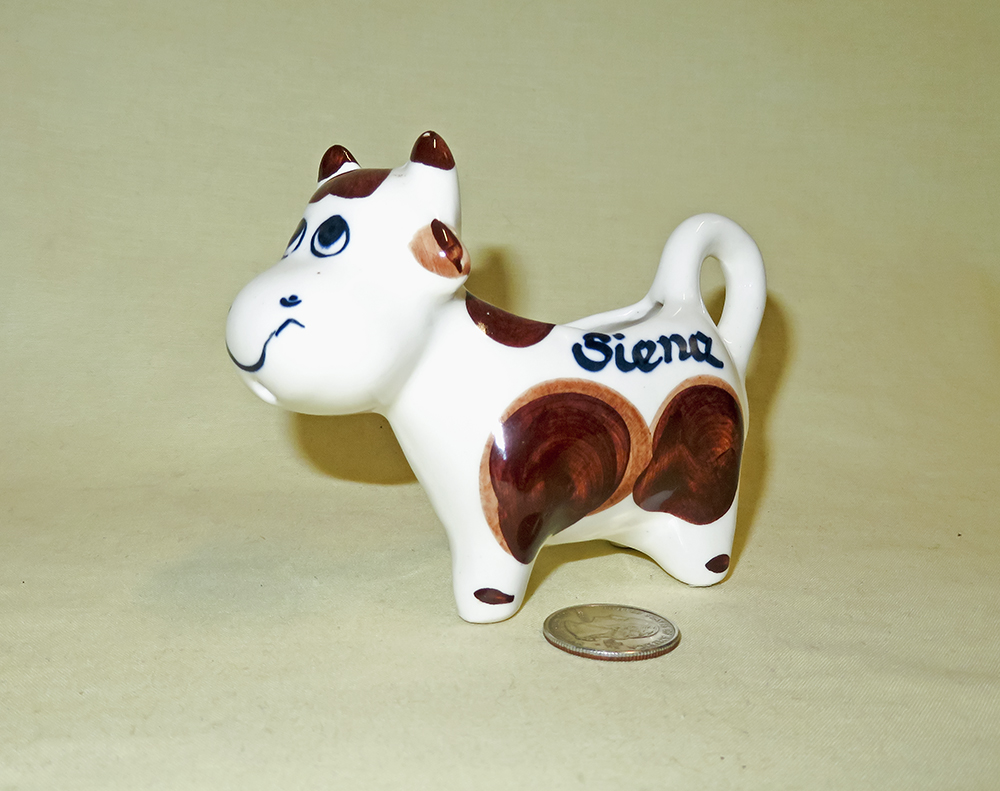 |
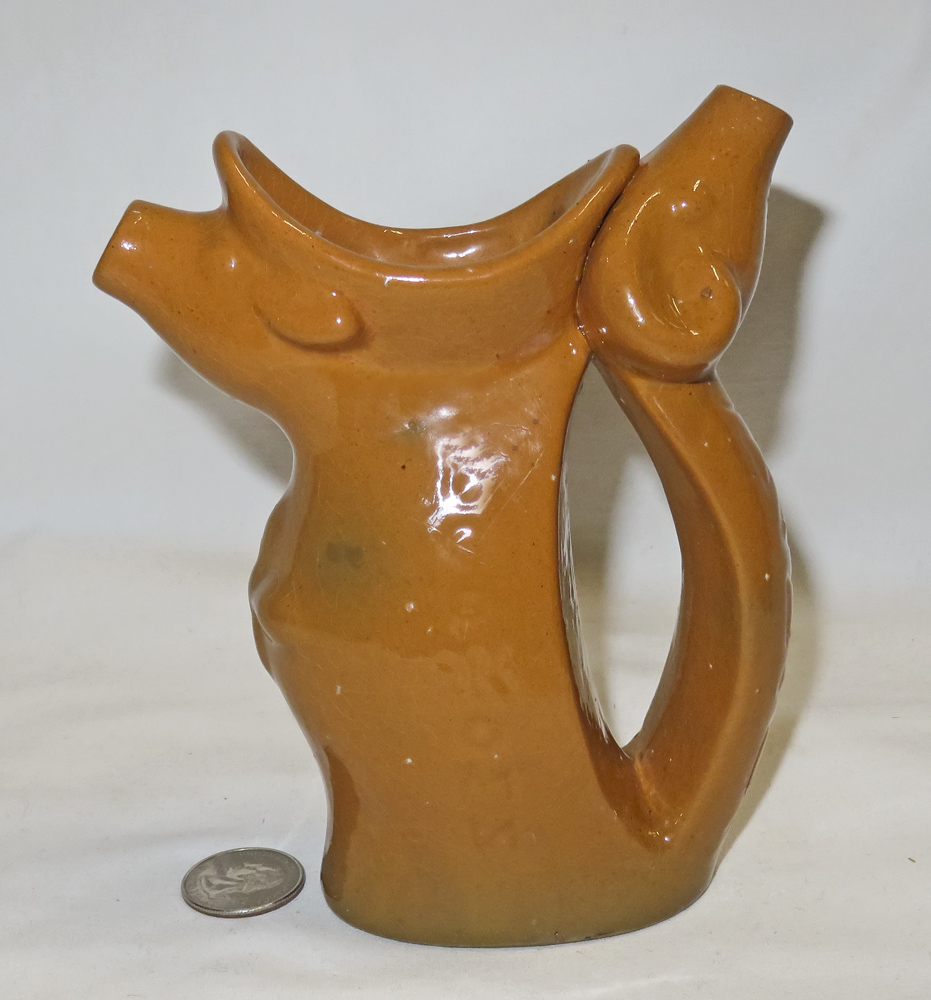
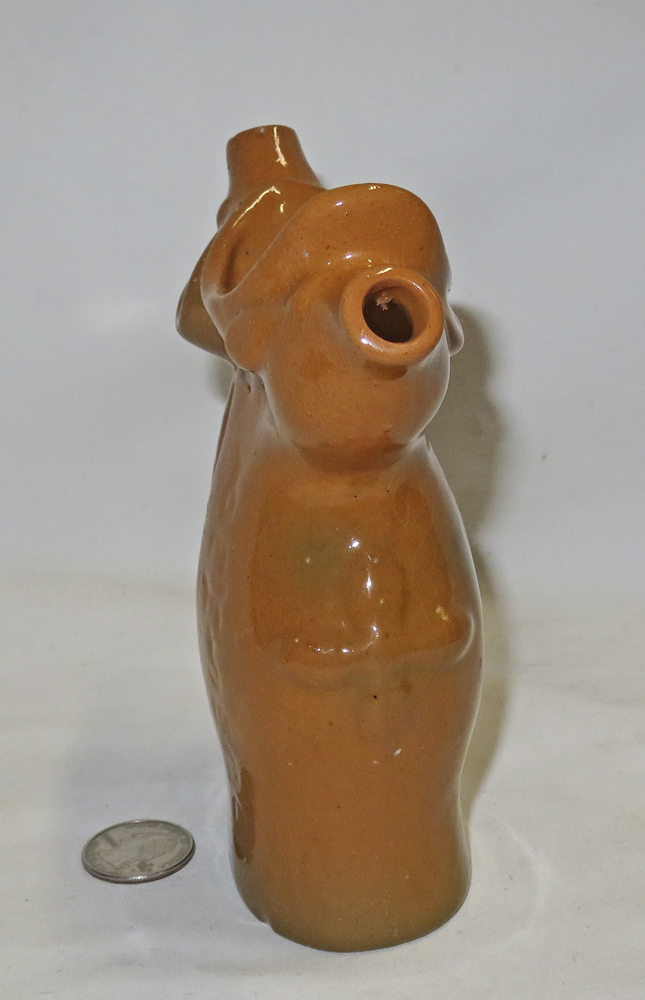
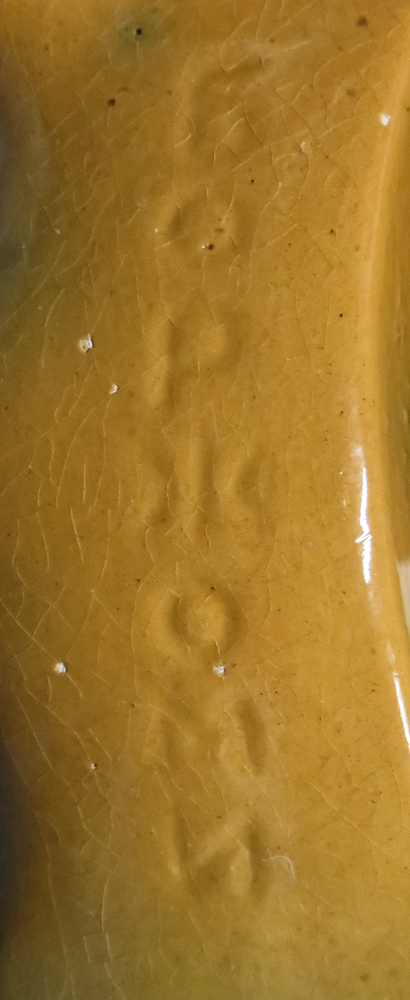
Th1s little caricature with the oversized head is a bit of a strange combination: a Polish cow, marked for Siena which is a very popular medieval town and UNESCO World Heritage site in Tuscany, Italy. Why would Italians choose to advertise one of their very lovely old cities with a Polish cow caricature?? |
|
|
|
|
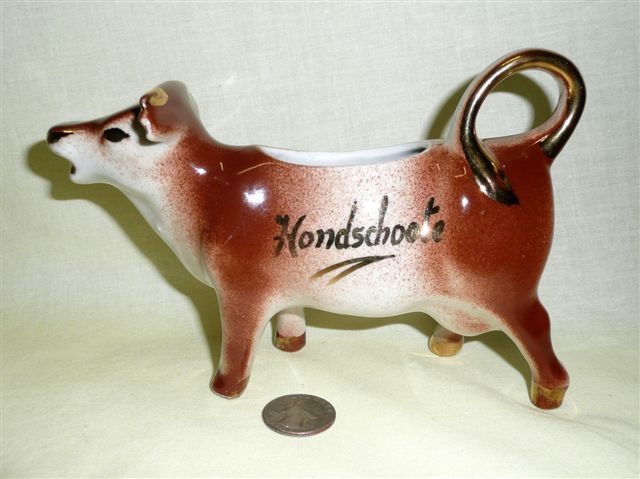 |
This unpretentious little brown cow provided quite a history lesson for me when I went to the web to look up the name on its side. From www.nationmaster.com, with a bit of added spice from wikipedia merged in, we learn that “Hondschoote is a commune of the Nord département in France. It lies on the French side of the Franco-Belgian frontier, just inland from the North Sea. The North Sea is a sea of the Atlantic Ocean, located between the coasts of Norway and Denmark in the east, the coast of the British Isles in the west, and the German, Dutch, Belgian and French coasts in the south. ... In the Middle Ages, Hondschoote was part of the Spanish Netherlands. A thriving wealthy cloth-town, it had thousands of small workshops making serge cloth from locally-grown linen flax. But in the 16th century, when French armies attacked the Spanish army, battles raged over Hondschoote. The French burned and looted the town. The cloth-makers of Hondschoote fled as refugees to what is now Belgium and to England, taking their skills to benefit France's rivals. “The famous Battle of Hondschoote was a key event in saving the French Republic after the Revolution. It was fought from September 6 through 8, 1793 during the French Revolutionary Wars and resulted in a French Victory under Generals Jean Nicola Houchard and Jean-Baptiste Jourdan against the British under the Duke of York. The English king sent an army via Flanders to capture Dunkerque as a key invasion port to rid the country of revolutionaries. They were joined by troops from Hanover and Austrians from neighboring Austrian Flanders. 40,000 Frenchmen defeated 24,000 British and Hanoverian soldiers, capturing 6 flags and all of the Duke of York's artillery. This strategic victory resulted in the British lifting the siege of Dunkirk. Despite his triumphant entry into the city, General Houchard was later tried and guillotined for failing to pursue the British." Really sweet guys, those French revolutionaries. |
|
|
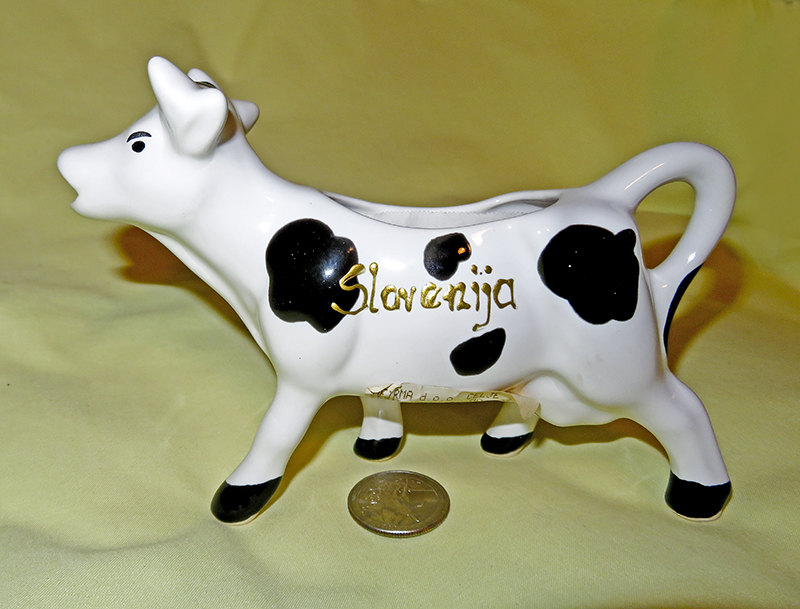 |
This is my only cow from Slovenia – not made there, I’m sure, but a nice souvenir from my visit to that lovely country nonetheless. |
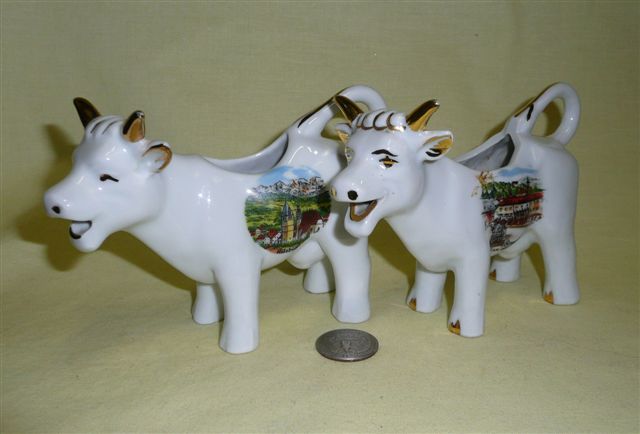 |
Here are a couple of devilish-looking Austrian souvenirs, the one on the left from Kitzbühel, a medieval city in the Tyrol, Austria, that’s now a very fancy ski resort. Its picture nicely displays the old buildings of the town set against the mountains. The one on the right advertises Bruck an der Mur, in the Austrian state of Styria at the confluence of the Mur and Mürz rivers, founded in 1263. Once an important medieval trade center, in addition to remaining an important rail and river junction it’s now known for it’s annual artist and clown festival. The picture shows its famous 15c Kornmesser house. |
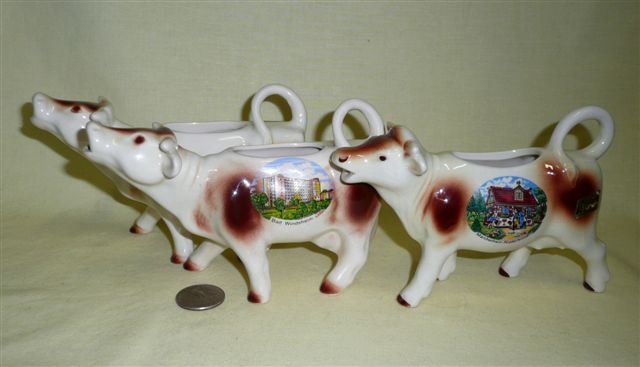 |
Here’s an interesting German contrast to the two Austrian cows’ souvenir pictures - a creamer
advertising Bad Windsheim, which is an even older (~741) small historic town in Bavaria, now known
mostly for its waters, spa, and an open air museum. Why would such a lovely old town choose to show
off such an ugly modern building? There’s another conundrum here as well: this creamer appears to be
from the same mold as the Goebel creamer shown here with it; but it’s unmarked, and bears the black
and gold sticker of E&A Böckling, Neudenau, which is in Baden Württemberg. But…the Marchenhein
Goebel-marked souvenir creamer here bears both the Goebel mark and the E&A Böckling sticker. I
can’t find anything about E&A Böckling on the web; an anyone tell me about them or the
relationship, if any, between them and Goebel? |
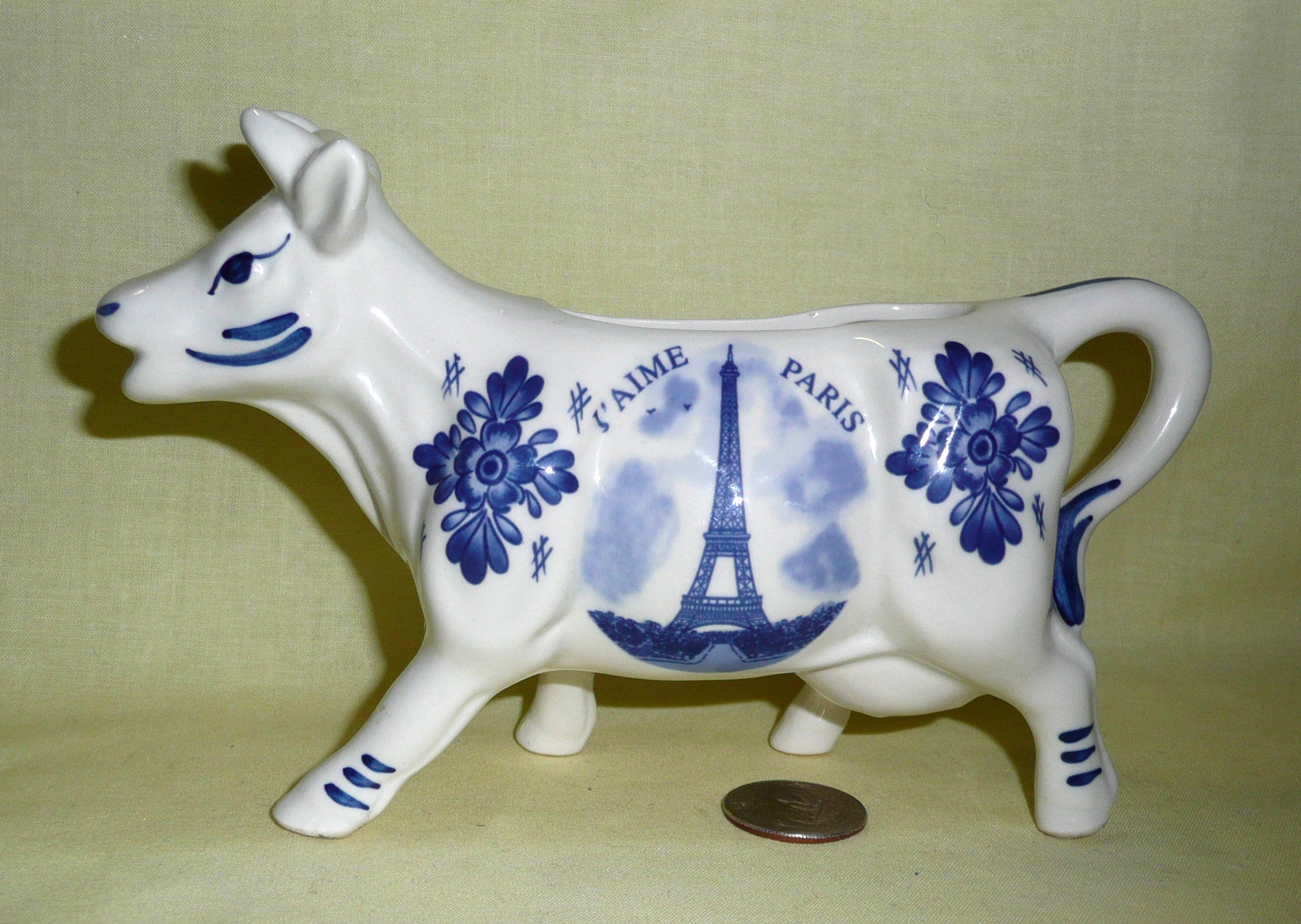 |
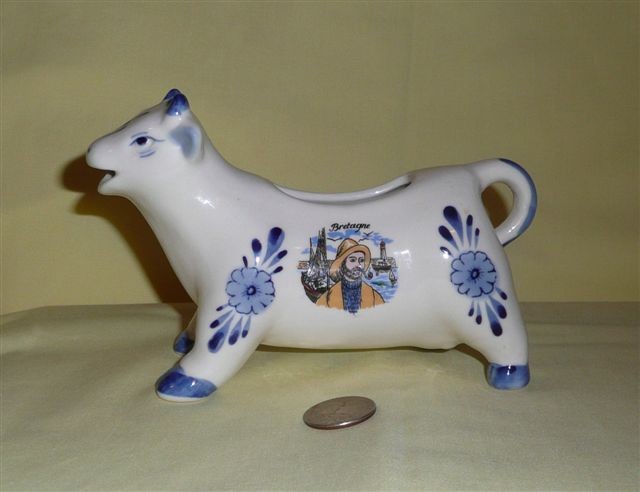
The French aren’t shy about seeking the cow-loving tourist’s francs (or euros these days) either…this is a fairly common mold with Delft-like coloring and decorations, marked with a ‘e’ with a crown on top of it inside a wreath, underneath in script: “Peint a la main, Elvesa, France”. Somehow the picture of the Eiffel Tower doesn’t look hand painted to me. Nor do the flower sprays. I guess they mean the little blue slashes… |
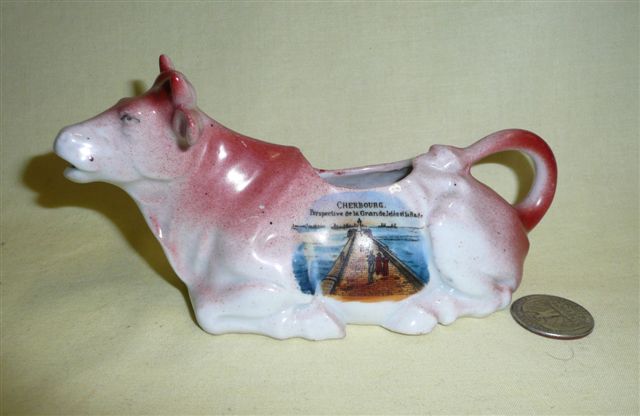 |
Nor, it appears, were the French averse to the same sort of German imports that the Brits favored…as per this lovely example from Cherbourg. |
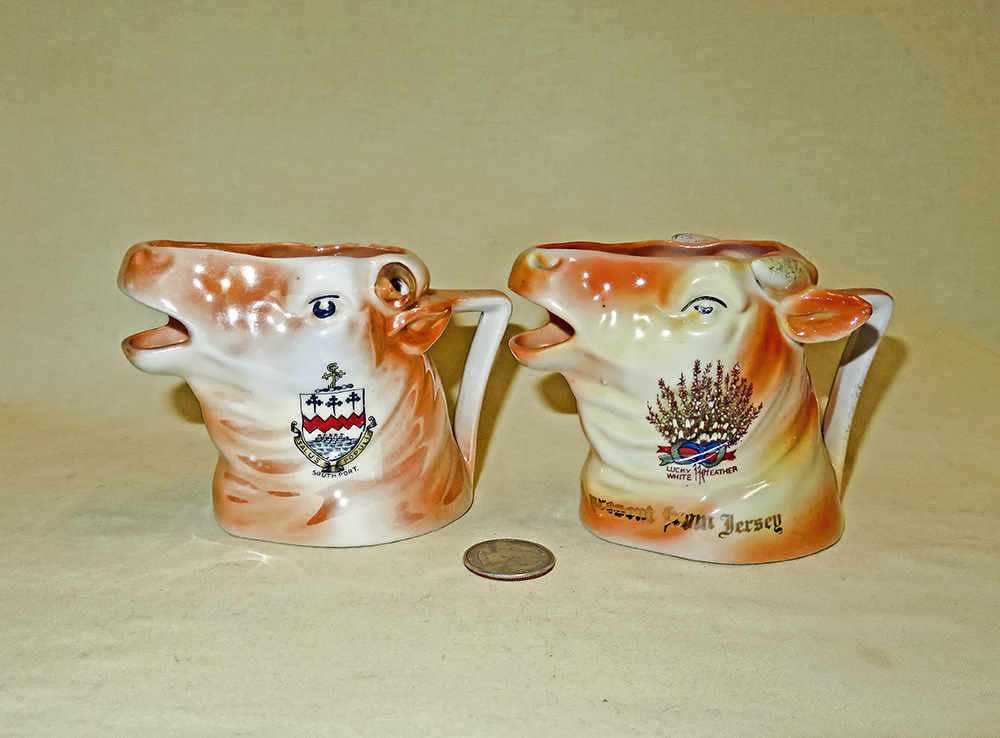
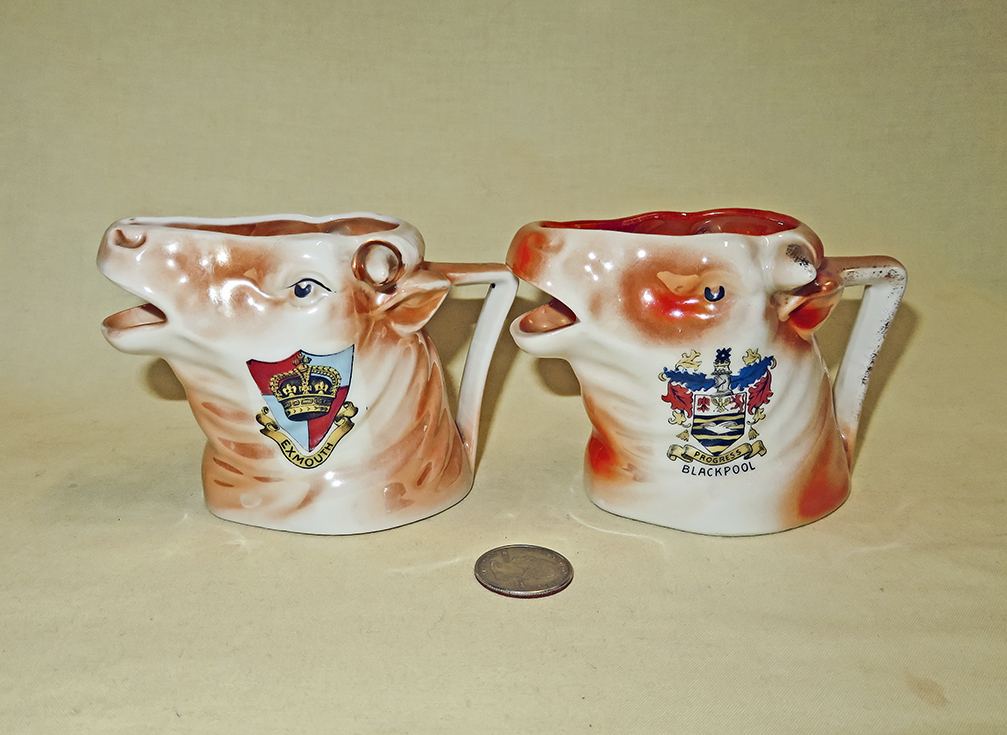
|
|
 |
|
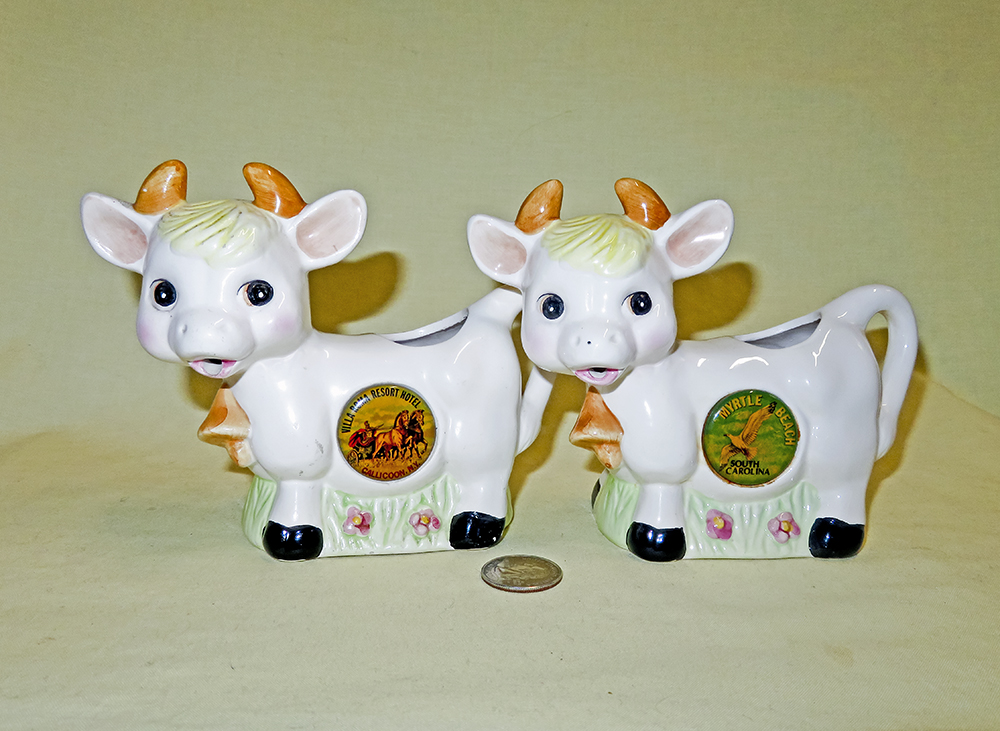
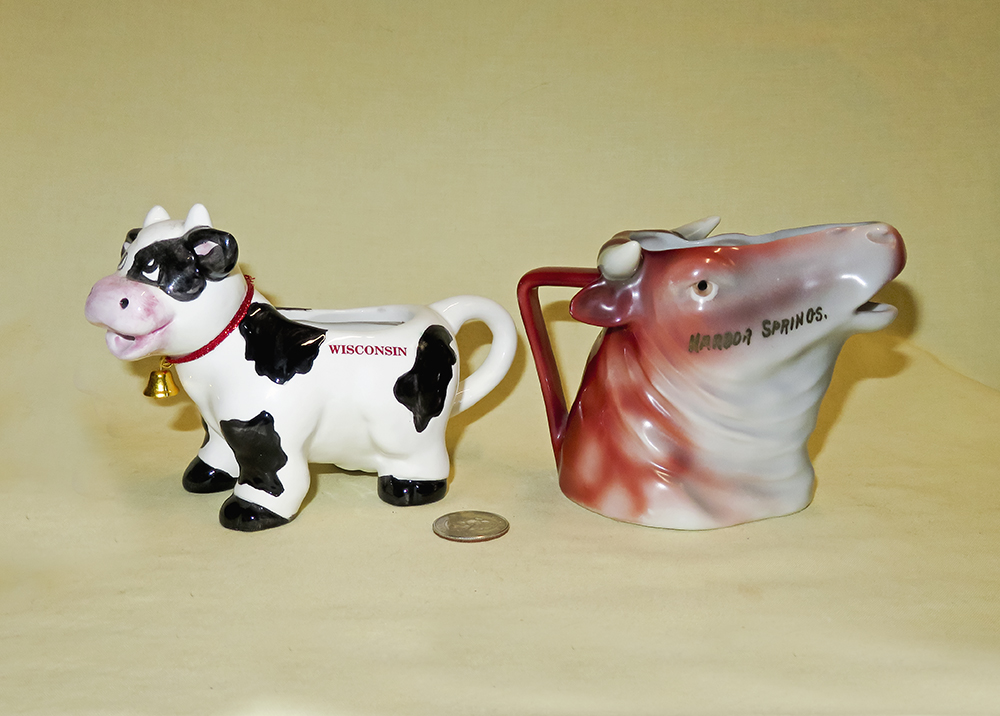
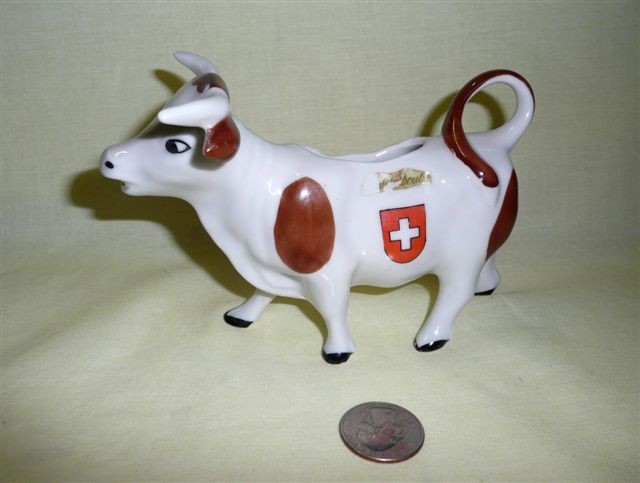
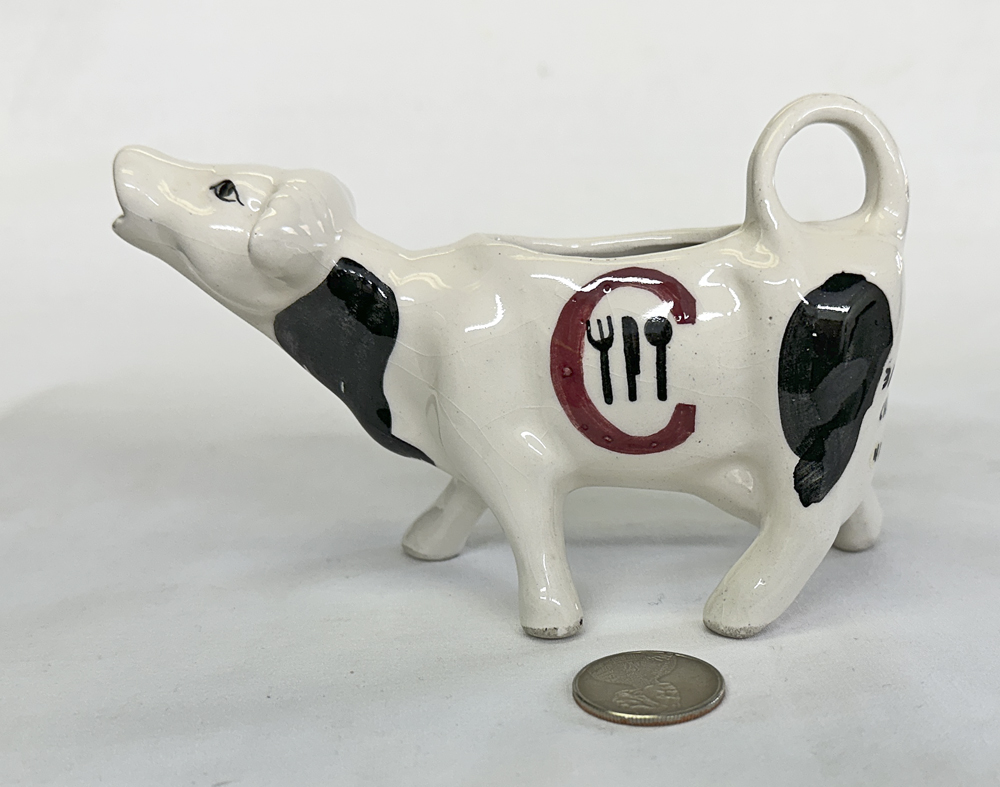
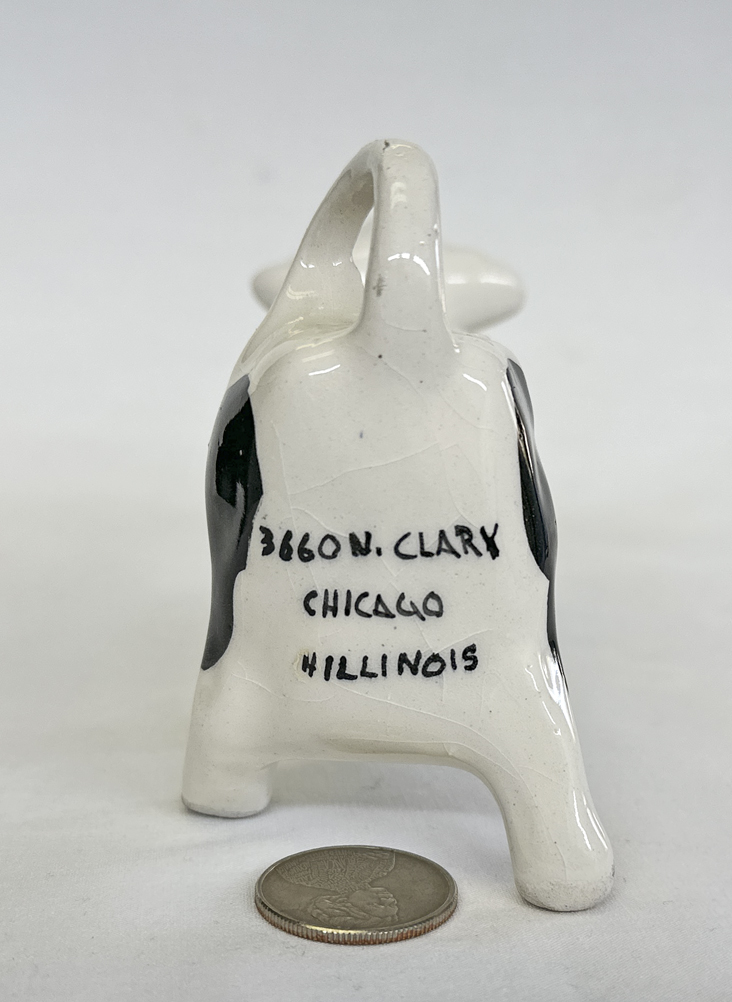
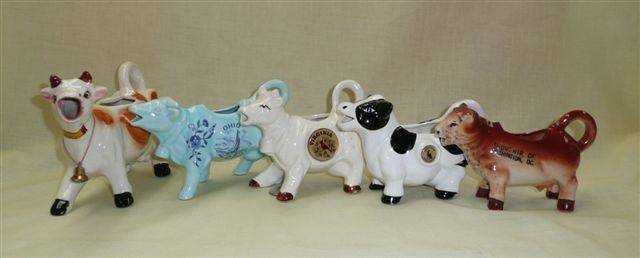
More from the US. First are a couple of those awful ‘cute’ cows (more of them in the Modern Variations page), one with an emblem that bears horses and ‘Villa Roma Resort Hotel’, which is a family resort in Callicoon, N.Y. Why would someone put pictures of horses on a cow?? Its neighbor is from Myrtle Beach, SC and at least has a fairly representative seagull on the emblem. It the picture on the right, there are two drastically different approached to designing souvenir cow creamers - the Wisconsin cow is a rather inexpensive ceramic caricature made in Chine. Wisconsin has a plethora of cows, so I'd think they might have found something with a bit more class. At least it's an interesting design. The head creamer is marked for Harbor Springs, which is a small resort community on Little Traverse Bay on NW Lake Michigan. It’s unusual in that it’s a Royal Bayreuth piece – the only one of theirs I’ve ever seen used as a souvenir. Generally these are too expensive for the tourist trade, so it may be that it was marked by a previous owner. The other unusual thing about it was its price – less than $10 to me, whereas these lovely Royal Bayreuth creamers typically sell for many times that. You can learn more about them on the Heads and Favorite Brands pages. |
|
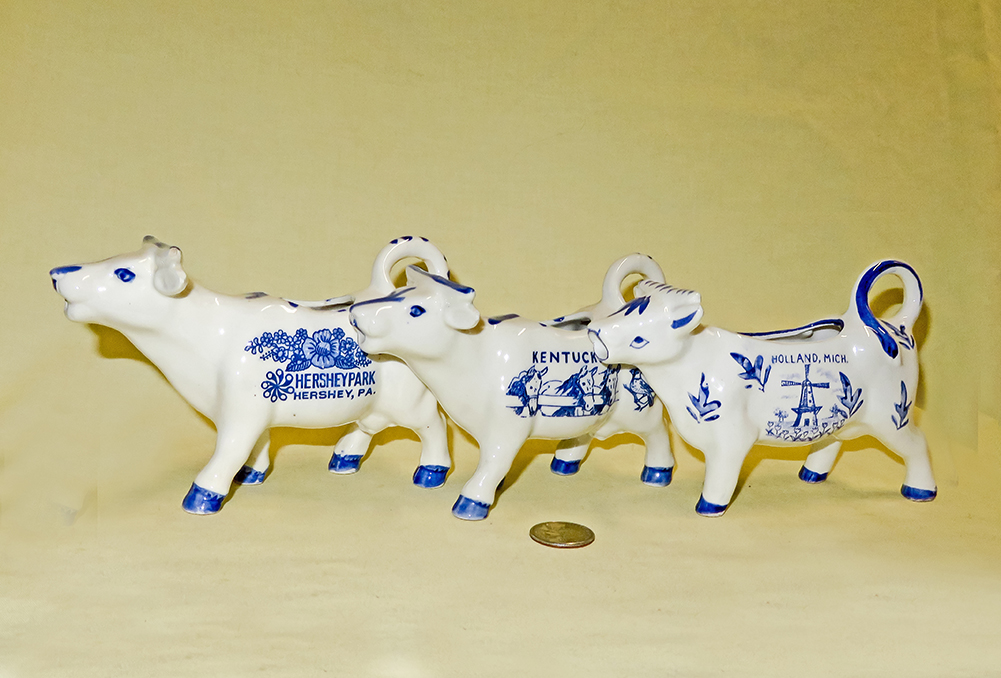 |
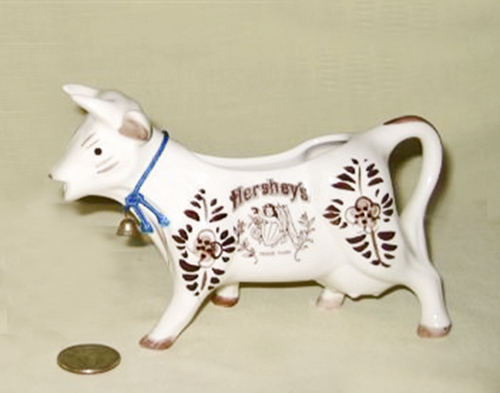
These three, from quite diverse US locations, all have Delft-like coloration. I can sure understand that for Holland MI (that city also has a couple colorful Delft-like ones on the Delft page), but am not sure whi either Hershey Park or Kentucky would do so. |
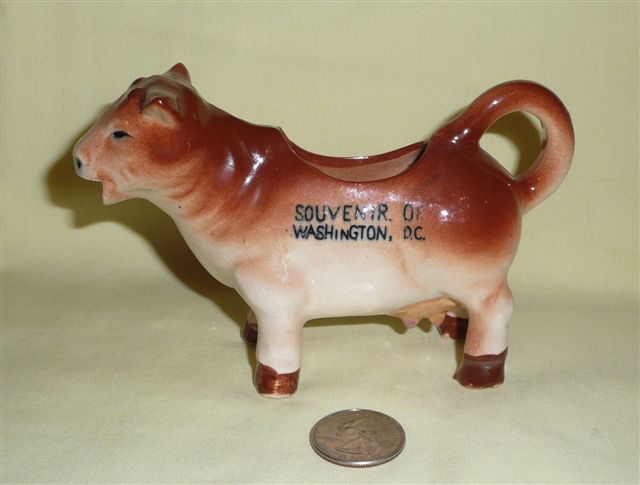
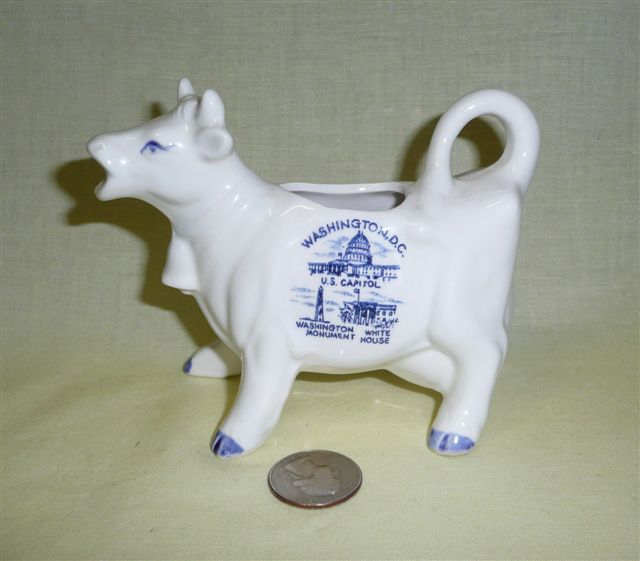
Here are two from DC
|
|
|
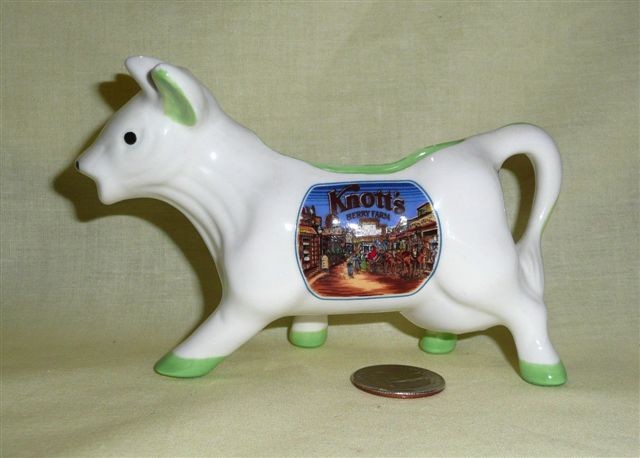
I don’t have any idea why Knotts Berry Farm chose to give its cow green ears and hooves. |
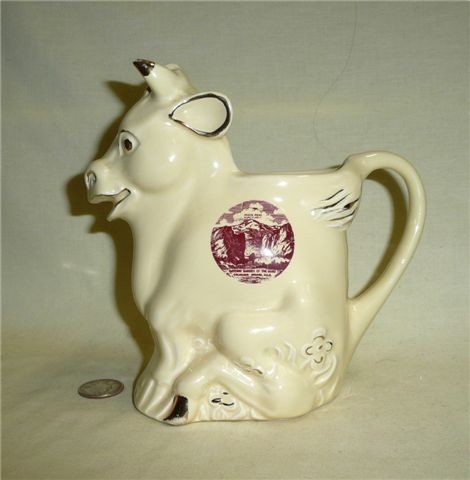 |
This pitcher is from the Pearl China Company of East Liverpool, Ohio, ‘Americas Crockery City’. It is serving as a souvenir from Pike’s Peak and likely dating from the 1950s. This company’s story is told on the Pitcher page, along with a shot of black and blue as well as yellow versions of this fierce looking sitting cow. This is the only souvenir version of a cow from this company that I have found - and interestingly, although it bears their mold mark (635) is does not carry the company’s logo. |
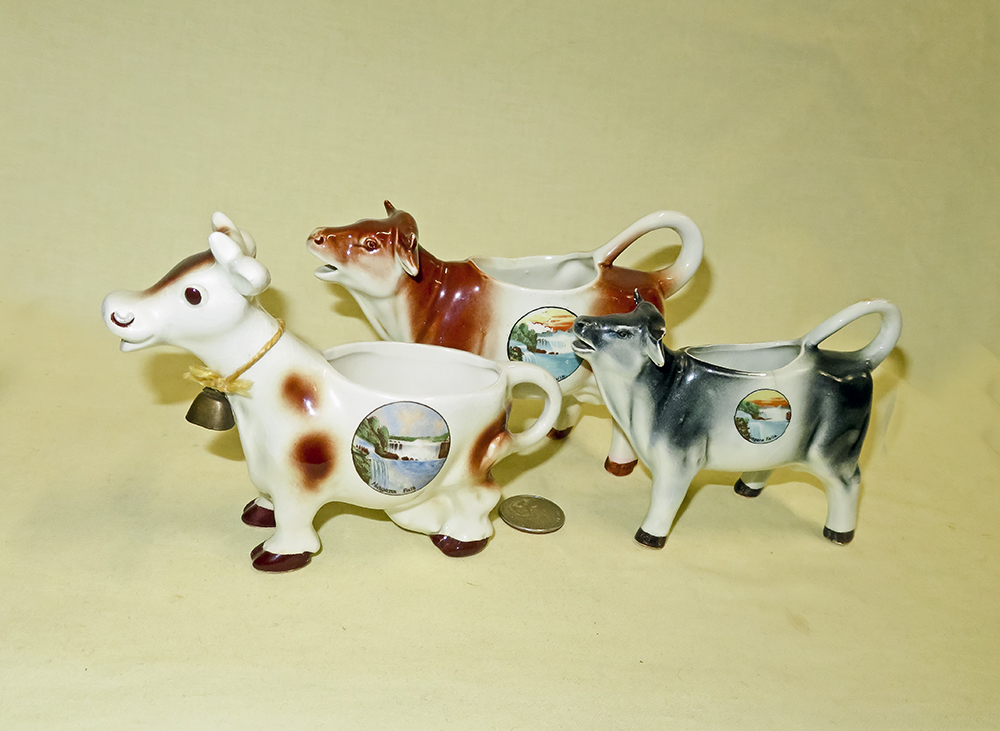 |
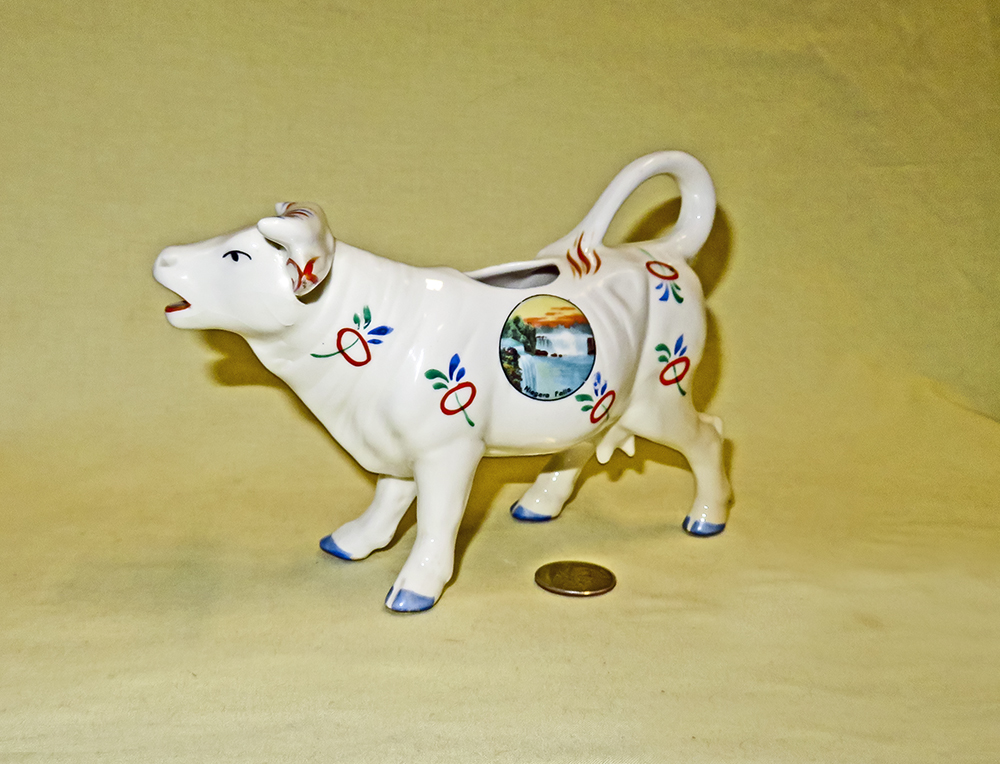
Not to be surpassed is the popular tourist attraction of Niagara Falls. Souvenir creamers from there seem to fall into two categories. Fairly early ones – say through the 1950s – are generally high quality ceramic or porcelain, and bear a nice circular transfer print of the falls. These three are large V-Bee Goebels, and this mark was used from 1950-1955. |
> 
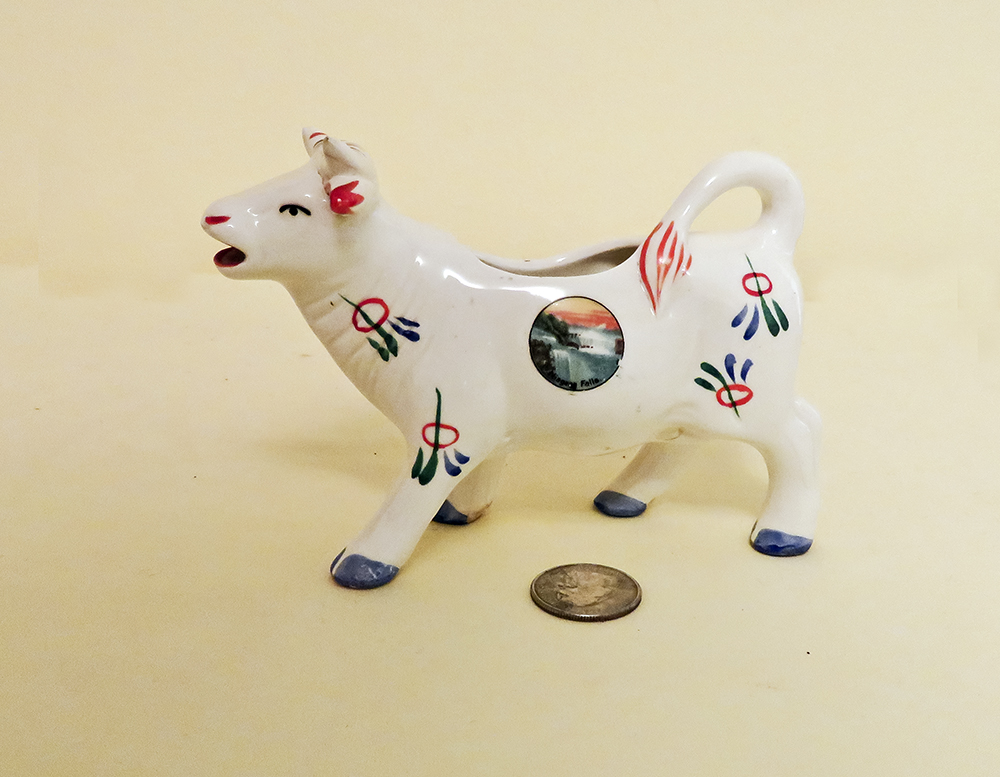
|
|
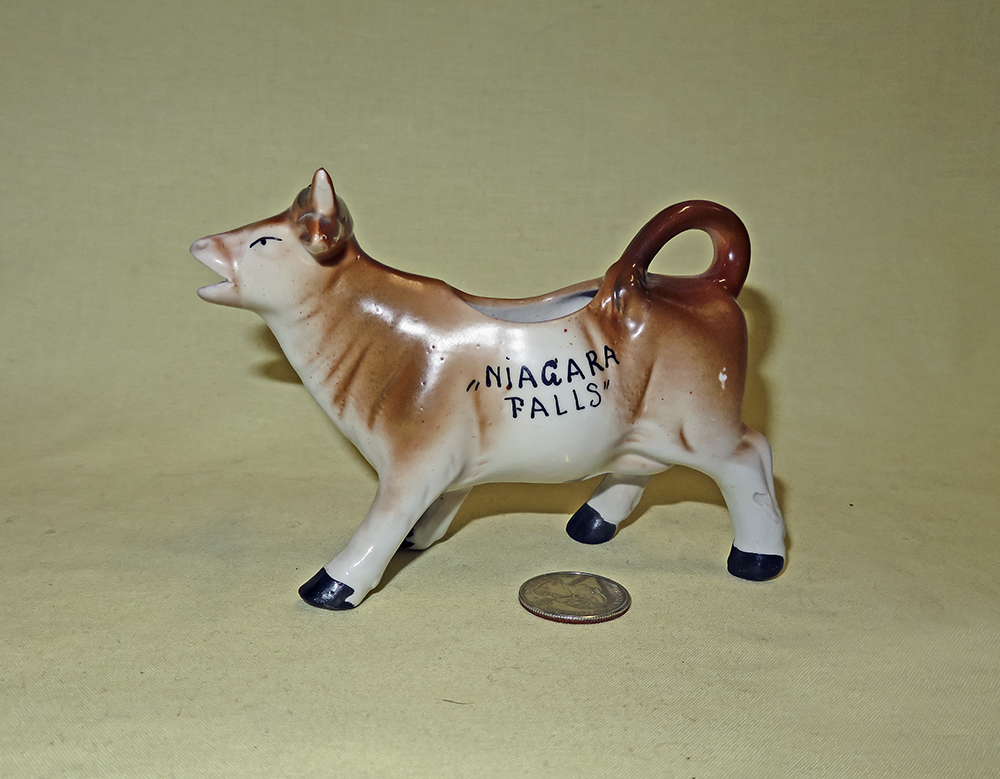
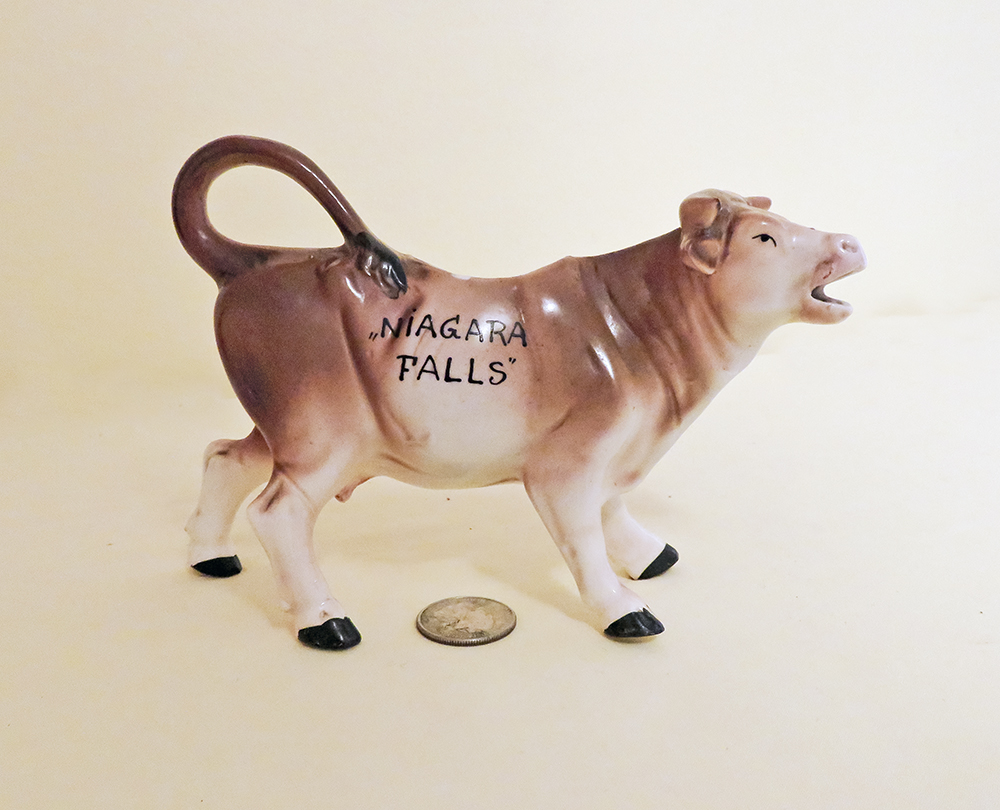
|
|
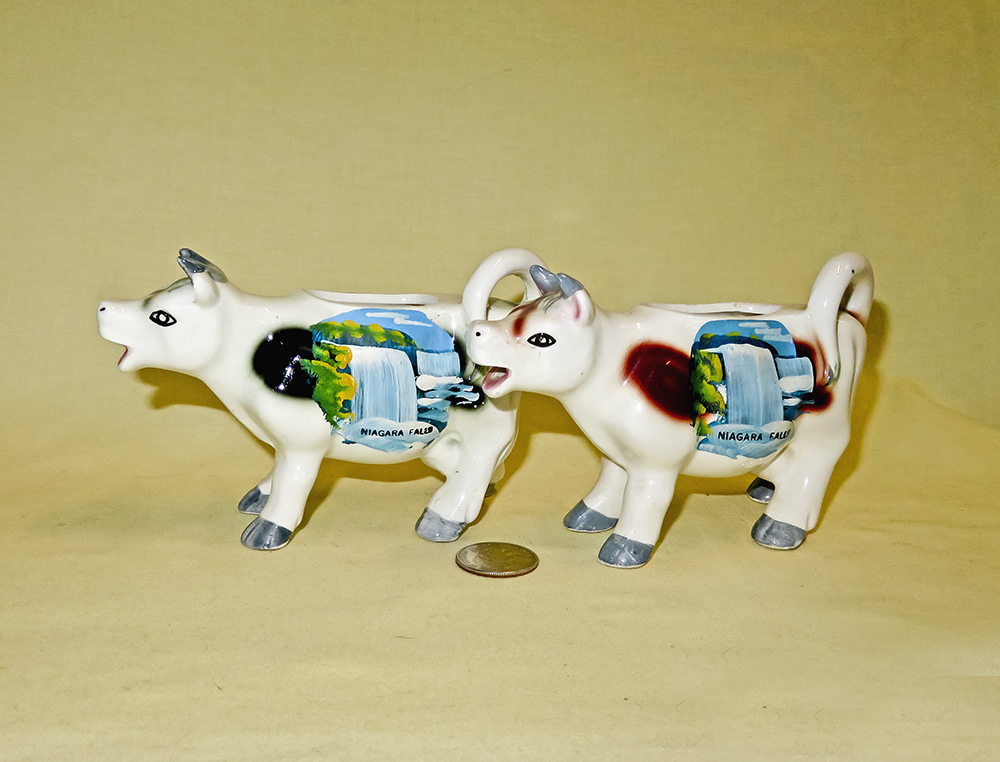

|
|
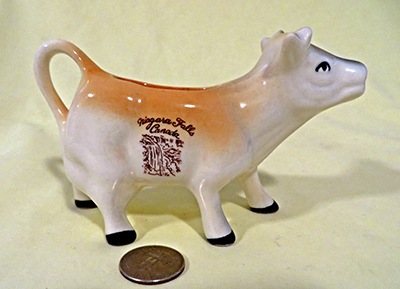 |
This small, simple brown and cream cow seems to have nationalistic pride since it celebrates only the Canadian side of the falls. |
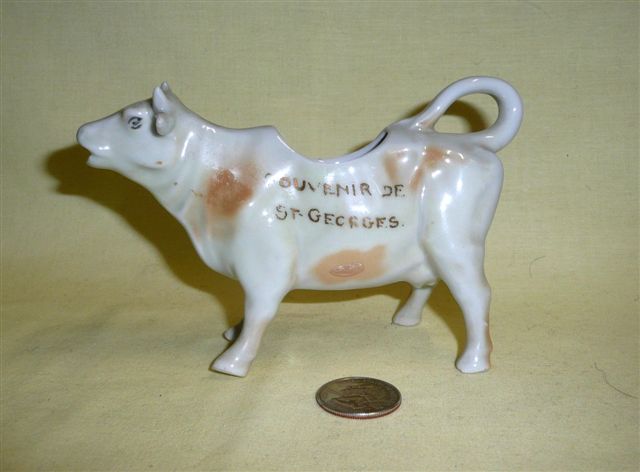 |
This nice porcelain cow is simply marked “Souvenir de St Georges”. I did my normal atlas search, but it turns out that there are a whole lot of “St Georges” in French speaking regions. I queried the seller who indicated that it was most likely from the one in Quebec, because it came from the estate of an elderly lady who lived in Buffalo NY. With that hint, I found via Wikipedia that although it’s a relatively small city, population just above 30 thousand, Saint-Georges is often considered the Metropolis of the Beauce Region of Quebec province because it's the largest city in the area. Its history dates to the late 1700s, and today it is an important manufacturing centre, including textiles, steel forgings, garage doors, bicycles and truck trailers, and it also boasts a number of stores and services not found elsewhere in the region. And apparently it is large enough to sport a souverir or two. |
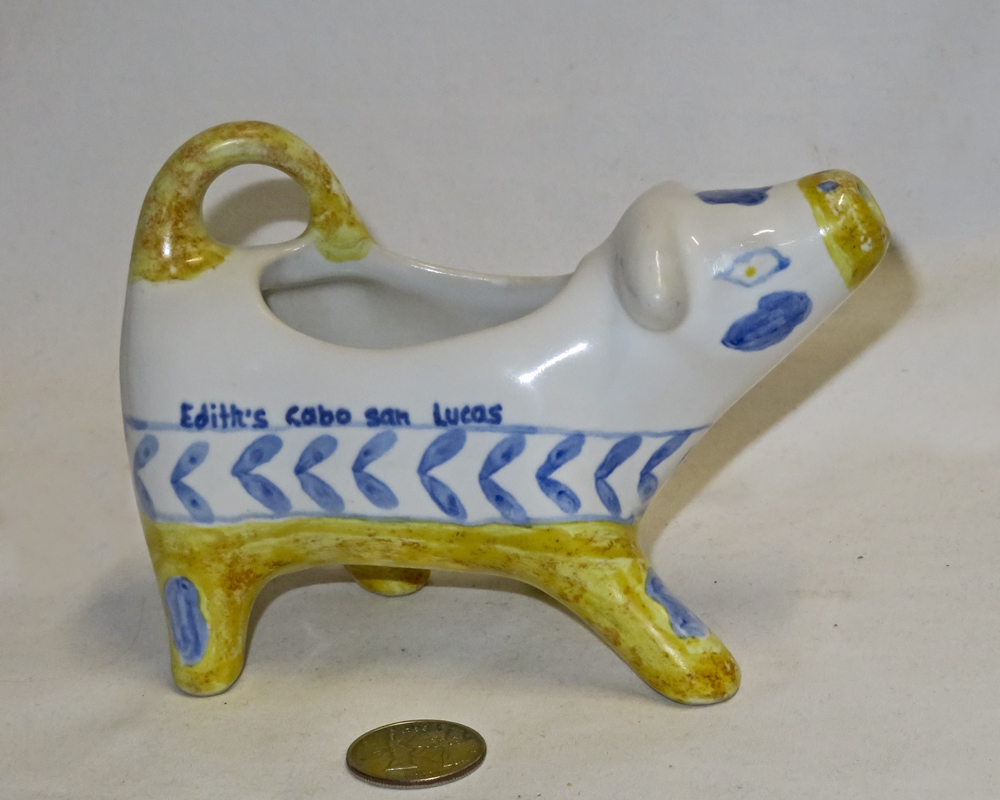
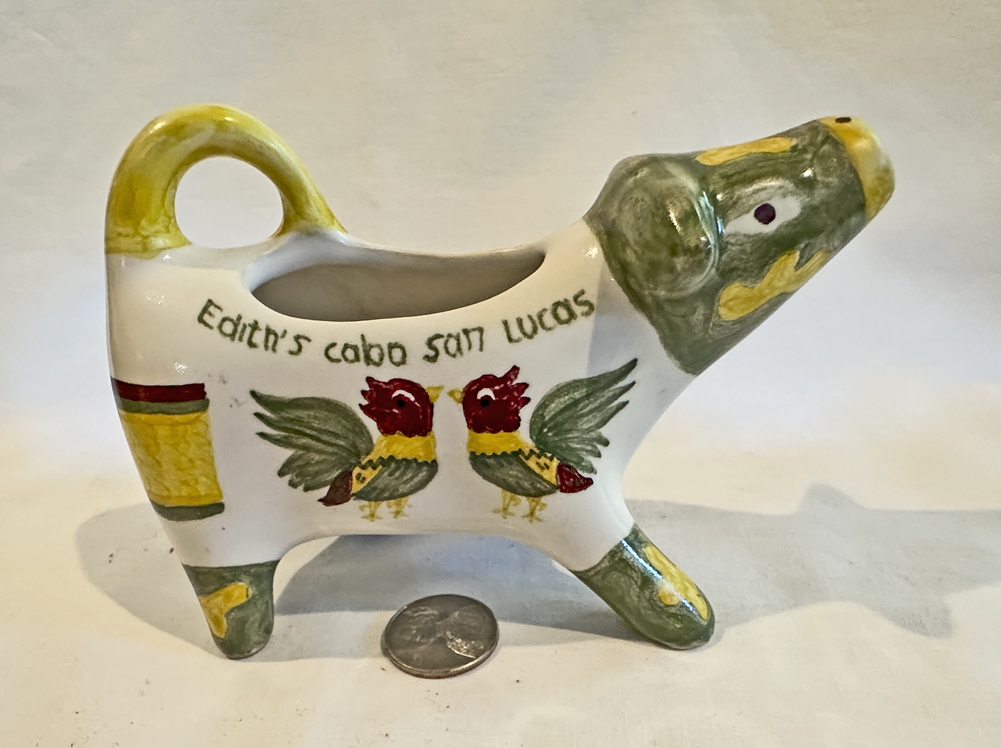 Heading far south, we find that some enterprising Mexican bars and restaurants have picked up on the cow-ad trick. They are prominently marked for Edith's Cabo San Lucas. Their web site "edithscabo.com" comes up in English, giving you a good indication of the locale of most of its clientelle. It proclaims "Edith's is a vivid combination of the Cuisine of Baja California with a Guerreran flair, featuring a regional fusion of steaks and seafood with local ingredients. A loving, privileged view of Medano Beach and the world famous Arch of Cabo San Lucas, candle lights and palapas set the atmosphere for an unforgettable culinary experience." It notes that "Edith was born in Jalapa, a little town in the mountains of the mexican State of Guerrero, where she learned the flair of grandmother María Morales, and with it a deep understanding of the flavors and aromas of Guerreran cuisine...She arrived to Cabo San Lucas in 1977 and fell in love with Baja California Sur... Edith worked in this restaurant from her arrival in Cabo, which was previously known as "Esthela's by the Sea". At age 15, she was a waiter. Today she owns it and named it after her in 1994.". She is obviously a very emterprising (and lovely from her picture on the site) lady. A second story here is about the cows' maker - they are clearly marked for "Estanzuela, Pintado a mano, Mexico". It's web site informs us that "Cerámica Estanzuela was founded in 1986 with the purpose of creating jobs for the Estanzuela region, municipality of Tlalpujahua Michoacán, so that people who belong to this region would not have the need to look for work in Mexico City or abroad, by having a stable and formal source of work, close to their homes. This is how we started with a small factory that over the years has been growing and innovating to satisfy the national and international market."...and these dauys they have some 60 employees and several offices across Mexico. I wonder if Edith uses their ceramics in her restaurant...gusss I'll have to visit next time in Baja. |
|
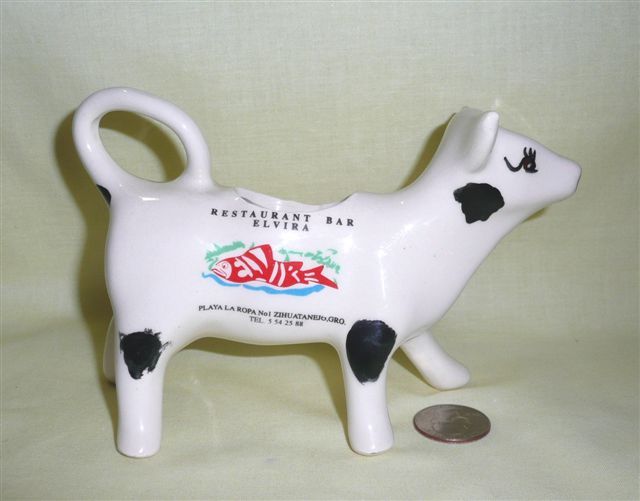 |
The little white cow has a less impressive pedigree, but serves very effectively to advertise the Restaurant Bar Elvira that’s in the town of Zihuatanejo, south of Ixtapa. It has received mixed reviews on the web… |
|
|
|
|
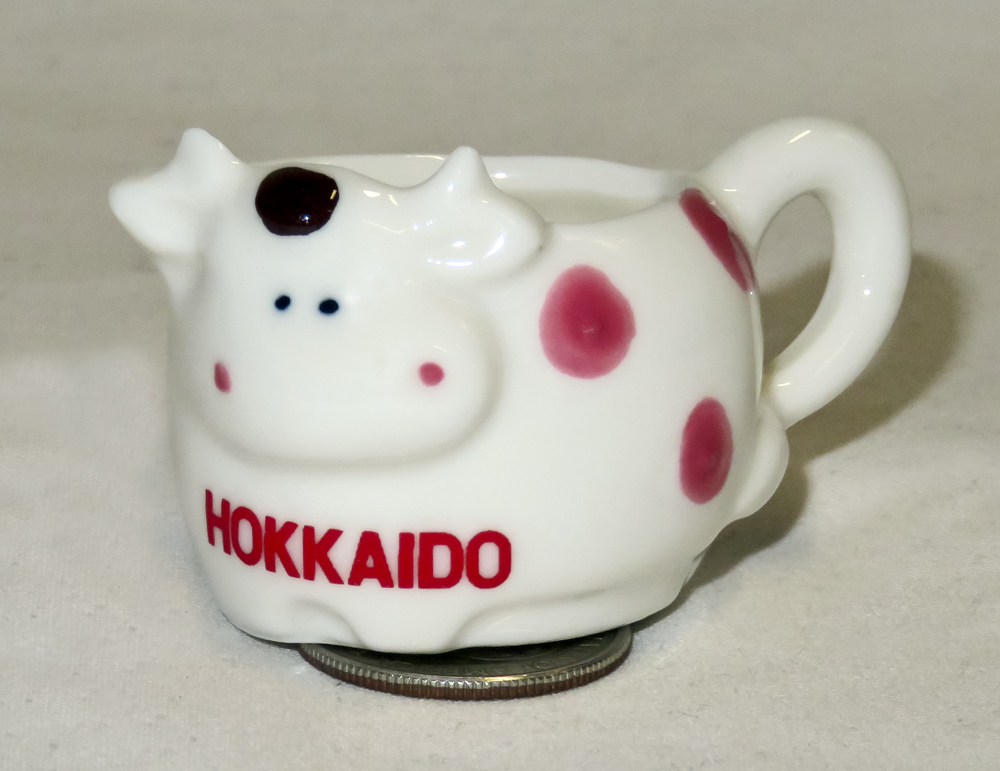 |
The Japanese aren’t big on milk, albeit they do appreciate good beef…but even then, that’s usually associated with Kobe, not Hokkaido. And while this little guy isn’t really a creamer, more a little pitcher or mug of sorts, he was cute (and cheap) enough that I couldn’t pass him up, especially because he’s my only souvenir cow from anywhere in Asia. |
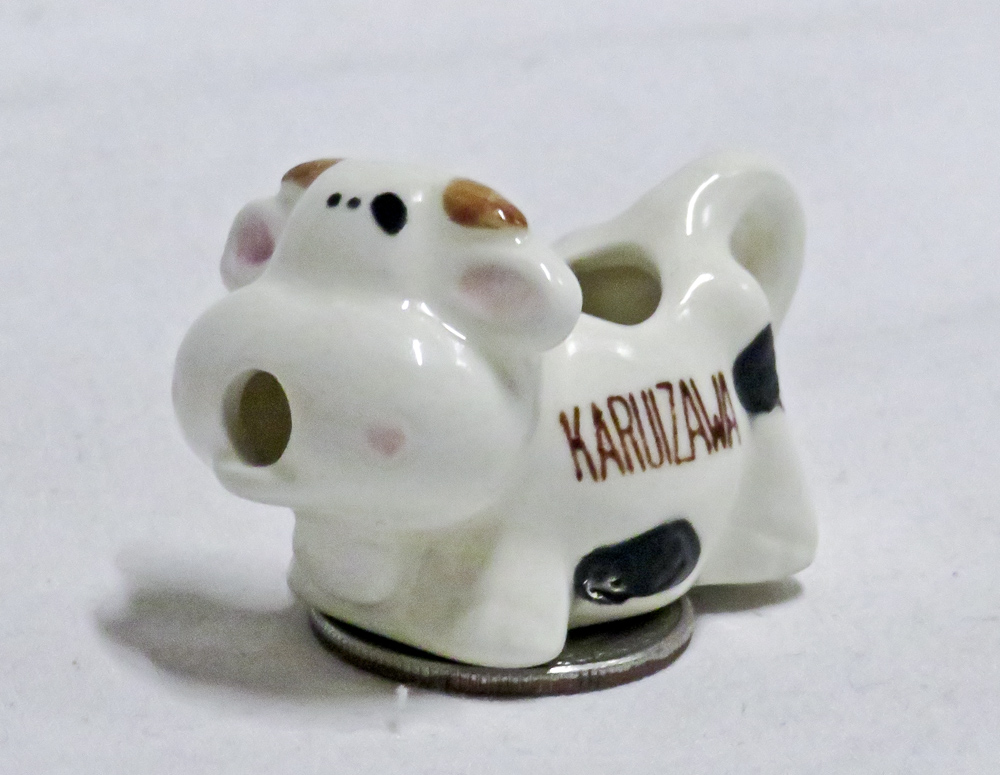 |
Per usual, once I make a statement like the one above I am proved wrong, if only a few years (6+ in ths case) later. So here is a real souvenir cow creamer from Japan - even if it's very tiny like the Hokkaido pitcher. It advertizes Karuizawa, a mountain resoet at the foot of an active volcano. It arrived accompanied by a tiny pig pitcher...and you can learn more about them both way down on the Miniatures page. |
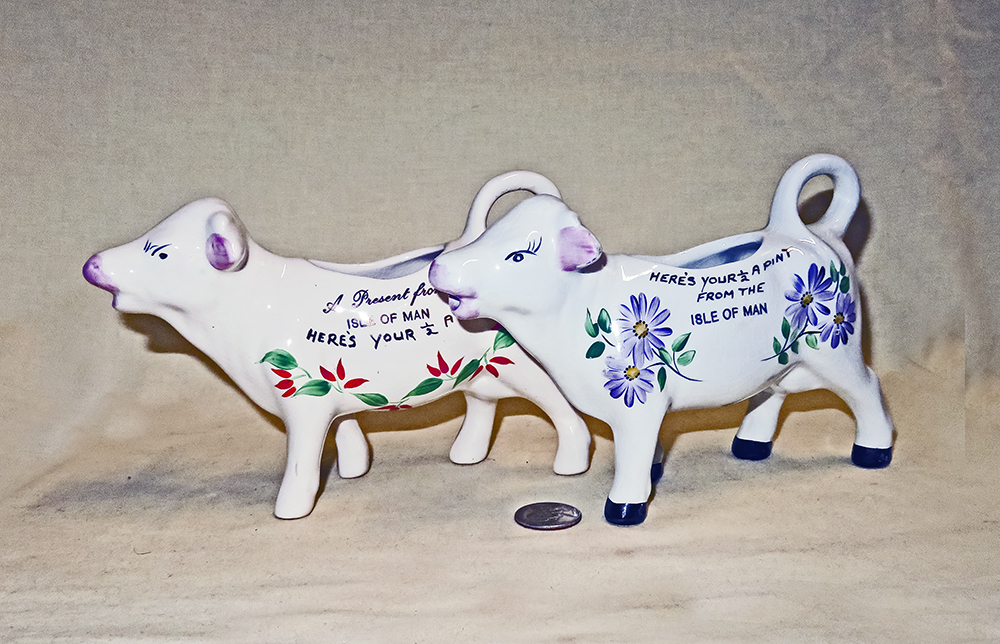 |
We'll close out this page with a typically UK approach to souvenirs and advertising: Beer (and only occasionally cream) Here first are a couple from the Isle of Mann - where presumably everyone goes for 1/2 a pint. Since I don't have any others from that lovely spot, here's a bit about it. From Wikipedia we learn that the Isle of Man, which has been inhabited since before 6500 BCE, is located in the middle of the northern Irish Sea. It is a is a self-governing British Crown Dependency. The head of state is Queen Elizabeth II, who holds the title of Lord of Mann and is represented there by a Lieutenant Governor. The island’s foreign relations and defence are the responsibility of the British Government. while its own parliament and government have competence over all domestic matters. The island’s parliament, Tynwald, claims to be the oldest continuously existing ruling body in the world. As for oither places, cows can teach us a lot. |
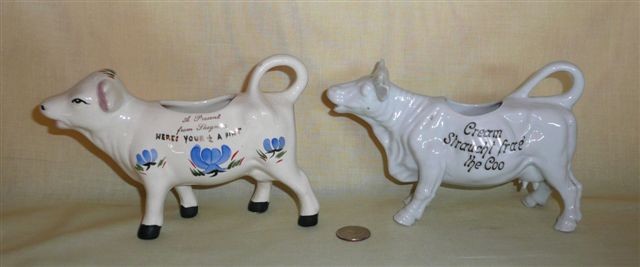 |
|